
Bullet trains have been parked at the same top speed for years. The fastest scheduled service on Earth runs at 350 km/h, about 217 mph, a mark China’s Fuxing fleet has held since 2017 while the TGV and the Shinkansen cruise around 320 km/h. Physics didn’t set that ceiling so much as economics did: above 350, energy bills, brake wear and track punishment all climb faster than the speedometer does.
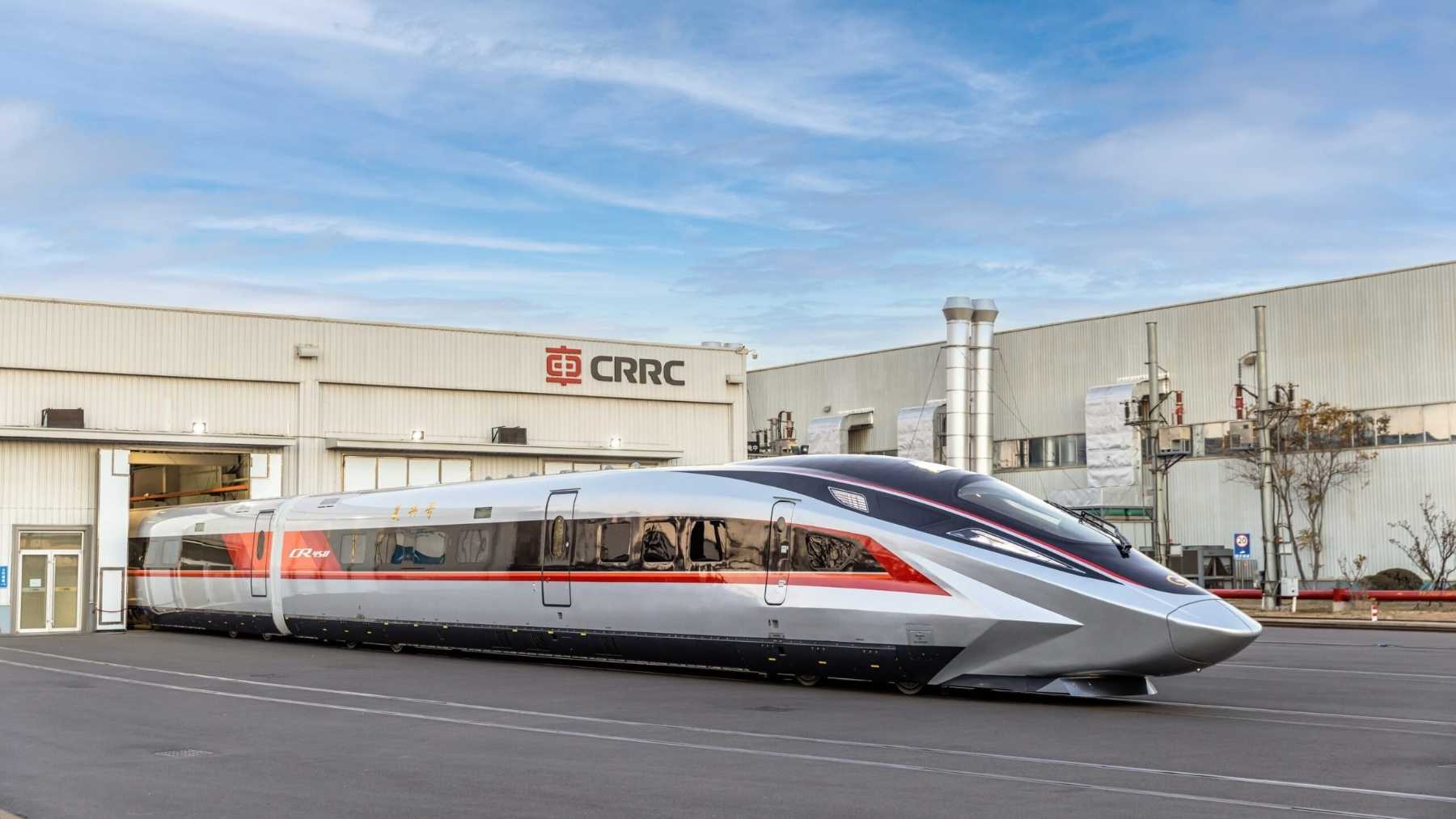
But according to China State Railway Group’s update via China Daily, the train built to raise that number has now passed every type test on its schedule and logged 300,000 kilometers of operational assessment runs. The train is the CR450, and China Daily, the state-run outlet that relays the railway group’s milestones, calls it “the world’s fastest high-speed train under development.” The design brief is simple to state and brutal to certify: 400 km/h, roughly 249 mph, every single day, with paying passengers aboard.
A single trainset hit 453 km/h in trials, about 281 mph. And still, the number regulators care about most sits at the other end of the throttle: the thing has to stop, and it has to do it in less than 6,500 meters.
Fastest, with the asterisks attached
Some scope first, because speed claims around trains get slippery fast. The outright test record for a wheel-on-rail train still belongs to France: a shortened, hot-rodded TGV touched 574.8 km/h back in April 2007, and nobody has seriously chased it since. That was a one-day stunt with a modified trainset, not a product you could buy a ticket for.
Maglevs are their own category. Shanghai’s airport shuttle ran at 431 km/h for years before dropping to 300 in 2021, and it floats on magnets over a 19-mile track rather than rolling steel on steel across a national network. China’s vacuum-tube maglev program is off chasing airliner numbers in a sealed pipe, which is spectacular and also nowhere near carrying anyone to work.
The CR450’s claim is narrower and more useful: the fastest train ever designed for scheduled service. Nobody on Earth sells a ticket above 350 km/h today. This is the machine engineered to make 400 the number printed on a timetable, with the same reliability as the trains doing 350 right now.
Where CRRC found the extra 50 km/h
The CR450 is the next generation of the Fuxing family, built as an eight-car set with four powered cars by two CRRC subsidiaries. The prototypes rolled out in Beijing at the end of 2024, and the figures CRRC and the state railway group published at the unveiling explain the approach: drag down 22 percent against the current CR400, total weight down about 10 percent, courtesy of aluminum alloy, carbon fiber and glass fiber construction.
The nose tells you where the effort went. It stretched from 12.5 meters on the 350 km/h trains to a full 15 meters on the CR450, because at these speeds the front of the train is doing more work than the motors are. Traction moved to permanent magnet motors, energy use at 400 km/h stays under 22 kilowatt-hours per kilometer, and cabin noise holds at 68 decibels, per the railway group’s data.
Acceleration is the stat you’d actually feel from a window seat. Zero to 350 km/h takes 4 minutes and 40 seconds, per CRRC, a full 100 seconds quicker than today’s CR400 fleet manages. On a network where trains launch out of stations every few minutes, that time compounds all day long.
Stopping it is the harder trick
Running 453 in a straight line is, in engineering terms, the fun part. The certification case lives in the brakes. At 400 km/h, the CR450’s emergency braking distance comes in under 6,500 meters, per the railway group. Call it four miles, with every system working exactly as designed.
CRRC’s claim is that this matches the stopping distance today’s CR400s need from 350 km/h, and that comparison is the entire game: 50 km/h more speed for zero extra braking real estate. The program also ran two trainsets past each other at a combined 896 km/h, a record for that kind of crossing test, which exists to hammer the cars with each other’s pressure waves and see what flinches.
The group’s March data went further into the boring, decisive stuff. Fatigue margins on load-bearing structures and temperature rise in rotating parts at 400 km/h are comparable to the CR400’s at 350, it says. In certification terms, the fast one wears like the slow one. That’s the sentence regulators underline.
So when do passengers actually get on?
Here’s the honest status, and it’s why any headline claiming the CR450 has “launched” deserves a squint. It hasn’t. As of the railway group’s March update, the program was set to finish operational assessments and lock the final design during 2026, and then ease the train toward commercial operation, in the group’s studiously unhurried phrasing. No entry-into-service date has been announced.
The homework is public, and it’s substantial. CRRC has said the certification program calls for 600,000 kilometers of successful trial running before passengers ride, and the March update put the completed operational assessment at 300,000 kilometers, logged on the Shanghai to Chongqing to Chengdu corridor and the Shenyang to Baishan line. Trade outlet RailwayPro summed up the state of play in March as the world’s fastest conventional train nearing launch. Nearing, not launched.
Where it runs first isn’t publicly settled either. Industry outlet Railvolution reported that the Beijing to Shanghai trunk line would get it first, with the 1,318-kilometer trip dropping from around four and a half hours to roughly 3 hours 20 minutes. Other reporting has pointed instead at the second Chengdu to Chongqing line now under construction, which is being engineered for 400 km/h running from day one, since older corridors would need signaling and track work to host the full speed.
The American scoreboard, since you’ll ask
Stateside, the fastest thing you can actually board is the new Acela, which tops out at 160 mph, and only on a handful of short stretches of the Northeast Corridor. The CR450’s daily cruising target sits almost 90 mph above that.
The first genuinely high-speed track in the country only got its construction contract approved this June: up to $3.5 billion to lay rail and string wire through California’s Central Valley, designed for 220 mph, moving ahead even after Washington pulled roughly $4 billion in federal grants from the project last year. Brightline West, the private Las Vegas line that broke ground in April 2024, is chasing 200 mph across the desert on its own schedule.
The physics on offer are identical on both sides of the Pacific. The certification and construction machines are not. One of them is currently processing the fastest train ever designed for a timetable. The other just approved its first mile.
Rail is having a strange, crowded year. India just ran the final engineering trial on the world’s longest hydrogen trainset, America signed for its first real high-speed track, and China is quietly working through the file that decides which corridor gets the CR450 first.
The 453 km/h run was the easy headline. The one worth waiting for is duller: the first published schedule that lists a departure planned around 400 km/h. Records are for press releases. Timetables are for keeps.
 @jaysonosmars ROOKIE2 months ago