
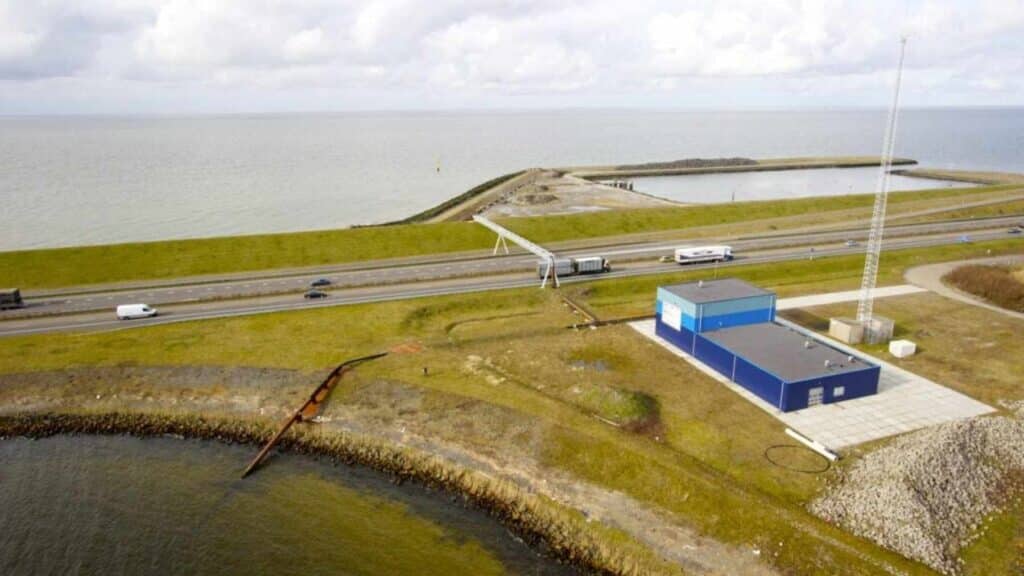
The Dutch have spent centuries rearranging their own coastline, and the Afsluitdijk is the biggest swing they ever took at it. Finished in 1932, the dam runs about 20 miles across the mouth of what used to be an arm of the North Sea, penning the salty Wadden Sea on one side and the freshwater IJsselmeer on the other.
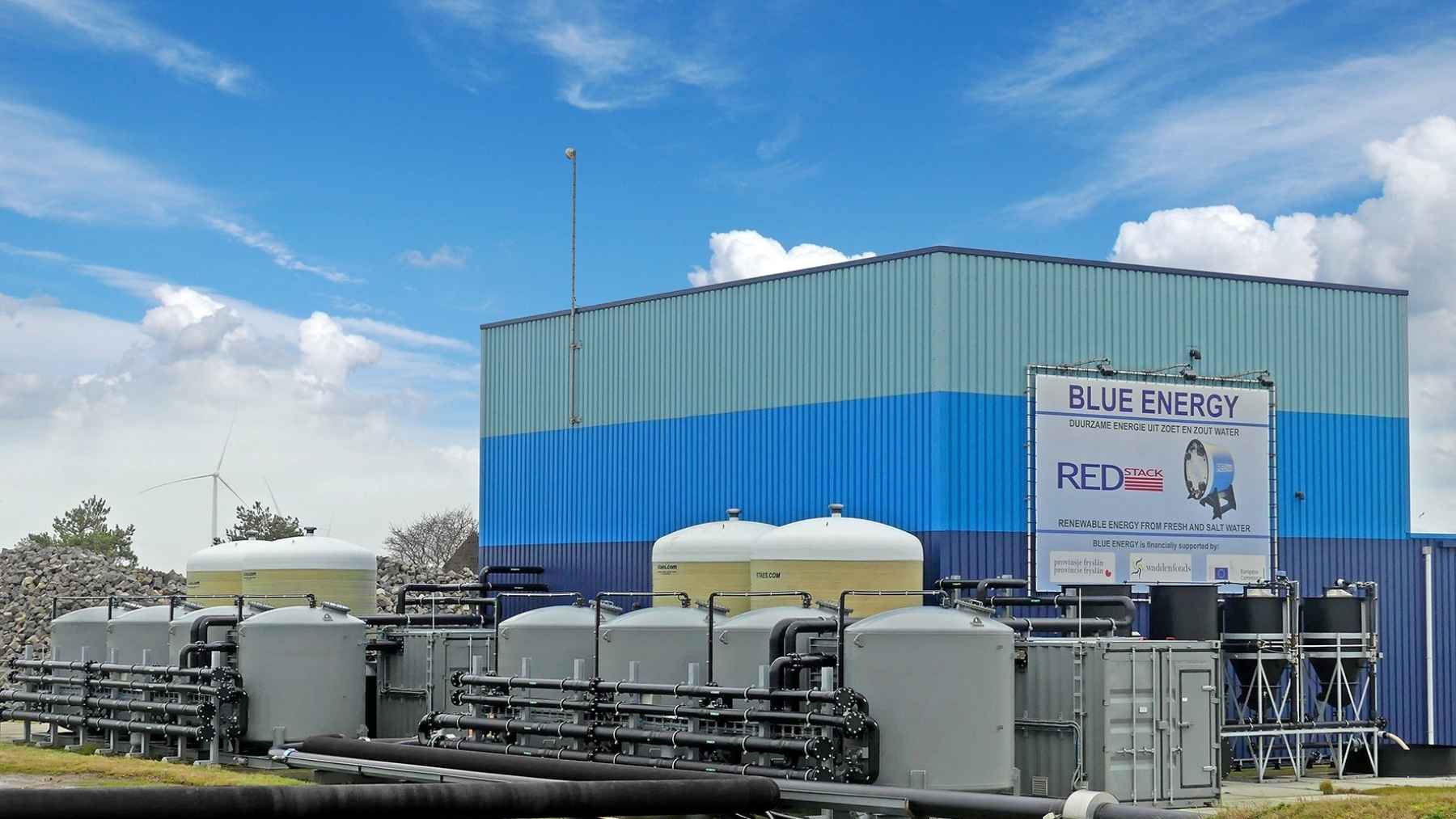
Halfway along, at a spot called Breezanddijk, sits a small blue building most drivers never register. It has housed the world’s first reverse-electrodialysis power plant since November 26, 2014, when King Willem-Alexander switched it on.
Osmotic power has had a loud year and a half. Japan started up its first plant at Fukuoka last August, Denmark has been running one on industrial brine since 2023, and France is chasing grid scale on the Rhône. The Dutch machine predates all of them.
It also has the least flattering paperwork. The follow-up plant on the dike, the one meant to prove this technology can grow, carries a total investment of €11.13 million and a rating of 16.5 kilowatts.
The Dutch got there first, with a different machine
Two technologies get filed under “osmotic power” and they are not interchangeable.
Statkraft’s plant at Tofte in Norway, opened in 2009, used pressure-retarded osmosis. Fresh water pushes across a membrane into salt water, pressure builds behind it, and a turbine turns that pressure into electricity. Statkraft closed it in January 2014.
Breezanddijk skips the turbine. Stacks of alternating membranes let sodium ions drift toward one electrode and chloride ions toward the other, and you collect the resulting current straight off the electrodes. That made it the first reverse-electrodialysis plant anywhere, a distinction Dutch Water Sector was careful to spell out at the opening.
Fujifilm supplied the membranes. Wetsus, the water research center in Leeuwarden, supplied the science. REDstack, a Wetsus spin-off founded in 2005, ran the thing, with Deltares and the marine research institute NIOZ joining later for the ecology work. The regional program behind the dike still lists the pilot as active.
Fifty kilowatts was the label, not the meter reading
The 50-kilowatt figure has followed this plant around for more than a decade, and it pays to be precise about what it is. That was the capacity the installation was designed to reach.
When an Italian research team published the first detailed performance study of a full-scale RED pilot in 2016, they pointed out that no operating data from the Afsluitdijk had been made public since the November 2014 opening. The plant was famous. Its output was not.
What does exist is peer-reviewed work done on the site itself. In 2022, researchers from Wetsus, Twente, Wageningen and Groningen ran two small cross-flow stacks in series at the REDstack facility for more than 30 days on genuine Wadden Sea and IJsselmeer water, and published the results in Chemical Engineering Journal.
Gross power density held at roughly 0.35 watts per square meter of membrane. Net, once you subtract the pressure needed to shove water through the stacks, it was 0.25 W/m², at a best-case energy efficiency of 37%. By the end of the run the net figure had slid to 0.1 W/m² as the pressure drop climbed.
Those numbers are easy to skim past. So do the arithmetic. At 0.25 watts per square meter, 50 kilowatts needs something like 200,000 square meters of membrane. That is about 37 football fields of the stuff, folded into stacks and fed filtered seawater around the clock.
Real seawater is full of things that eat power plants
The same 2022 study took the stacks apart afterward. The autopsy found organic fouling on the membrane surfaces and the spacers, biofilm through the flow channels, and organisms roughly ten times larger than the 5-micron nominal pore size of the cartridge filters feeding the system.
The cleaning routines they tried did not bring the pressure drop back down.
That is the practical problem with running this technology on natural surface water instead of factory brine. The Wadden Sea is silty and alive, pre-treatment costs energy, and the energy budget was thin to start with. Rik Siebers, REDstack’s director at the time, framed the pilot as exactly that education, saying it taught the company how to handle algae and other organisms coming out of the lake and the sea.
Eleven million euros, sixteen and a half kilowatts
In March 2023 the Waddenfonds, the public fund for projects in the Wadden Sea region, approved €4,904,022 toward a new installation on the dike, against a total build cost of €11,134,707.
The province of Fryslân added more than €1.2 million. The De Nieuwe Afsluitdijk program put in €1.3 million in July 2023, alongside the Investeringskader Waddengebied and the municipality of Súdwest-Fryslân.
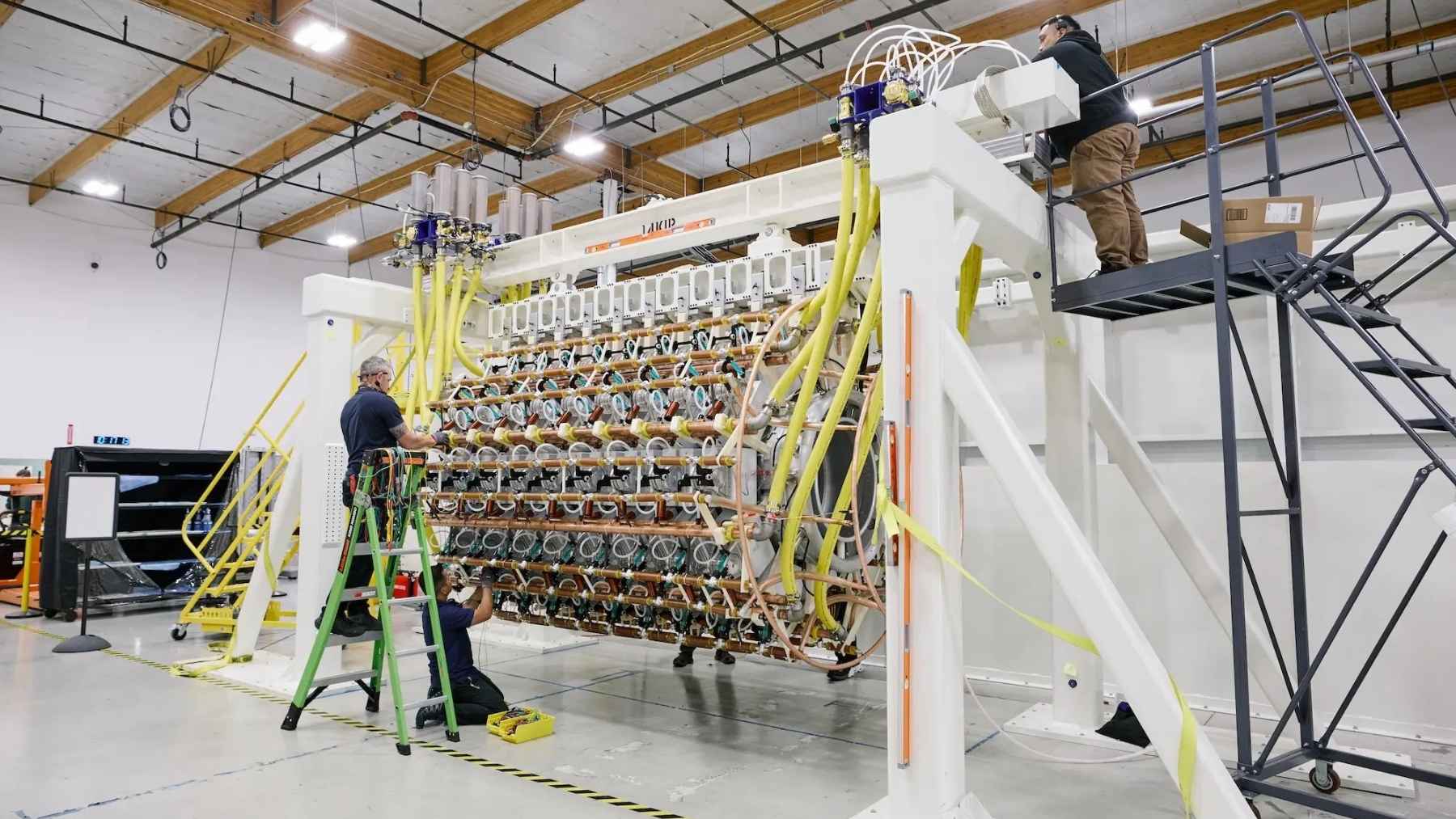
The specification is 12 large industrial membrane stacks, a 16.5-kilowatt rating and 132,000 kilowatt-hours a year. The program puts that at enough for about 40 households and just over 19.8 tons of avoided CO2 annually.
Siebers described the new plant to regional broadcaster Omrop Fryslân as enough for a small village. The broadcaster observed that this did not look like much set against the ambitions REDstack had been describing.
Those ambitions run to a 100-megawatt commercial plant on the Afsluitdijk, which Siebers placed somewhere between 2030 and 2035, depending on which financiers showed up.
The grant also covers the unglamorous half of the job: an assembly line to build stacks at industrial size, plus ecological research with Deltares and NIOZ into intake damage to zooplankton, fish larvae, shellfish and fish eggs. Companies in the Wadden ports draw 188.6 cubic meters of water per second from the Wadden Sea between them, so the intake question is not academic.
As of the most recent public updates from the funding bodies, the bigger plant is still written about in the future tense.
The company now sells the stacks, not the electricity
In January 2025 REDstack closed an investment round with PureTerra Ventures, northern development agency NOM and Easter Technology on undisclosed terms, to build an automated production line in Heerenveen for its ElectroMembrane stacks. Paula González took over as chief executive from Siebers around the same time.
Founder Pieter Hack had told The Northern Times in late 2024 that the company could then assemble roughly one stack a week by hand, and wanted the automated line running by the end of 2025 to get that to ten.
Open REDstack’s website today and you get three markets: salt removal from water, resource recovery including nitrogen and lithium, and carbon capture. Power generation is not one of them. Blue Energy lives on the page titled Our Heritage.
Which is a redirection rather than a failure. The stack turned out to be the sellable object, and the dike is where it was proven.
The hydrogen chapter went the same way. In February 2019 REDstack told Dutch Water Sector it was rearranging one stack to make hydrogen directly, since the process had been throwing off small amounts as an unwanted loss since 2014. Hack expected first production by mid-2019 and was looking for a partner to deliver it at 700 bar. Seven years later, hydrogen is not on the company’s list of markets either.
What the dike has actually proven
A second experiment on the same site just ran out of road. SeaO2, a spin-off with roots at Delft and Wetsus, moved its direct ocean capture prototype in alongside REDstack on the dike in 2023, stripping CO2 out of seawater with the same family of membrane hardware.
On June 23, 2026 a Dutch court declared SeaO2 bankrupt. Trustee Roland Camphuis told MT/Sprout there is concrete interest in a restart and that the company’s value sits in its intellectual property and the people who understand it. Thirteen employees are on notice, and the pilot on the Afsluitdijk is standing idle.
None of that makes the chemistry wrong. Fukuoka is generating, the Danish brine plant is generating, and Spain’s Sacyr is buying Dutch stacks for desalination work.
What the Afsluitdijk shows is the size of the bill. More than eleven years on the dike, four public funders and eight figures of investment bought a membrane stack good enough to sell to other industries, and a power plant rated for about forty houses. Anybody who wants osmotic power at grid scale is going to have to be comfortable paying that tuition first.
 @judiphillips ROOKIE2 months ago