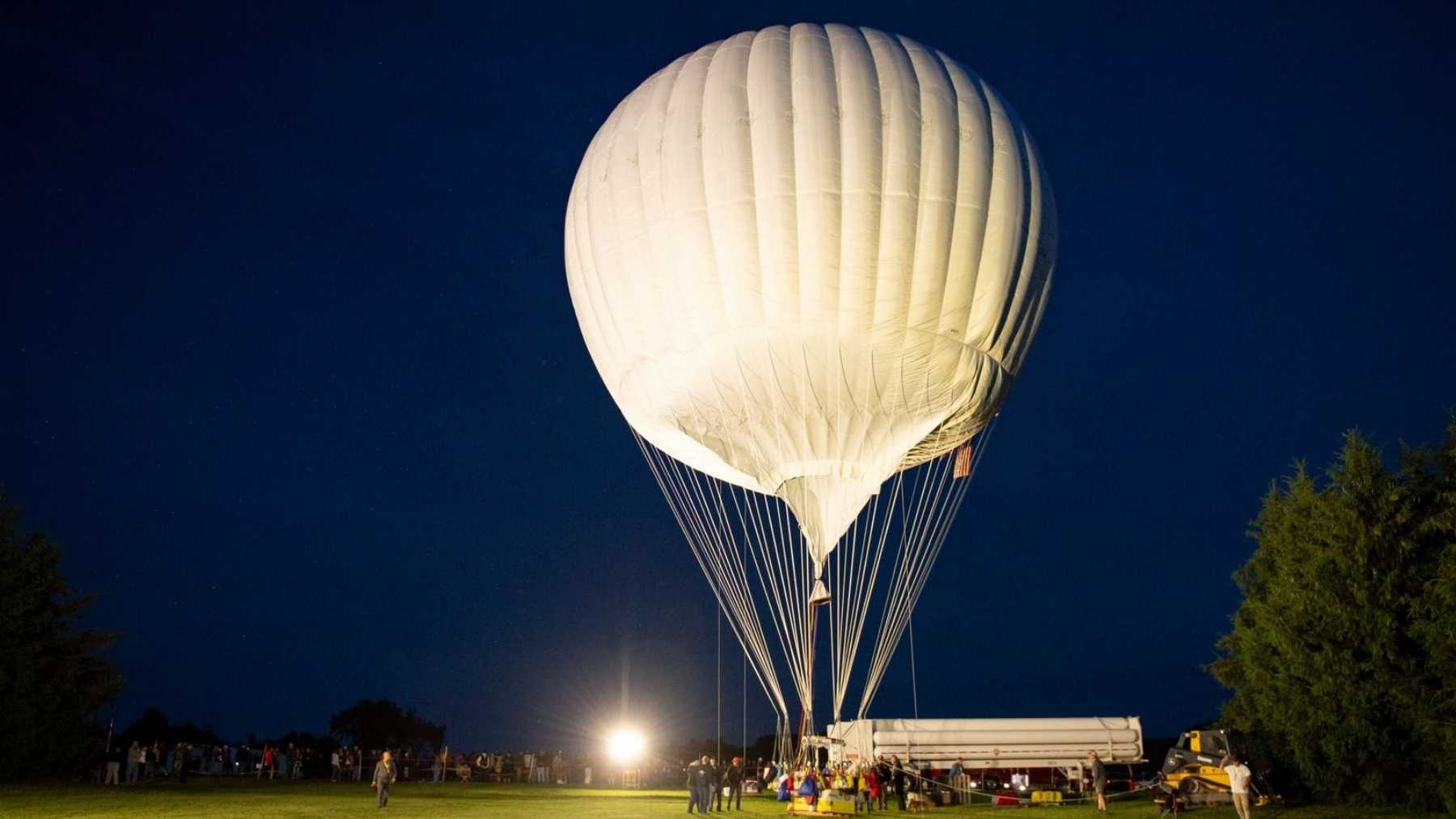

Crossing the Atlantic in a balloon is one of those bucket-list aviation stunts that sounds romantic right up until you remember the part where there is nothing under you but cold saltwater for a day and a half. People have managed it before, usually with helium or a hybrid Rozière rig that mixes gas and hot air. A three-person crew has now done it on hydrogen alone, and they set the thing down in a small Luxembourg village called Bastendorf.
The balloon is called Atlantic Explorer, and the body that ratifies this kind of record, the World Air Sports Federation (FAI), says it touched down near Bastendorf and the neighboring village of Tandel on June 7 at 0419 UTC, a hair after six in the morning Luxembourg time. Preliminary numbers put the flight at 70 hours and 11 minutes in the air and 2,852 nautical miles covered, call it 3,260 statute miles or 5,252 kilometers depending on how you like your units. It is the first time a crewed balloon has crossed an ocean on hydrogen with no helium and no propane burner riding along.
Three pilots, an open basket, and a plastic rain cover
The crew was an international mix. Bert Padelt, out of Bally, Pennsylvania, is the one who actually built the thing. He is a master balloon builder who runs a balloon repair station, and he and his wife Joanie designed and built both the Atlantic Explorer envelope and the gondola. Peter Cuneo flew in from Albuquerque, a retired engineer and a fixture in competitive gas ballooning who, with his wife Barbara Fricke, has won the America’s Challenge gas race four times. The third seat went to British adventurer Alicia Hempleman-Adams, from Bath, an Arctic explorer and record-setting balloonist who, when she is not airborne, works in fashion. Her father, Sir David Hempleman-Adams, crossed the Atlantic solo in an open basket years back, so this was very much a family-business kind of attempt for at least one of them.
The basket is the part that should make your stomach drop. The three of them rode in an open gondola roughly the size of a small closet, with a thin plastic rain cover doing most of the work of keeping the weather out, which is to say not much. No pressurized cabin, no heater, no walls. For 70 hours. Over the North Atlantic. In a June that, at altitude, has nothing to do with the June the rest of us were having on the ground.
Ice, St. Elmo’s Fire, and a basket at -17
The weather did not cooperate. The crew flew through torrential rain, snow, and cold severe enough to read −17°C (about 1°F) inside the basket, and the balloon iced up, which dragged on its performance. Ice on a gas envelope is a real problem. It piles on weight nobody planned for and it changes how the lifting gas behaves. At one point they had St. Elmo’s Fire flickering in the basket, the atmospheric electrical discharge sailors used to scribble about in their logs before deciding maybe they should have stayed home.
Getting above the worst of it meant climbing. The pilots pushed up to 25,000 feet to clear the nastiest weather, which is commercial-jet cruising altitude, except instead of a sealed aluminum tube you are in a wicker basket with an oxygen tank strapped to your face. The team was on supplemental oxygen for much of the flight. Cruise mostly sat lower, around 14,000 feet by the team’s own account, with the runs up to 25,000 reserved for the bad stuff. They managed altitude the old way, climbing and sinking to find favorable air currents, and rode them to speeds of up to 62 mph (100 km/h).
Why hydrogen is the interesting part
Gas balloons are not new. The first crewed transatlantic crossing came in 1978 with Double Eagle II, which ran on helium, and most long-distance attempts since have used either helium or a Rozière design that pairs a gas cell with a hot-air section heated by propane. Hydrogen got pushed out of crewed aviation almost a century ago for reasons most people can name without prompting. It burns, it is lighter than helium, and the publicity in 1937 was not great.
But hydrogen has genuine advantages for a long flight. It lifts more per cubic meter than helium, it is cheaper, and the supply is not squeezed the way helium’s is. That is the whole point of this one: the FAI lists it, pending ratification, as the first transoceanic flight using hydrogen as its sole source of onboard lift. That “sole source” bit is doing a lot of work. Plenty of long-haul flights lean on a propane burner to manage altitude. This crew did not have one, which means every altitude change came from venting gas or dropping ballast — the original 18th-century playbook, just with modern fabrics, modern weather data, and a satellite link.
For anyone following the broader hydrogen story we cover on the ground side, from the first large-scale engine to run on 100% hydrogen on Spain’s grid to a green steel tower in Sweden and the first zero-diesel hydrogen tanker in Lithuania, this one lands as more symbolic than commercial. Nobody is launching a hydrogen-balloon airline. But it is a useful proof that you can handle the gas safely in a sustained operation with people on board, which is the exact question that keeps surfacing in hydrogen mobility on the ground too.
From Maine to Normandy to a Luxembourg field
The launch happened in the small hours of June 4 from Presque Isle, Maine, a town that exists in the American imagination almost entirely as the place balloons take off from when they are trying to cross the Atlantic. It is the same town the Double Eagle II crew launched from in 1978, which is not a coincidence. The balloon drifted across Nova Scotia and Newfoundland, and once it cleared the coast it spent roughly 36 hours over open Atlantic with no landing option other than the water below. That is a day and a half of “if something breaks, we are swimming.”
European landfall came on June 6, the 82nd anniversary of D-Day. The Atlantic Explorer crossed into France just north of Siouville-Hague on the Cherbourg peninsula, paralleled the Normandy coast over open water, and made its first French landfall at Le Havre before drifting east overnight and setting down outside Bastendorf the next morning. A retrieve team made up of some of Europe’s most experienced gas balloonists was waiting to help pack it all up and deal with the paperwork. You can follow the full track and the day-by-day flight diary on the crew’s Atlantic Explorer project site.
Records, an MBE, and a second-ever
By the FAI’s preliminary count, several records are lined up for ratification. The headline one is the hydrogen-only crossing itself. There is also a distance record for the balloon’s size and class (an AA-09 gas balloon), plus the first transatlantic crossing by a woman flying a straight, non-Rozière gas balloon. With that, Hempleman-Adams becomes only the second woman in history to cross any ocean by balloon, and the first British woman to do it by gas balloon. She was already made an MBE for services to hot air ballooning in the 2024 King’s Birthday Honours, so the trophy shelf had some stock on it before this.
Her own read on the trip, given to UK press after landing, was on the understated side. The ice that built up flying through rain, she said, “made conditions extremely difficult and added real jeopardy to the flight,” and she credited the safe crossing to the team around her. “Real jeopardy” is a polite way to file 70 hours of supplemental oxygen, sub-zero exposure, and St. Elmo’s Fire in a closet-sized basket. The other way to file it would be to never agree to the trip in the first place.
Whether hydrogen balloons turn into a recurring thing or stay a one-off depends mostly on whether other crews actually want to inherit these particular conditions. The gas works. The route works. The math works. The wicker basket at 25,000 feet in a snowstorm is the part that is going to be a harder sell.
 @petercuneo ROOKIE2 months ago