
Maritime shipping has a diesel problem. Roughly 90% of global trade moves on ships, and almost all of them burn heavy fuel oil or marine diesel, which is why the sector accounts for about 3% of global CO2 emissions and a much bigger share of the sulfur and particulate pollution you get near ports.
Hydrogen, ammonia and methanol have been the industry’s favorite talking points for years now, mostly in the form of slide decks and pilot studies. But this week in Lithuania, a port authority did something more concrete than another conference panel: it christened a working commercial tanker that runs entirely on green hydrogen and batteries, with zero diesel and no fossil backup anywhere on board.
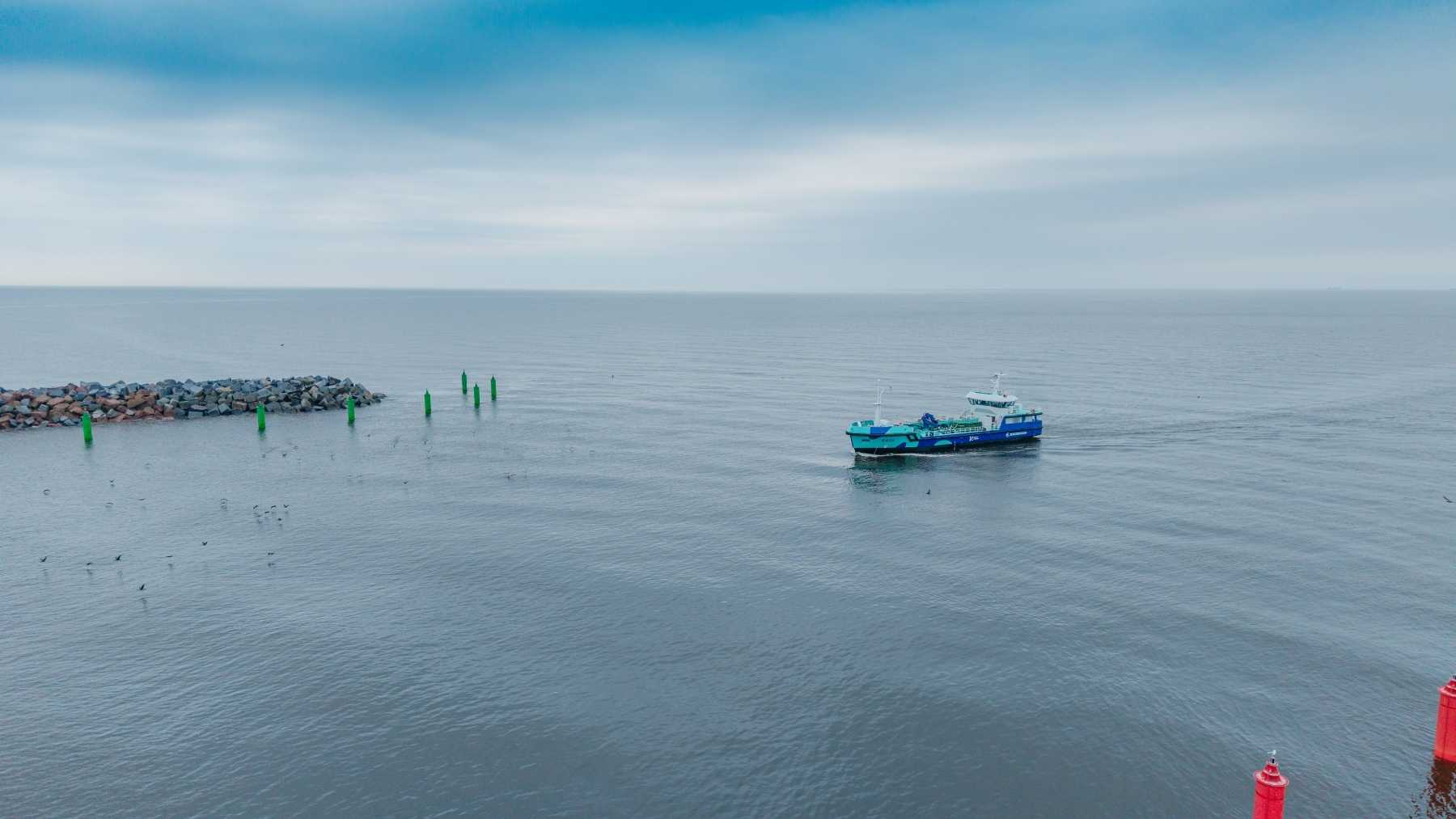
The ship is called Rasa, and it was christened at the Port of Klaipėda on June 18, 2026. This is not a concept render. It’s a 42-meter tanker that’s about to start collecting sludge, sewage, stormwater and garbage from other ships calling at the port. Glamorous work, no. Technically interesting, very much yes.
A big battery, a small fuel cell, and zero diesel
Strip away the press-release language and the propulsion system comes down to three blocks: a big battery, a small fuel-cell stack, and an all-electric driveline. No diesel genset hiding in a corner for backup. No dual-fuel engine. Just electrons.
The builder, Estonian shipyard Baltic Workboats, says Rasa pairs an approximately 2 MWh energy storage system from Dutch supplier EST-Floattech with two 40 kW hydrogen fuel cells from French firm Genevos, all feeding an electric propulsion package from Danfoss Editron, good for more than 10 hours of continuous zero-emission operation. That 2 MWh battery pack is doing most of the heavy lifting for propulsion, about the same energy storage as roughly 20 long-range EV battery packs strapped together.
The fuel cells are smaller than you’d expect. Two 40 kW units is 80 kW total of continuous hydrogen-to-electricity conversion (about 107 horsepower), roughly what you’d get from a base economy-car engine. They aren’t there to spin the propellers directly. They sit behind the battery as range extenders, topping it up while the ship works the harbor and stretching the zero-emissions duty cycle well past what a pure battery boat could manage.
On battery alone, the numbers are tight but workable. The tanker can hold up to 8 knots for roughly eight hours on battery power, which is plenty for the low-speed harbor crawling this job involves. When the battery runs low, the fuel cells kick in. The Klaipėda State Seaport Authority says that depending on workload, the combination can keep Rasa working for up to 36 hours of port operation without plugging in to recharge.
Klaipėda makes its own hydrogen on the dock
Here’s the part that separates Rasa from most so-called hydrogen vehicles. Most hydrogen on the road or at sea today runs on what the industry awkwardly calls grey hydrogen, made by steam-reforming natural gas, which emits roughly as much CO2 as just burning the gas would. Calling that a clean fuel is generous. Rasa is different because the port isn’t only running a hydrogen ship; it’s producing the hydrogen itself, from renewable electricity and water, right next to the dock.
The Port of Klaipėda opened Lithuania’s first green hydrogen production and refuelling facility in June 2026, built around a PEM (polymer electrolyte membrane) electrolyser that splits water using renewable power. At full capacity the plant is designed to make around 127 tonnes of green hydrogen a year, enough to supply passenger cars, heavy trucks, ships and the port’s own machinery.
That facility is a separate project from the ship, roughly half of it EU-funded through the Next Generation Lithuania recovery plan, with commercial hydrogen supply due in autumn 2026. So Rasa doesn’t have to truck H2 in from somewhere else and then call it green because a certificate says so. The hydrogen and the tanker share a postcode.
That matters for one specific reason: hydrogen is a pain to move. It’s the smallest molecule there is, it leaks through seals, and shipping it long distances cryogenically or as ammonia bleeds energy at every step. As Autonoción US has covered, moving the molecule is usually the expensive part of the whole hydrogen equation. The closer you make it to where you use it, the better the math looks.
Four countries built one tanker
Rasa isn’t one company’s project, and the supplier list tells you where European maritime hydrogen tech actually lives right now. An Estonian shipbuilder, a Dutch battery integrator, a French fuel-cell maker and a Danish drive supplier, all working on a tanker commissioned by a Lithuanian port.
Baltic Workboats says the delivery marks two firsts for the yard: Rasa is the first tanker built at its Nasva shipyard on the island of Saaremaa, and its first vessel using hydrogen as an onboard energy source. The hull and most of the auxiliary systems came from Western Baltija Shipbuilding in Klaipėda, part of the BLRT Grupp; Baltic Workboats handled the electric propulsion, power management, batteries, automation and outfitting, with the hydrogen system finished in Estonia. A crew of just three runs the whole thing, thanks to automated monitoring and control.
The vessel itself cost about $13 million (€12 million), commissioned by the Klaipėda State Seaport Authority. The hydrogen and battery hardware is the expensive part, and you can see it in the bill; a conventional diesel workboat this size would come in a good deal cheaper.
Rasa is a floating waste truck, and that’s the point
The boring job description is also the clever bit. Rasa isn’t a glamorous container ship or an offshore wind crew vessel. It’s a floating waste truck, equipped to collect and treat sludge, sewage, stormwater and garbage from ships calling at Klaipėda, with the heavier waste hauled to onshore treatment plants. It carries up to 400 m³ of liquid waste and is built to run around the clock.
This is a smart way to debut a hydrogen propulsion stack. Harbor service vessels run predictable routes, come back to base every day, and operate at modest speeds. That’s close to the ideal duty cycle for a battery-first hybrid with a fuel-cell range extender, the same logic carmakers like Volvo have used for why hydrogen suits heavy trucks before it suits passenger cars. It’s about matching the fuel to the duty cycle, not replacing every diesel everywhere.
There’s a second-order trick here too: Rasa makes other ships cleaner. Under the port’s rules, vessels have to hand over the waste they generate before they leave Klaipėda, and Rasa is the boat collecting it. Every diesel-burning visitor leaves the port a little less filthy than it arrived. The clean ship makes the dirty ships a touch less dirty just by existing.
The “world’s first” claim, and where it gets slippery
Calling Rasa “the world’s first” anything is the kind of line that gets shipping nerds typing in comment sections, so it’s worth being precise. There have been hydrogen ferries, hydrogen demonstration vessels and dual-fuel concepts for years. Norway’s MF Hydra has run on liquid hydrogen since 2023 — but it’s a passenger ferry, it burns hydrogen trucked in from Germany, and it still carries two diesel generators as backup.
What Klaipėda is specifically claiming is narrower and cleaner: the first commercial tanker running on green hydrogen and electricity, with no fossil-fuel backup at all, fed by an on-site green hydrogen plant. Algis Latakas, director general of the Klaipėda State Seaport Authority, framed the launch as “cleaner, smarter and more environmentally friendly,” and tied it to Lithuania’s standing as a maritime nation.
So the precise claim is a lot narrower than “world’s first hydrogen ship.” But it’s still a real milestone. A working commercial tanker, with an actual cargo job, running on locally made green hydrogen and grid-charged batteries, with no diesel generator in the back. Nobody had put that exact configuration into service before.
Harbor boats first, container ships later
The honest read on Rasa is that it’s a test of the technology at the scale where the math currently works. A 42-meter harbor tanker doing 8 knots is a long way from a transoceanic container ship doing 22, and the engineering doesn’t scale in a straight line. You can’t just multiply the fuel cells by 50 and call it done; hydrogen storage volumes, bunkering infrastructure and class-society rules all get harder fast.
That’s exactly why this kind of vessel is the right place to start. Harbor service, short-sea ferries, river barges and offshore support boats are where battery-plus-fuel-cell propulsion can compete on cost and operations today, not in 2040. The wider regulatory push is already pointing that way: as Autonoción US has reported, governments are writing rules to force ships onto fuels made from green hydrogen, even as almost nobody is producing the stuff at scale yet. If Rasa runs its waste-collection job for the next decade without a diesel safety blanket, that’s a serious data point for every other port authority on the Baltic, the North Sea and beyond. Klaipėda just bought itself one of the more interesting case studies in European shipping, for roughly the price of a mid-size yacht.