
Toyota has spent more than three decades telling anyone who will listen that hydrogen belongs inside a fuel cell, where it gets converted to electricity through a quiet electrochemical handshake and leaves nothing behind but water vapor. At ACT Expo in Las Vegas last month, the company doubled down yet again: fuel cell Class 8 trucks in its logistics fleets by early 2027, Gen 3 stacks, freshly certified stationary generators, the full hydrogen society pitch.
Meanwhile, on the Basque coast of Spain, a Finnish company just did the thing Toyota’s playbook treats as a detour. Wärtsilä took a giant piston engine, fed it nothing but pure hydrogen, and put the electricity on Spain’s national grid. The company announced it Thursday as the world’s first demonstration of a large-scale engine running on 100% hydrogen. Not a blend. Not “hydrogen-ready” hardware waiting for fuel that never shows up. Combustion, the old-fashioned kind, burning H2 the way a diesel burns diesel, with customers flown in from around the world to watch it run in June.
The machine in Bermeo
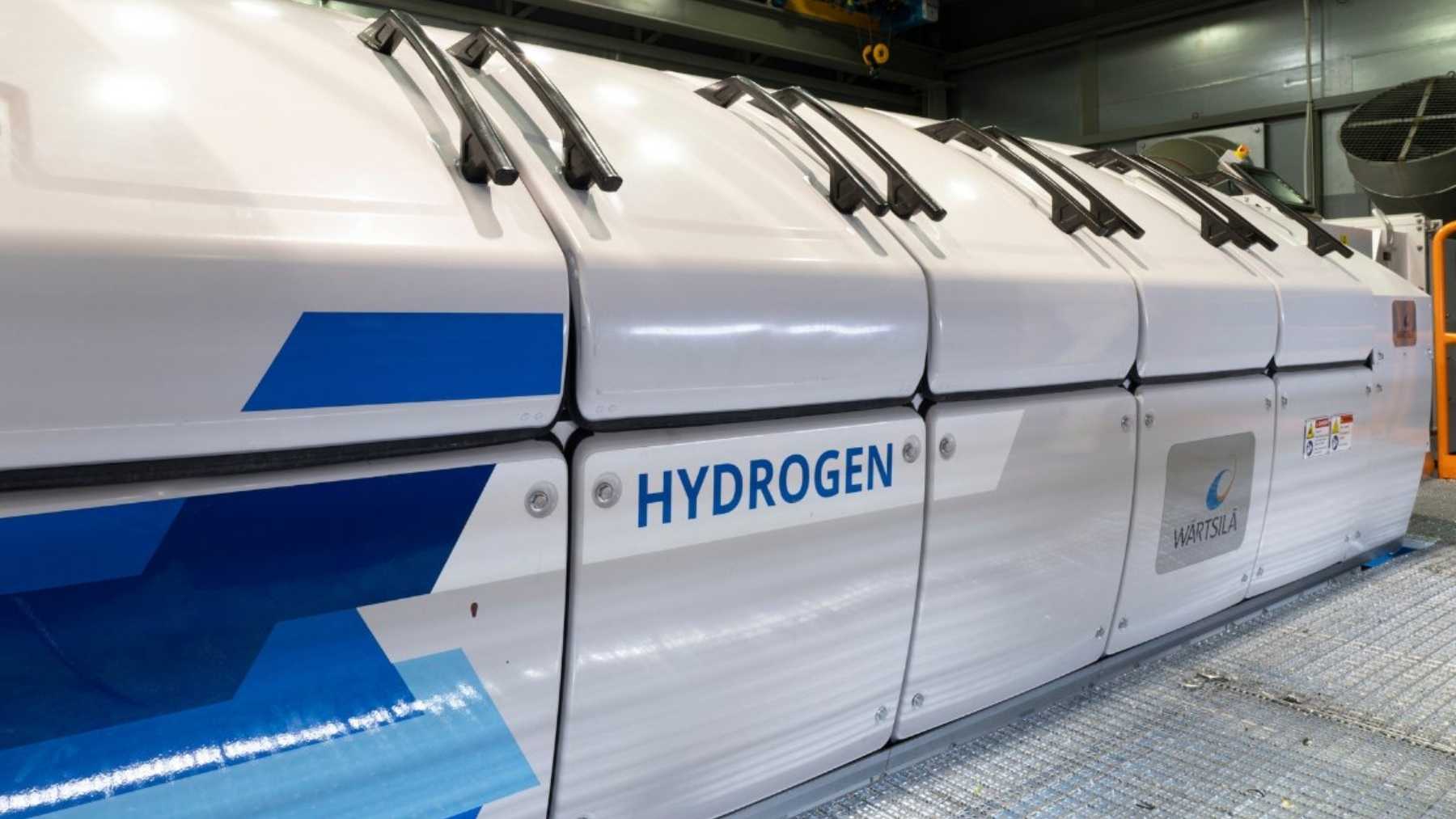
The engine is the Wärtsilä 31H2, and it is not a science project squeezed into a shed. It comes off the Wärtsilä 31 platform, a medium-speed industrial four-stroke whose diesel version once took a Guinness World Record as the most efficient four-stroke diesel engine on the planet. In conventional form the 31 is a monster by car standards: roughly 15 feet tall, nearly 29 feet long, with a cylinder bore of 12.2 inches and up to 9.8 MW of output, call it around 13,000 horsepower. If you come from cars, that sounds unhinged. If you come from container ships, it is one of the smaller things in the building. Wärtsilä now describes the 31H2 as the world’s largest pure hydrogen engine, with its performance being verified in Bermeo.
The platform arrived in two flavors when Wärtsilä launched it back in 2024 as the first large-scale hydrogen-ready engine power plant. The 31SG-H2 runs on natural gas and digests hydrogen blends up to 25% by volume until you fit a conversion package and go full H2. The 31H2 is the headline act: built to burn pure hydrogen from day one, while keeping the option of dropping back to natural gas when the H2 supply gets thin. Until this week, that second engine was mostly a brochure. Now there is one in Bermeo making real electrons for the Spanish grid, and the platform behind it has over a million running hours and more than 1,000 MW installed worldwide, so the bottom end is anything but experimental.
Rasmus Teir, Wärtsilä’s Director of Technology Strategy & Decarbonisation, framed the trial as a test of whether engines can deliver “the flexible, dispatchable sustainable power needed to support future renewable energy systems.” Strip the corporate varnish off that sentence and it reads: when the sun goes down and the wind dies, somebody has to keep the lights on, and today that somebody usually burns natural gas.
Spain was not a random choice
Wärtsilä calls Spain one of the forerunners in renewable energy adoption, and picked it as the test bed partly for its push to cut exposure to fossil fuel price swings. But there is a rawer reason Spain understands this conversation better than almost anyone. In April 2025 the Iberian grid went down in a blackout that left the peninsula dark for hours. The official investigation traced the collapse to cascading overvoltages and voltage-control failures rather than to renewables themselves, but the event happened during a high-renewables window, and it turned grid inertia and firm backup from an engineering footnote into a national talking point. A machine that spins real iron, provides actual rotating mass, and burns a carbon-free fuel is aimed straight at that anxiety.
Bermeo itself is no pop-up either. It is one of Wärtsilä’s three engine-testing sites, alongside Vaasa in Finland and Trieste in Italy, where the company has spent years running P2X fuels like hydrogen, ammonia and methanol through single-cylinder rigs and full-scale engines. So the news is not that hydrogen can combust. Chemistry sorted that out long ago. The news is that Wärtsilä is now confident enough in 100% H2 at full industrial scale to wire the thing into a national grid and invite its customers to watch.
Two bets on the same molecule
Here is where the Toyota contrast stops being a cheap framing device and becomes the actual story. A fuel cell converts hydrogen electrochemically: efficient, silent, nothing out the tailpipe but water. Toyota has been at it for over 30 years, and its ACT Expo slate shows where that work is headed, including ANSI/CSA FC 1 and FC 6 certification for its stationary fuel cell generators aimed at hospitals, data centers and disaster sites.
Combustion runs the other direction. You burn the gas, you get mechanical work, you spin a generator. Less elegant chemistry, but with advantages a fuel cell cannot match at power-plant scale. The hardware is proven across a century of industrial use. Wärtsilä’s engine plants are built for extremely fast ramping with no minimum up or down time, which is exactly the profile a renewables-heavy grid pays for. And a combustion chamber is not picky: fuel cells need high-purity hydrogen or the stack starts to degrade, while a piston engine will eat pretty much anything you can ignite.
Neither approach wins outright. They solve different problems. Toyota wants to decarbonize the thing moving the freight. Wärtsilä wants to decarbonize the thing keeping the freight terminal lit at 3 a.m. when the solar farm is asleep.
The NOx catch
Burning hydrogen sounds perfectly clean, and on carbon it genuinely is, because there is no carbon atom in the fuel to oxidize. Air is the complication. It is roughly 78% nitrogen, and at combustion-chamber temperatures that nitrogen bonds with oxygen into NOx, the same pollutant family that wrecked diesel’s reputation. Wärtsilä’s own fuel researchers are blunt that “hydrogen combustion, on the other hand, is fast and happens at a high temperature,” which is precisely the recipe for making more of it, and the company says the entire combustion concept and aftertreatment chain has to be developed around that reality.
That is the unglamorous substance of the Bermeo trial. The headline is hydrogen on the Spanish grid. The actual work is injection geometry, mixing strategy, valve timing and whatever aftertreatment keeps the exhaust inside what a European regulator will sign off on. Get that wrong and the product never ships. Get it right and every gas-engine power plant on Earth has a carbon-free upgrade path.
What it means for the cars
For a site that mostly cares about things with wheels, Bermeo matters in a sideways but real fashion. The case against hydrogen passenger cars has never been the physics, it has been the pump. Our own coverage of the 2026 Toyota Mirai laid out the arithmetic: roughly $5,000 to cover 10,000 miles, around 70 stations in the whole country, owners holding cars they can barely fuel, and a $5.7 billion class action over it. Toyota’s answer has always been that the hydrogen society is coming. Patience.
What Wärtsilä just demonstrated is, in a roundabout way, a load-bearing piece of that society. If utilities decide hydrogen engines are how you firm up a renewable grid, somebody has to make green H2 in bulk. Toyota itself is positioning for that exact demand: under its partnership with plant engineer Chiyoda, the company said in March it plans to mass-produce 5 MW PEM electrolyzers from fiscal 2029, each good for around 100 kg of hydrogen an hour. Grid demand pulls electrolyzer volume, electrolyzer volume pulls distribution, and somewhere far down that chain a working pump might finally appear within range of a Mirai owner. Maybe. Eventually.
The nearer-term beneficiary is heavy transport. European engineers have spent years on hydrogen ICE for trucks precisely because the hardware looks like a modified diesel, with the same block and crank and different injectors, and we have already seen liquid-hydrogen systems built to retrofit into trucks, ships and aircraft without touching the basic architecture. Bermeo does not prove the truck case. It proves something one level up: that 100% hydrogen combustion now works at full industrial scale, on a live grid, in front of customers, and that the phrase “engines have no future in a zero-carbon world” needs an asterisk.
Toyota’s bet and Wärtsilä’s bet are not actually fighting. They grab the same molecule from opposite ends, one chasing the cleanest conversion inside a vehicle, the other the most flexible conversion outside one. The open question is which path scales faster, and whether either moves quick enough before batteries eat the rest of the lunch.
 @borisjohnston ROOKIE3 months ago