
- 2 MONTHS AGO · ENERGYA 128-megawatt battery next to 470,000 solar panels outside an Air Force base in Georgia now stores their daytime power for cold winter mornings, and nine more batteries are approved that add up to over 3,000 megawatts
- 2 MONTHS AGO · ENERGYA reactor at Canada’s largest nuclear plant came off the grid by evening and a second one dialed back to 87 percent power, both pulled by hand as millions of gizzard shad packed the intake screens, and the count hit up to 4.95 million fish against a site record of 800,000
- 2 MONTHS AGO · ENERGYAn 850-megawatt battery pushed 700 megawatts into the grid for two straight hours, pulled almost 850 back out of it, and the grid operator has now cleared it to run at full power, nearly a year after a transformer failure cut its grid contract in half
- 4 WEEKS AGO · ENERGYA California hillside water battery is designed to hold 5 million gallons in its upper tank that only firefighters can touch and 80 megawatt-hours in roofed tanks instead of a dam, and the drill rig started boring the same day the utility cut power to 3,601 customers
- TODAY · THIS ARTICLEHome batteries bolted to garage walls across California sent 745 megawatts into the grid in one evening, more than any residential fleet in the US has ever delivered, up from 580 a month earlier when more than 140,000 of them were already hooked up
If you’ve got a battery hanging in your garage, there’s a good chance you bought it for one reason. When the power goes out, your fridge and your Wi-Fi keep running while the rest of the street sits in the dark.
But a lot of those batteries have picked up a second job. On the evening of Oct. 6, with a heat wave pushing California’s grid pretty hard, home batteries across the state sent a combined 745 megawatts back into the system. Sunrun, which announced the figure on Oct. 14 for its own fleet and Tesla’s, called the Oct. 5 and Oct. 6 events “the largest residential distributed power plant dispatches in U.S. history.”
The night before, those same fleets had delivered 669 MW. And on Sept. 9, about four weeks earlier, more than 140,000 home batteries had set the previous record at 580 MW.
So how does a box in somebody’s garage end up working for the grid?
California pays people to do this
Basically, a company signs up thousands of battery owners, and when the grid gets tight, its software tells all of those batteries to start discharging at once. To a grid operator, a few hundred megawatts showing up from tens of thousands of houses looks pretty much like a power plant firing up, which is why the industry calls the setup a virtual power plant.
The main program behind these events is Demand Side Grid Support, or DSGS, which the California Energy Commission runs from May through October. Tesla’s DSGS enrollment page says an event gets called when wholesale power prices pass $200 per megawatt-hour, events land between 4 and 9 p.m., and a Powerwall can earn up to $280 a year.
There’s a second program too. The California Public Utilities Commission’s Emergency Load Reduction Program runs through PG&E, Southern California Edison and San Diego Gas & Electric, and Tesla says it pays $2 for each extra kilowatt-hour a battery delivers during an event. According to Sunrun, Oct. 5 was also the first night this year when every participating utility territory got both calls at once.
Nobody’s paying off a home battery with $280 a year. Still, for a box that’d otherwise sit there waiting for an outage, it’s a pretty easy check to cash.
Most of the batteries in these events have been Tesla Powerwalls. If you’ve never seen one, the current Powerwall 3 is a 287-pound slab that measures 43.5 by 24 inches and 7.6 inches deep, and it can go on a wall or the floor. It stores 13.5 kWh and, according to Tesla, can put out 11.5 kW continuously. The older Powerwall 2 holds the same 13.5 kWh, weighs 251.3 pounds and tops out at 5 kW continuous.
Who actually sent the power?
Tesla got its numbers out first, in an Oct. 8 post on X from its energy division. The dashboard it shared showed 85,774 homes with Powerwalls taking part on Oct. 6, with a participating peak of 601 MW and 932 megawatt-hours delivered. That’s a lot of garages.
Then Sunrun’s Nov. 4 quarterly report said its customers supplied more than 430 MW, or 58%, of the 745 MW peak.
Now, if you add 601 and 430 you get 1,031 MW, which is a lot more than 745. I don’t think anyone’s padding their stats here. Sunrun installs and operates a huge number of Powerwalls, and it said it owned or operated 55% of the roughly 110,000 Powerwalls in the September event. So plenty of batteries probably show up in both companies’ tallies. Neither company’s published a split that untangles them. Sunrun also hasn’t said how many batteries took part on Oct. 6.
Tesla’s figures do let you do some fun math, though. I ran them, and 601 MW across 85,774 homes works out at about 7 kW per house, which is more than a single Powerwall 2 can deliver continuously. My guess is that a lot of those homes have a Powerwall 3 or more than one battery, but Tesla hasn’t broken that down.
So is 745 megawatts a lot?
It’s going to depend on what you’re comparing it with, and on which unit you’re looking at. A megawatt measures how hard you’re pushing power at a given moment. A megawatt-hour measures how much energy you actually delivered over time. Think of it as horsepower versus the size of your gas tank.
Sunrun’s release gives peak megawatts for the combined fleets and says the batteries discharged over several evening peak hours, but it doesn’t say how many megawatt-hours they delivered. Tesla’s 932 MWh is the equivalent of holding its 601 MW peak for a little over an hour and a half. Sunrun puts it another way: at the evening peak, 745 MW would cover every home in both San Francisco and San Jose.
I’m more impressed by how fast the record keeps moving. The 539 MW mark from the previous July held for more than a year until Sept. 9, while the 580 MW mark that replaced it lasted less than four weeks. That’s fast. Frankly, it’s the kind of jump I’d normally expect from a utility switching on a new plant.
DSGS events only run from May through October, so it’s a fair bet nobody tops 745 MW in California before next May. There’s also a Google-funded project with PG&E around San Jose that’s meant to enroll nearly 21,000 home devices, and Sunrun said in October it expected the first dispatches that month. I haven’t seen any results from it yet.
California now has a law for this
We wrote about SB 913 back in May, when it was still working its way through the state Senate. Gov. Gavin Newsom signed it on Sept. 30, along with a companion bill, SB 905, and both come from state Sen. Josh Becker. SB 913 directs the CPUC to build a path for fleets of customer batteries and other home devices into the state’s resource adequacy market.
Resource adequacy is basically the state’s insurance policy. Utilities have to line up enough capacity ahead of time to cover the hottest evenings of the year, and home battery fleets have been restricted in how they count toward it.
That’s arguably a bigger deal than any single record. DSGS has lived budget to budget, and the CEC’s own guidelines say the program was first planned at $314 million but only $109.5 million has been allocated to it. Newsom proposed moving money from another expiring program to keep DSGS running through the end of this year, and I haven’t found anything firm on what its budget looks like after that.
Under the bill Newsom signed on Sept. 30, the CPUC has until June 2028 to set up the rules that let battery fleets like this one count toward resource adequacy.
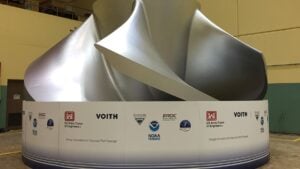 While most dam turbines are designed around the water, the stainless steel runner spinning in a Snake River dam was designed around a juvenile Chinook salmon, and balloon-tagged fish came through it alive 98.25% of the time as it pulls about 4% more power out of the riverEnergy · 1 hour ago
 Two 853-foot wind turbines 80 miles off England are expected to get new towers and nacelles after a blade failed on each one, and a few dozen more of the 95 on the first phase of the world’s biggest offshore wind farm still need repairs before it runs at full powerEnergy · 3 hours ago
 Two 525-foot cooling towers with 62,000 tons of concrete in their shells came down in 45 seconds at a shut-down German nuclear plant, and a 400-megawatt battery of more than 200 containers is now going up on its old grid connection, due to switch on next yearEnergy · 5 hours ago