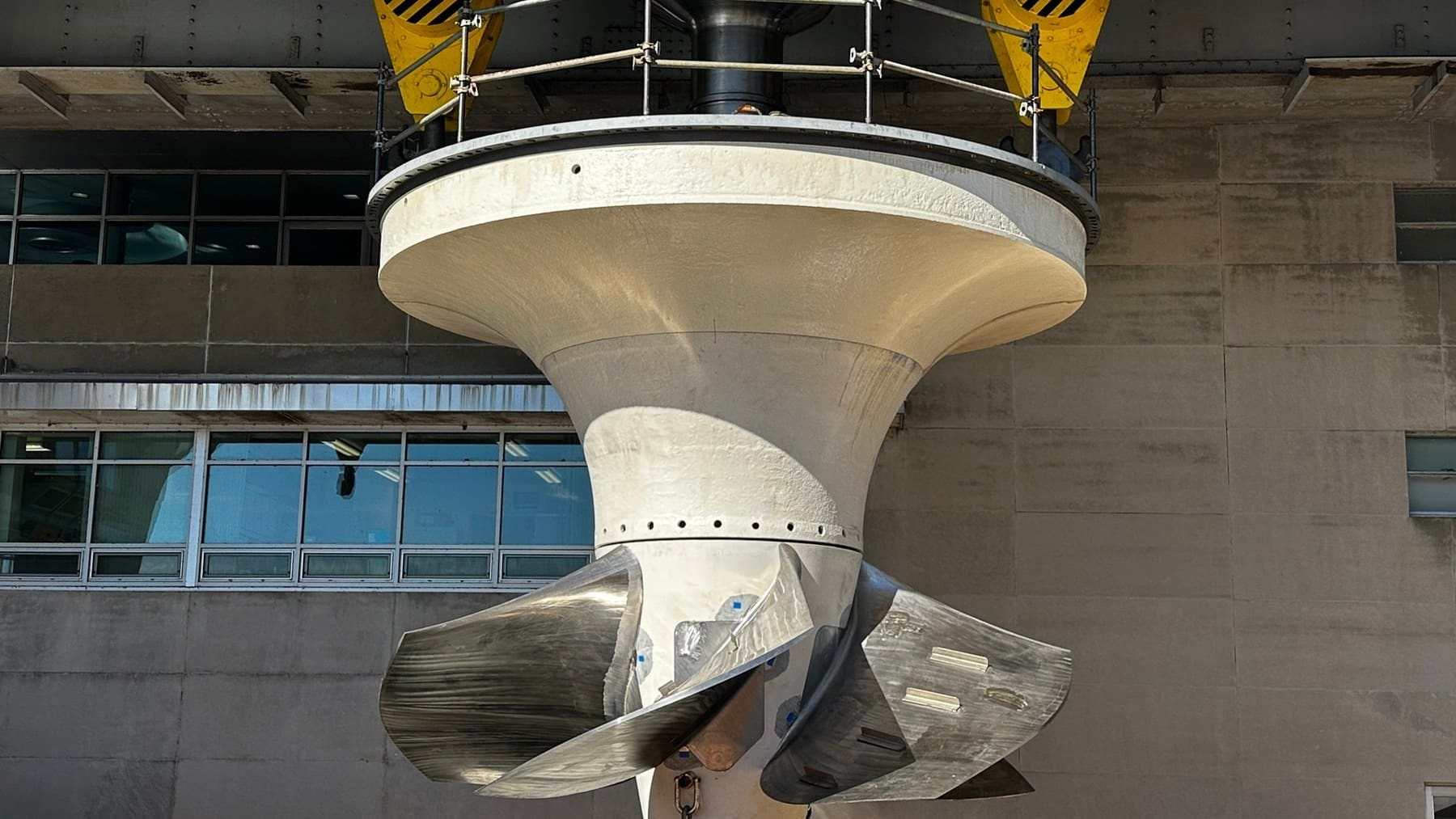

- 2 MONTHS AGO · ENERGYA 22-foot runner has been spinning under the Cumberland River since 1957, and the one going in to replace it has seven blades instead of five, the same 264-inch diameter and the same 75 rpm, because spreading the same water over two more blades keeps it from pitting the metal
- 1 MONTH AGO · ENERGYA 27-foot robot snake no wider than a quarter went into a sealed nuclear hot cell in Scotland carrying a 2.5-ounce radiation sensor and a camera, steered from the back by cables like a puppet, and two balloons inflate to prop it up and hold it still once it gets there
- 1 MONTH AGO · ENERGYA 19-megawatt dam on a Maine river ran one of its three turbines for four hours on a Saturday in the middle of a herring run of about a million fish, thousands of them came out the other side dead, and the owner shut the whole plant down and has kept it dark since to let the rest go by
- 1 WEEK AGO · ENERGYA 908-megawatt Ohio reactor once ran with a football-sized hole eaten through more than 6 inches of its steel lid by leaking boric acid, leaving a stainless liner three-eighths of an inch thick to hold back 2,155 psi, and its replacement lid came from a plant that never opened
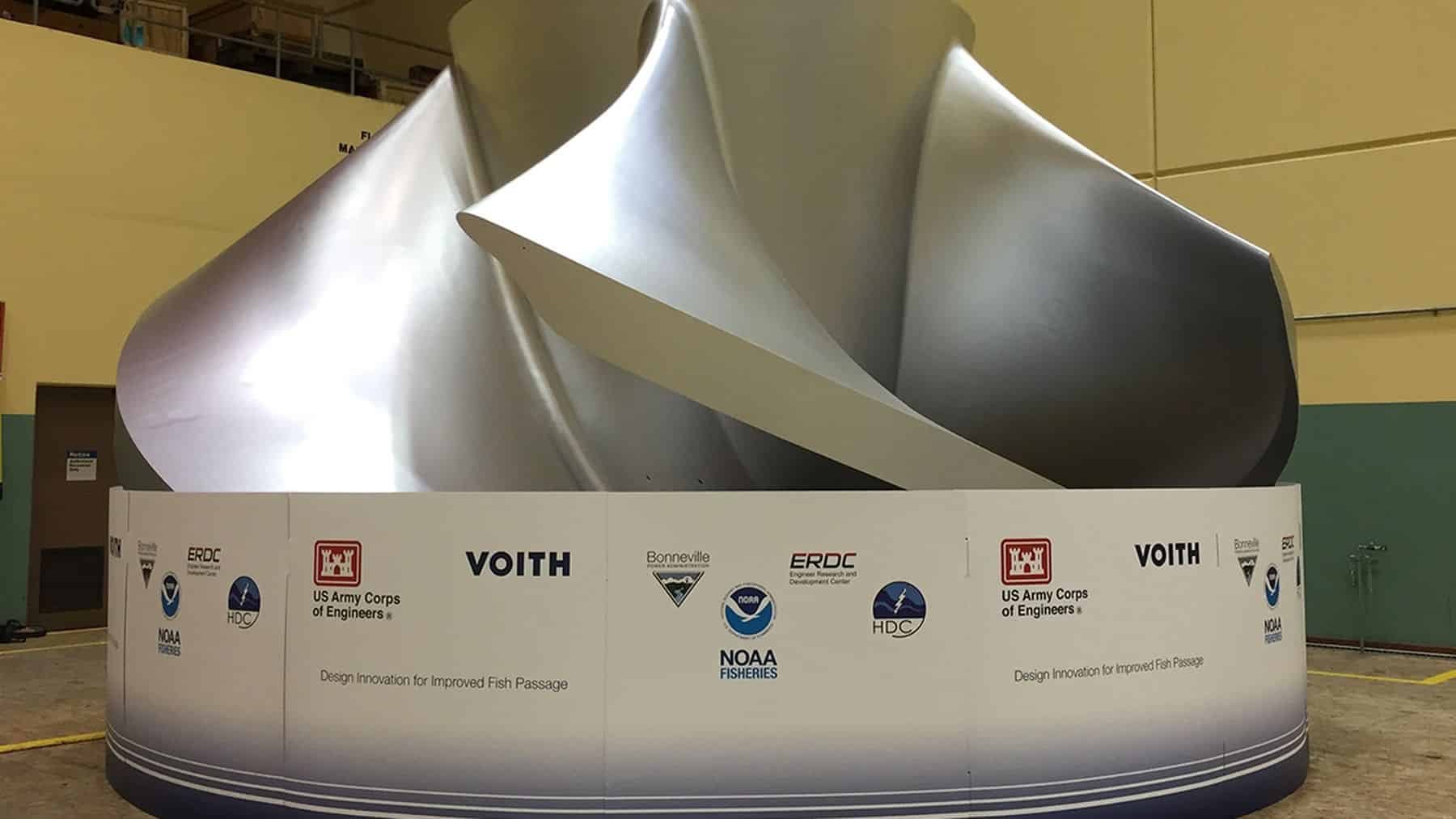
- TODAY · THIS ARTICLEWhile most dam turbines are designed around the water, the stainless steel runner spinning in a Snake River dam was designed around a juvenile Chinook salmon, and balloon-tagged fish came through it alive 98.25% of the time as it pulls about 4% more power out of the river
Young salmon on the Snake River have a pretty rough commute. They hatch upstream, ride the current toward the Pacific, and on the lower Snake alone they’ve got four federal dams to get past. Some go over the spillways or through bypass systems built for fish. Some get pulled into the turbine intakes instead.
That’s a bad place to be if you’re a few inches long. Hydro turbines have generally been designed around the water: how much of it comes through, how far it falls, and how much electricity you can squeeze out of it.
So what happens if you flip that and design the turbine around a juvenile Chinook salmon?
The Army Corps of Engineers has been finding out at Ice Harbor Dam, the last of those four dams before the Snake runs into the Columbia. Pacific Northwest National Laboratory (PNNL) published the latest round of results on November 17, and they’re about the second of the dam’s two new runner designs. To make sense of them, you need the first one.
So what does a fish-friendly turbine look like?
When most people picture a turbine, they’re picturing the runner, the big propeller-looking thing the water spins on its way through the dam. Ice Harbor’s original runners were Kaplans. Basically, that’s a propeller whose blades pivot on the hub so the turbine can run efficiently with more or less water coming through. Pivoting blades need machinery and oil inside the hub, and the Corps says its new units use greaseless parts and better seals to cut down on oil leaking into the river. Which tells you a bit about how the old ones were doing.
The first new runner went into Unit 2, and it skips the pivoting entirely. Its blades are locked at one angle, so it works a lot like a boat propeller. It’s also made of stainless steel instead of the carbon steel in the originals. According to the Corps, stainless holds up better against corrosion and cavitation (tiny vapor bubbles that form and collapse against the blades and slowly eat away at them).
Getting the shape right took years of model testing, with engineers and fish biologists working on it together. Early design work presented by the Corps and the manufacturer, Voith Hydro, tried four blades instead of the original six, made them longer, and kept the hub small. Fewer blades means fewer chances of a fish getting hit. I couldn’t find the final blade count published anywhere, so don’t take four as gospel.
Pressure was the other big target. When water rips through a runner, pressure can drop hard for a split second. For a fish, that’s a lot like a scuba diver shooting to the surface way too fast, because gas in the swim bladder expands and does real damage. Biologists call it barotrauma, same as with divers. The Corps’ design guidance aimed for a minimum pressure of 14.7 pounds per square inch absolute (psia), which is just normal air pressure at sea level, and never less than 10 psia.
Martin Ahmann, the Walla Walla District hydraulic engineer who led the technical side of the project, told Northwest Public Broadcasting that “improvements that we make for fish generally result in improved efficiency for power.” That sounds like the kind of thing an engineer says to keep the budget people happy. It turns out he was pretty much right.
For the live-fish tests, biologists fitted juvenile Chinook with balloon tags and sent them through the turbine. The balloons inflate afterward, the fish float up, and someone fishes them out to check on them. Across the unit’s operating range, the Corps reported a 98.25% direct survival rate. Voith says similar-sized conventional Kaplans usually land in the low 90s. The Corps also counted a 2.3% decrease in visible injuries compared with testing on the old turbine.
PNNL’s Sensor Fish rode along too. A Sensor Fish is a fish-shaped tube packed with pressure sensors and accelerometers, and each one logs about 2,000 measurements per second on its way through. You don’t have to catch a real fish and guess what happened to it. The device tells you what it felt.
Then there’s the power. Voith says hydraulic efficiency went up 4%, and the Corps puts the gain at 3% to 4%. So the dam gets more electricity out of the same water while killing fewer fish, which frankly isn’t the trade-off most people would expect.
Why not use fixed blades everywhere?
You’d think the Corps would’ve just copied that runner into the other two units. It didn’t. A fixed-blade runner works well across a much narrower range of flows, and the Snake doesn’t run at the same rate all year. So Units 1 and 3 got a new adjustable-blade design built on the same fish-first approach, with stainless steel blades and improved seals.
That’s arguably the more interesting test of the two, since most of the big turbines on this river system are Kaplans. PNNL counts 90 large ones in the Federal Columbia River Power System, and a lot of them are nearing the end of their service lives.
Unit 3 went first. A gantry crane lowered 360 tons of components into the turbine pit, including the new runner, the shaft, an intermediate headcover and an upper discharge ring insert. The unit went back into service after a roughly four-year installation, and biologists from Normandeau Associates and PNNL ran live-fish and Sensor Fish tests on it that November.
Unit 1 is identical, so the Corps said it would only test Unit 3. Its runner was the last one in, lowered into the powerhouse last fall to wrap up a decade-long, $149 million job.
The adjustable runner’s results are in
PNNL’s new paper, published in the journal Energy Nexus, is the formal write-up of those Unit 3 Sensor Fish tests. The researchers compared the new runner with the original turbine. At the generator limit, where the unit runs flat out, the new runner raised the lowest pressures fish experience, which cuts the risk of barotrauma. At the other settings, pressures were about the same as before.
The new runner also produced a smaller share of severe acceleration events in the runner region (basically, fewer hard knocks), and the Sensor Fish data pointed to higher 48-hour survival. PNNL says that matches what the live fish showed.
The abstract doesn’t include the actual numbers, and I couldn’t get the full paper to load. But PNNL presented what looks like the same Unit 3 dataset to the Corps’ fish evaluation program before the paper came out, and that presentation does have figures.
The team sent 826 Sensor Fish through Unit 3 at four settings, from about 67.8 to 103.1 megawatts, with roughly 99 feet of head. Head is just how far the water drops on its way through the dam, and it’s what gives it the push. Live juvenile Chinook came out the other side and were still alive 48 hours later 96.91% of the time, compared with 95.90% for the original turbine. At the top setting, 28.4% of Sensor Fish passes dipped below sea-level pressure, compared with 35.2% through the old turbine.
That’s roughly one extra survivor for every 100 fish through the unit, which is a fairly modest gain on paper. Oddly enough, the weakest setting was peak efficiency, where live-fish survival dropped to 94.73%. If you’re running the dam, it’s safe to assume that’s the number you’d want to dig into.
The fixed-blade runner still comes out ahead, and PNNL’s own table lists it at 97.75%. That’s half a point below the 98.25% the Corps announced for the same runner, and I couldn’t find anything in either source explaining the gap.
When the fixed-blade results first came in, the Corps said they could open the door to rebalancing how the dam runs. With fish-friendly runners now in three of its six units, Ice Harbor probably has a lot more room for that than it used to.
The same approach is already heading down the Columbia. The Corps is replacing all 14 main turbines at McNary Dam, and we covered the first generator rotor coming out of that dam earlier this month.
Back at Ice Harbor, PNNL’s Unit 3 paper went up on November 17 in volume 24 of Energy Nexus, and Unit 1, the last of the three new runners, has been in the powerhouse since last fall.
 Two 853-foot wind turbines 80 miles off England are expected to get new towers and nacelles after a blade failed on each one, and a few dozen more of the 95 on the first phase of the world’s biggest offshore wind farm still need repairs before it runs at full powerEnergy · 1 hour ago
 Two 525-foot cooling towers with 62,000 tons of concrete in their shells came down in 45 seconds at a shut-down German nuclear plant, and a 400-megawatt battery of more than 200 containers is now going up on its old grid connection, due to switch on next yearEnergy · 4 hours ago
 An 8-foot fence of 16 solar panels stands upright along a California yoga studio’s parking lot, facing the cars instead of the sky, and the studio painted the wall behind it white so the back of every panel catches the bounce, without losing a single spaceEnergy · 5 hours ago