
Living at the end of a military runway is about as much fun as it sounds. You get jets over your roof at all hours, and the land right around a busy base tends to get bought up so no one builds homes under the flight path. Around Robins Air Force Base in central Georgia, a big chunk of that kept-clear land ended up doing something useful. Georgia Power covered 650 acres with over 470,000 solar panels, good for 128 megawatts, and it’s the utility’s biggest self-built solar farm.
Now there’s a battery sitting next to it.
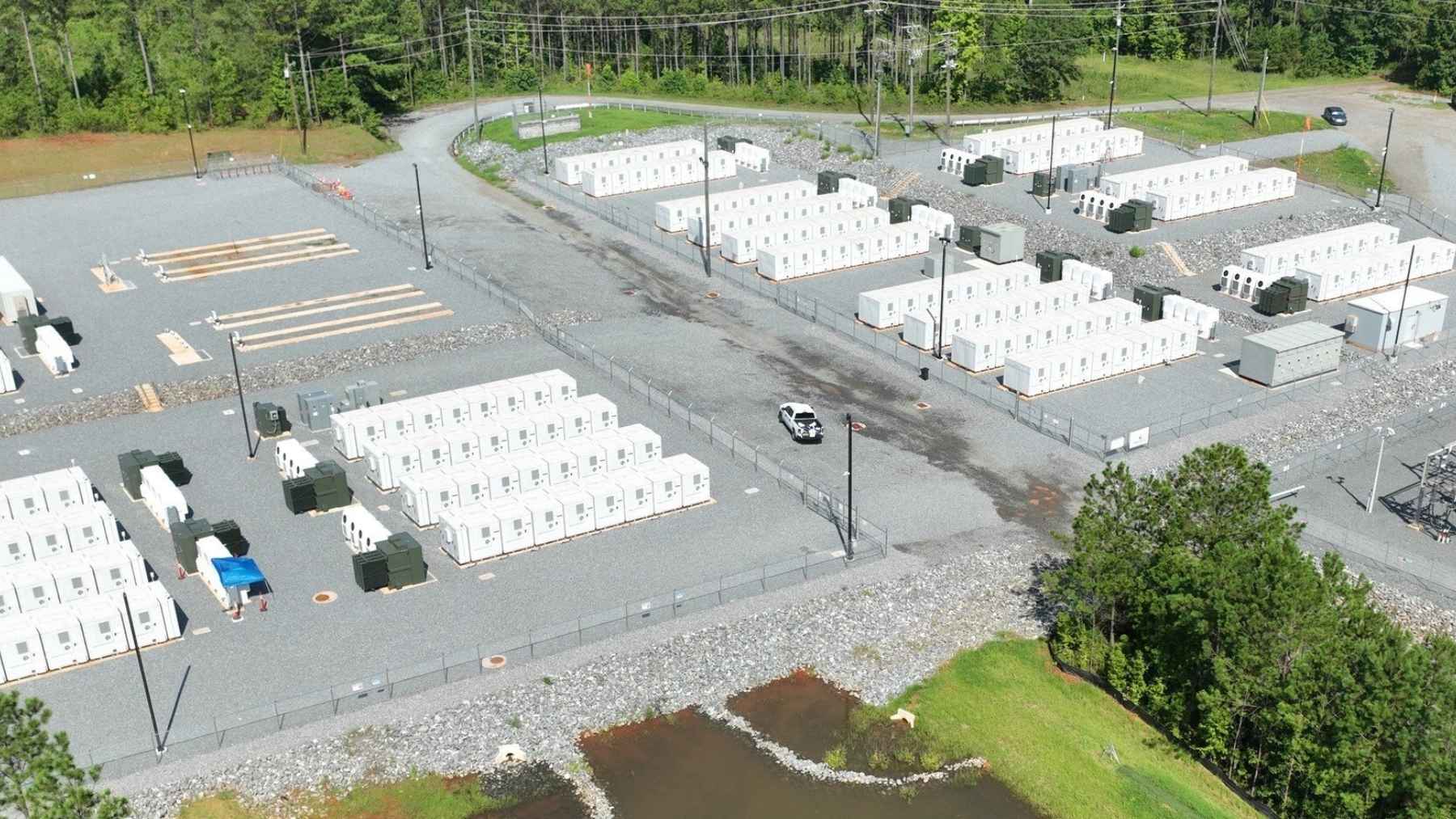
Georgia Power announced on September 15 that the Robins Battery Facility is in commercial operation, after a ceremony with leaders from the base, state lawmakers and Macon-Bibb County Mayor Lester Miller. It’s rated at 128 megawatts and can feed stored power back into the grid for as long as four hours.
If you’re keeping score, that’s the same 128 megawatts as the solar farm. Georgia Power’s release even bundles them together as the “128 MW Robins Solar and Battery Facility.” That’s probably not a coincidence, and it has a lot to do with why the battery ended up there in the first place.
So why park a battery next to solar panels?
The boring answer is plumbing. When Georgia Power announced construction, it said sharing the solar site meant it didn’t have to build a new generator step-up substation, and it could avoid some of the costs and long lead times tied to hooking a new project up to the transmission network.
A step-up substation is basically the big transformer yard that takes a power plant’s output and cranks the voltage way up so it can travel down transmission lines. They’re slow and expensive to build. The solar farm next door already has its connection to the grid. So the battery plugs into infrastructure that’s already there. That’s a pretty sensible bit of recycling, frankly.
It isn’t a one-off either. Georgia Power did it again in Lowndes County, where a 49.5-megawatt battery sits beside the solar farm next to Moody Air Force Base.
What do 128 megawatts for four hours actually get you?
You’ll see two units thrown around with grid batteries, and they measure different things. Megawatts are how hard the battery can push at any one moment, kind of like horsepower. Megawatt-hours are how much energy it holds, which is closer to the size of your gas tank.
Georgia Power only gives the first number and the four hours. Solar Power World did the multiplication and came up with 512 megawatt-hours. Tesla lists its Powerwall 3 home battery at 13.5 kilowatt-hours, so Robins holds roughly as much as 38,000 of them. That’s a lot of boxes on a lot of garage walls.
Still, it’s not exactly a monster. Georgia Power’s McGrau Ford site in Cherokee County comes in at 530 megawatts across two phases, against 128 for Robins. Over in Australia, an 850-megawatt battery just ran full-power tests.
The job is simple enough. According to Georgia Power, the battery soaks up energy when customers aren’t using much and hands it back when demand climbs, and the example the company keeps reaching for is cold winter mornings.
That one might surprise you. You’d probably assume July air conditioning is the grid’s biggest headache in Georgia, and it’s certainly a big one. But on a freezing morning, a lot of heating tends to switch on around the same time, and solar panels aren’t doing much at that hour. If your house heats with electricity, you’re part of that spike.
So does the battery only charge from the panels next door?
I honestly can’t tell you. Georgia Power’s first battery, the 65-megawatt Mossy Branch site near Columbus, is a standalone unit that charges straight from the grid. For Robins, the company only talks about storing renewable energy and pairing the battery with solar, and it hasn’t said whether the batteries ever take power from anywhere else.
It also hasn’t said what chemistry is inside or who made the cells. That’s a bit of a shame, because not every grid battery is lithium these days. There’s one outside Brisbane running on liquid sodium at up to 645 degrees.
The battery was actually done in March
Georgia Power’s release doesn’t mention when construction wrapped up. Macon TV station 41NBC ran a story on the facility on September 10, with Georgia Power executives on camera, and reported that it was finished in March. According to the station, it’s up and running now.
Georgia Power’s target for commercial operation had been June. Rick Anderson, Georgia Power’s senior vice president and senior production officer, told the station the project came in “ahead of schedule,” while the written release settles for saying Burns & McDonnell delivered it on time. I’ll take either. Neither one gives the exact day the battery officially went into commercial operation.
Georgia Power is building a lot more of these
By Georgia Power’s count, its finished battery sites in Cherokee and Lowndes counties add up to 579.5 megawatts. Add Robins and, by my math, you’re at 707.5, or 772.5 if you count Mossy Branch too.
The Georgia Public Service Commission has approved nine more battery facilities on eight sites, worth more than 3,000 megawatts between them. The list includes power plant sites (Bowen, Hammond, McIntosh, Wansley and Yates), plus standalone sites in Hall and McDuffie counties. Georgia Power also has approval for two solar farms with batteries attached in Laurens and Mitchell counties, with 350 megawatts of generating capacity combined.
The utility says it picked those sites partly because they’re close to existing infrastructure and substations. That’s the Robins reasoning all over again.
The 57.5-megawatt battery at the old Plant Hammond site in Floyd County is the next one due. Georgia Power had it down for November when construction started, and on September 15 the company said it’s close to finished.