
- 5 MONTHS AGO · INDUSTRYA 1,200-ton German machine named Mary just started grinding under the Potomac in Washington, boring a 5.5-mile tunnel to stop the 650 million gallons of stormwater and raw sewage that hit the river every time the capital’s Victorian sewers overflow
- 5 MONTHS AGO · INDUSTRYA 135-foot ship with nobody on board just sailed out of San Diego inside a US carrier strike group, a 142-ton trimaran fueled with 14,000 gallons of diesel to run for months without a human touching it — the first drone ship of its kind deployed as a working piece of the formation
- 2 MONTHS AGO · INDUSTRYA 77-inch steel water main was threaded through 2.3 miles of new tunnels under a river, a rail line and two roads in Calgary, and the pipe it replaces stayed pressurized nearby, because it carries 60 percent of the city’s drinking water and has burst twice in two years
- 2 MONTHS AGO · INDUSTRYA million pounds of explosives shook 1.3 million tons of iron ore loose in a Minnesota pit, six times the mine’s first production blast, at a plant that sat half built for a decade, and its pellets are headed for a planned 10-million-ton steel mill in Iowa
- TODAY · THIS ARTICLEA 1.2-million-gallon steel tank at a Washington paper mill had worn to 0.07 inches in places, less than a seventh of its safe minimum, when 900,000 gallons of 200-degree caustic liquid burst out and killed 11 workers, 10 months after an inspection called it unfit for service
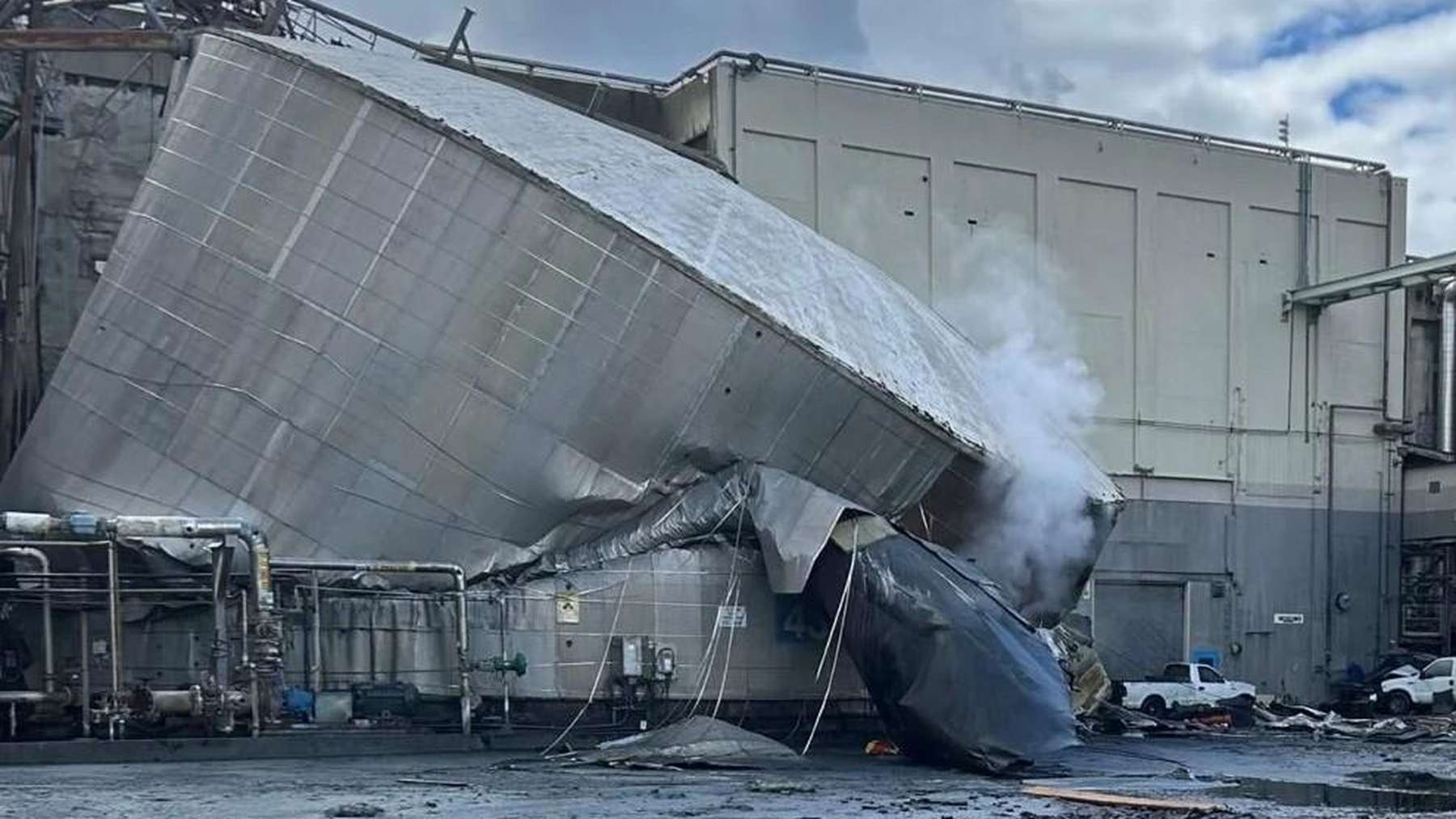
Back in May, a storage tank at a paper mill in Longview, Washington, split open and flooded part of the site with hot, caustic liquid. Eleven workers died and 12 more were hurt. On November 20, Washington’s Department of Labor & Industries (L&I) handed the company that runs the mill, Nippon Dynawave Packaging Co., the results of its six-month investigation into why.
So what did the state find? According to L&I, the tank’s steel wall had worn so thin it couldn’t hold what was inside it, the company had written warnings about that for close to a year, and the tank stayed in service anyway.
The agency cited Nippon Dynawave for 75 violations and $9,177,127 in penalties. L&I says that’s the biggest workplace safety penalty in Washington history, more than three times the old record of $2.9 million that followed the 2010 Tesoro refinery explosion.
L&I’s also referring the case for possible criminal prosecution. A referral isn’t a charge, though. It’ll be up to prosecutors whether anything comes of it.
Nippon Dynawave gets 15 working days from receiving the citation to appeal, and it’s already said it will. The company told Portland TV station KATU that L&I’s description of what it did “failed to include important facts,” and that it’ll take that up through the appeals process.
The G-tank’s wall was down to 0.07 inches
The tank in question was called the G-tank, and it held white liquor. That’s the caustic chemical bath a paper mill uses to cook wood chips down into pulp, and the batch in this tank was kept at around 200 degrees Fahrenheit. The U.S. Chemical Safety Board (CSB) lists the G-tank’s capacity at 1.2 million gallons, and the tank went up in 1986 and 1987.
If you’ve never looked closely at one of these things, a big storage tank isn’t one solid piece of steel. It’s a stack of steel rings, called courses, welded one on top of the other. The G-tank had five, numbered from the bottom up.
The bottom rings are built thicker because liquid pushes outward harder the deeper it gets. It’s the same reason you feel the pressure in your ears at the bottom of the deep end of a pool and not while you’re floating on top.
Course 2, the second ring from the bottom, wasn’t original. A leak turned up in Course 3 in April 2011, and the mill replaced Courses 2 and 3 with new rings that were 7/8 of an inch (0.875 inches) thick. Courses 1 and 4 were swapped out in September 2017. Nippon Paper Industries, the Japanese parent company, had bought the Longview plant in August 2016.
L&I puts the minimum safe thickness for Course 2 at 0.508 inches, a hair over half an inch. In February, ultrasonic testing measured part of that ring at 0.178 inches. After the failure, L&I measured a piece of Course 2 left exposed where the seam ripped open, and it came in at 0.07 inches.
Do the division and that’s less than a seventh of the minimum. If you’re trying to picture it, 0.07 inches is only a little thicker than two credit cards stacked together.
Course 3 wasn’t in great shape either. February’s test found limited areas as thin as 0.270 inches, against a minimum of 0.341. If this kind of slow-motion corrosion sounds a bit familiar, we’ve covered a reactor in Ohio where boric acid ate a football-sized hole through more than 6 inches of steel before anyone caught it.
So why did it fail that morning?
Frankly, the physics here isn’t complicated. A tank with weak walls is in the most danger when it’s full, because that’s when the bottom courses carry the most weight.
According to L&I, the G-tank had been at 60% or more on 181 of the 295 days since August 2025. On May 26, it went a lot higher than that. The mill’s digester, which is basically a giant pressure cooker where the wood chips and white liquor meet, was shut down. At 4 a.m., white liquor stopped flowing out of the G-tank toward it. The CSB says liquor kept coming in, though, and the tank had reached about 90% by 6:22 a.m. L&I says it ended up nearly full, at more than 900,000 gallons.
At that level, L&I found the pressure on the lower courses was more than double what they could handle. Its investigators say that’s what made an overstress failure inevitable.
The G-tank failed at 7:08:48 a.m. Roughly 900,000 gallons of white liquor flooded the courtyard, the electrical maintenance shop and the machine maintenance shop. The CSB says employees had gathered in that courtyard and the nearby buildings for morning meetings.
There’s one detail in L&I’s timeline I’ve had a hard time getting past. An engineer was booked to meet with the mill early that same morning to go over the G-tank’s thickness calculations.
The response gets its own section in the report. The first internal radio call for help went out at 7:14 a.m., and the company’s communications center called 911 at 7:18. First responders reached the main gate at 7:25, and the first hazmat vehicle showed up at 8:00.
Incident command is basically the system that decides who’s in charge and who goes where during an emergency. L&I says the first effective one came from the outside agencies once they arrived, and that the failures in the response contributed to serious injuries for four of the 12 injured workers.
The first warning came 10 months earlier
In July 2025, inspectors Nippon Dynawave had hired ran exterior ultrasonic tests on the G-tank. That’s a way of measuring steel thickness from the outside by bouncing sound waves through it, a bit like sonar for metal. The readings came back well below the minimums set by API 653, the American Petroleum Institute’s standard for inspecting aboveground storage tanks. L&I notes that Nippon’s own internal procedures cite API 653 too.
According to L&I’s report, the inspection company’s write-up said the tank was “not fit for continued service unless corrected. High likelihood/consequence of failure.”
That’s about as blunt as an inspection report gets, as far as I can tell.
Management confirmed it got that report in August 2025, and that’s when L&I starts its clock.
In September, a process manager emailed colleagues that the results didn’t look good and asked whether the tank should be pulled for repairs or kept running at a lower volume.
A second round of testing in October confirmed the July results, with nearly all of Course 2 and most of Course 3 under the minimum. In November, Nippon talked about checking the wall thickness every month. L&I says those monthly checks didn’t happen, and the next test was the third ultrasonic round in February, which found the corrosion had sped up.
Late in 2025, managers asked Nippon Paper Industries to put a G-tank replacement in the 2026 capital budget. Then in April, the Longview plant was told to cut capital spending, and it picked other projects.
Budget cuts happen at every plant. Still, it’s pretty unusual for a tank the company’s own inspectors had flagged as a high failure risk to lose out in one, at least if L&I’s account holds up on appeal.
L&I Director Joel Sacks put it this way in the agency’s announcement: “Nippon Dynawave had all the information they needed to act.”
Why 43 violations for one tank?
L&I counted one violation for every week the G-tank stayed in operation after the company received that July 2025 report. That works out to 43 of them, each classified as egregious willful serious, and the citation prices each one at $165,514. Here’s how the full $9,177,127 breaks down, according to L&I:
- Keeping the G-tank in operation: 43 egregious willful serious violations, $7,117,102
- Skipping required internal inspections on the G-tank and 13 other tanks: 14 egregious willful serious violations, $1,048,740
- Incident command failures: 4 egregious willful serious violations, $299,640
- Missing fitness-for-service tests on three other tanks: 3 egregious willful serious violations, $224,730
- Willful serious: 6 violations, $449,460
- Serious: 5 violations, $37,455
L&I says egregious willful serious and willful serious are the two most severe classifications under the state’s workplace safety laws. Again, those are the agency’s findings, and the company’s contesting how L&I characterized its actions. The money goes into the workers’ compensation supplemental pension fund, which supports injured workers and the families of people killed on the job.
Washington’s Department of Ecology has its own case against the mill, with a $296,500 penalty for environmental violations plus $665,000 to recover what the state spent on the emergency response.
We’re not done hearing about this mill, either. L&I has two more inspections open at Nippon’s Longview site. One opened June 12 over hazards unrelated to the tank failure, and the other opened July 1 after a worker on a forklift moving a tote of sulfuric acid ended up in the hospital.
The agency’s also opened inspections at Washington’s other two kraft mills, Port Townsend Paper Co. in Port Townsend and Smurfit Westrock in Longview, plus the state’s seven non-kraft mills. Those results aren’t due until February 2027.
The CSB’s federal investigation is still going, and I couldn’t find a date for its final report. I haven’t seen the G-tank’s height or diameter in anything either agency has published, so I can’t tell you how tall that column of liquor was when it gave way.
The next deadline is close, though. L&I has to issue its citation from the June 12 inspection at the Longview mill by December 9.
 A 7-mile railroad laid along the sand in Southern California washed out again when a king tide just under 8 feet met breaking waves of 6 to 9 feet, three days after Orange County’s transit agency approved a 30-year plan to keep the tracks on the beachIndustry · 3 hours ago
 A 40-foot drone boat ran 38 days and more than 4,600 miles without stopping, refueling or anyone touching it, 230 miles out in the Gulf, holding 4.5 knots through gales and 12-foot seas while it dropped eight drifters into the Loop CurrentIndustry · 23 hours ago
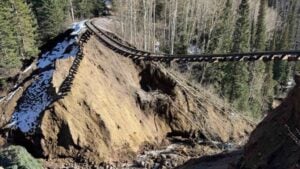 A 146-year-old narrow-gauge railroad in the Rockies is cut in two places, with 50 feet of track hanging in the air and an 80-foot-deep washout, and crews need more than $5 million and have until Memorial Day to rebuild the grade before its steam trains can run againIndustry · 1 day ago