
Solar panels do one thing: they turn sunlight into electricity. You know it, I know it, and it’s why every warehouse roof in America is slowly filling up with them. But electricity isn’t what most industrial sites actually spend their energy on. It’s heat. And in Belgium’s Port of Antwerp, there’s a solar plant that skips the electricity part entirely.
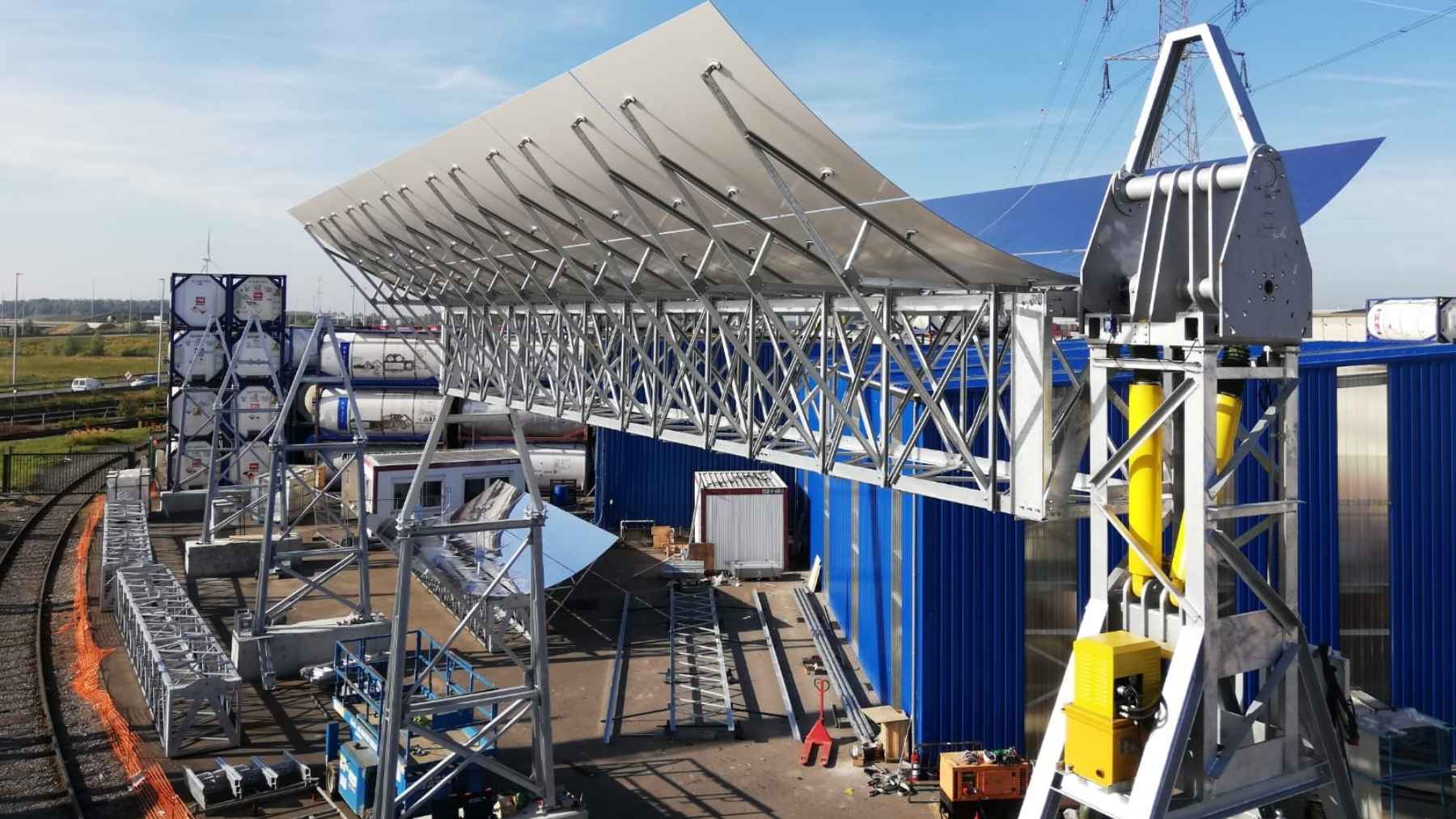
The plant belongs to ADPO, a chemical storage terminal in Kallo that runs more than 300 tanks, and it was built by Azteq, a Belgian solar heat company, as one of a handful of pilots backed by the Flemish government. It sits in what might be the least convenient spot in the whole port: on a steel frame directly above a working railroad track. Trains pass underneath it while it runs.
So why would anyone put a solar plant on stilts over live train tracks?
Because there was nowhere else to put it. Land is scarce in Flanders and scarcer in the port, and by Azteq’s own account it took a while to find any spot at all. The one that turned up was above the railroad, underneath a high-voltage power line, alongside a high-pressure gas pipeline, and on ground that only exists because dredged sand was pumped in to build it up, which is basically every constraint you don’t want on a construction site stacked onto one lot.
So what’s holding all this up?
Quite a lot of steel and concrete. According to Azteq’s project page, the company drove piles 66 feet long into that built-up ground and reinforced them with concrete foundations weighing 8.8 tons apiece, around 17,600 pounds each. On top of the piles went a steel frame tall enough for trains to pass safely below, and on top of the frame went the solar collectors themselves, with the mirrors reaching more than 36 feet above the ground at their highest point.
Even getting the hardware up there was a headache. A standard crane wasn’t allowed because of the safety rules covering the tracks and the overhead power line, so Azteq says it designed a special lifting rig just to set the collectors in place. The company also brought in specialized engineering firms to work out the wind load before anything went up. The build itself, once it finally started, took about two months.
Since then the structure has taken gusts of almost 75 mph and a few hailstorms without damage, according to the same page. That’s a pretty decent stress test for a mirror field on stilts, though every one of these figures comes from the builder, and I can’t find an independent engineering report that certifies any of them.
Why mirrors instead of solar panels?
Because ADPO doesn’t need electricity from this thing. It needs heat. The terminal stores liquid chemicals, and some of those products have to be held at temperatures above 284 degrees Fahrenheit or they thicken, set up, or drift out of spec. Steam also handles the tank cleaning. For years the terminal made that steam the way pretty much everyone does: by burning natural gas.
The mirror trick works like this. Curved mirrors track the sun through the day and focus its light onto a tube running along each mirror’s focal line, and the oil inside that tube gets hot. That hot oil then runs through a heat exchanger, which uses it to boil water into steam. That’s the whole system. You won’t find a turbine or a generator anywhere in it, and the plant has never produced a watt of electricity, because it was never designed to.
The steam comes off at 145 psi and gets knocked down to 58 psi before it’s used around the terminal, per ADPO. The operator puts the output at around 500 megawatt-hours of heat a year, roughly what it used to get from gas, and that’s an operating figure the company publishes rather than a metered study, so I’d treat it as an estimate. The Port of Antwerp, for its part, billed the plant at its opening as the first concentrated solar thermal installation in Europe’s process industry.
Each mirror segment is roughly 16 feet long, and they’re installed in lines of 120. How much mirror is up there in total depends on who you ask. Azteq’s page says about 11,800 square feet of collectors, while ADPO’s own report puts it closer to 10,800, and frankly I can’t tell you which figure is right. Neither one changes what the thing does all day.
Concentrating sunlight for heat instead of power is an old idea, and at utility scale it’s a fairly common one. It’s the same basic trick behind the tower ringed by desert mirrors in New Mexico, where the target is molten salt instead of oil, and the wider business of making industrial heat without gas has gotten crowded lately, right down to bricks baked to 1,832 degrees for oil-field steam. What makes the Belgian version odd is purely the real estate. Most mirror fields get a desert to sprawl across. This one got a train schedule.
The mirrors are still up there
Azteq claims the platform will keep delivering that heat, without emissions, for 20 years. That’s a builder’s brochure number, and I’d apply the usual salt. The early years are holding up, though.
ADPO put out its 2025 sustainability report in August 2026, and the mirrors are in it, photographed, still standing over the tracks and still turning sunlight into 145-psi steam.