
The Jones Act is one of those laws plenty of Americans have never read and still hold firm opinions about. Passed in 1920, it says that cargo moving between two U.S. points has to travel on a ship built here, flagged here, owned here and crewed here.
For a century that was mostly an argument about fuel barges and Puerto Rico. Then somebody tried to plant a wind turbine in the Atlantic, and it turned into a shipbuilding problem.
There was no American ship that could do the job. Not one. Every foundation and every turbine installed in U.S. waters until recently went in from a foreign vessel, fed by American tugs and barges shuttling parts out to it in open water.
So Dominion Energy had one built in Brownsville, Texas, and named it Charybdis, after the whirlpool that swallows ships in the Odyssey. It cost $715 million and took five years.
On January 27 it set the first 14.7-megawatt Siemens Gamesa generator onto its foundation 27 nautical miles off Virginia Beach. On July 31, Dominion told analysts it had 31 turbines standing, the 32nd going up, and that the last of 176 would not be installed until the end of 2027.
The law came first, the ship came second
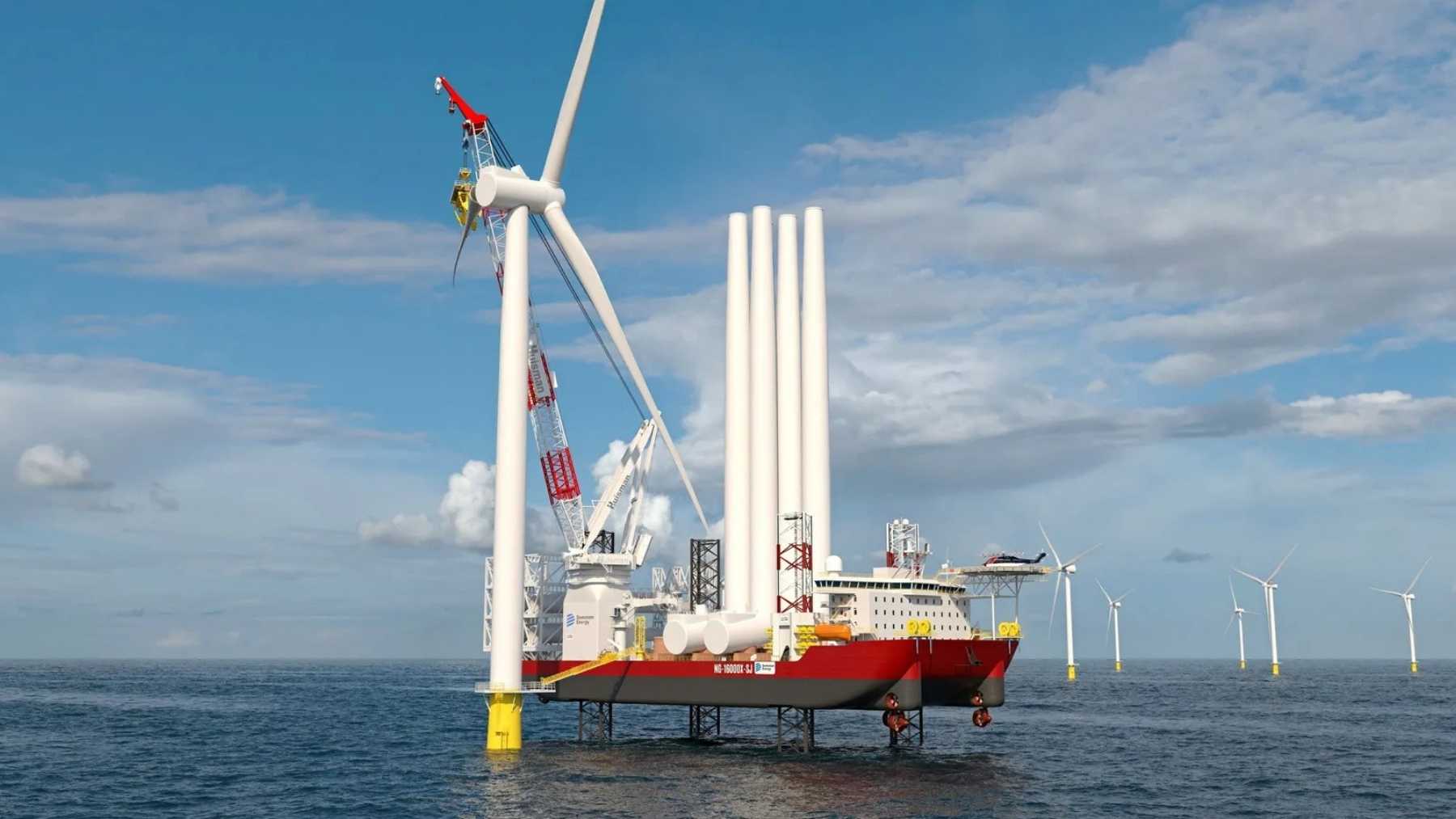
A wind turbine installation vessel is a strange animal. It sails to a spot, drops four legs to the seabed, lifts its own hull clear of the water on those legs, and turns into a stable platform with a crane on it.
The crane then stacks a tower, a nacelle and three blades onto a steel foundation already driven into the bottom. Then the ship lowers itself, pulls the legs, and moves to the next one.
The world has a small fleet of these, and none of them were American. Under the Jones Act, a foreign ship can still install the parts, but it cannot be the thing that carries them out from a U.S. port. That is why American projects ended up with feeder barges: a foreign jack-up parks at the turbine site, and U.S. tugs and barges bring the components to it, piece by piece, transferring them at sea.
It works. It also means transferring parts between two vessels in a swell, and these are not small parts. The turbines at this wind farm spin a 728-foot rotor, which puts each blade well over 300 feet of composite.
Dominion ran into the problem on its own two-turbine pilot off Virginia years ago and solved it by ferrying components back and forth from Canada, because a Canadian port is a foreign point and the Jones Act does not apply to it.
Building the ship instead was the expensive fix. Jones Act attorney Charlie Papavizas told Spectrum News in 2023 that a new installation vessel would run about $800 million from an American yard against roughly $400 million from a Singaporean one, and that a foreign-built ship can then go work anywhere on earth rather than waiting on U.S. orders.
Brownsville built the hull, the clever parts came from elsewhere
Charybdis is 472 feet long and 184 feet wide, with berths for 119 people and a helideck rated for an S-92. It carries four complete turbines per trip out of Portsmouth Marine Terminal, holds position on a DP-2 system, and moves at up to 10 knots on four fixed stern thrusters and three retractable ones up front.
The steel is domestic and the crew is American. The design is not. The hull came off a GustoMSC drawing, and the crane is a Huisman leg-encircling unit, both Dutch outfits, and the crane itself was contracted to Huisman in 2020 and shipped in from China on a heavy-lift vessel.
That is not a gotcha. It is what “first of its kind” looks like in practice when the domestic supply chain for a category does not exist yet. The yard had to learn to build a ship it had never built, to a rulebook nobody had applied to this type of vessel before.
Everybody runs into this. Britain spent around £900 million on a Teesside factory built specifically to roll the foundations for its biggest wind farm, and the tubes ended up arriving from Bilbao and from China instead.
The bill reflected it. The order was placed in 2020 at about $500 million, moved to $625 million, and landed at $715 million. At peak, more than 1,200 people were working on it. The finished hull weighed 23,163 metric tons when it was rolled onto three barges and launched in April 2024.
The other machine doing heavy work at this wind farm has a similar passport problem. The 5,000-ton Liebherr crane that drove all 176 foundations into the seabed sits on a Belgian-owned vessel, and we wrote about that crane last week as it started the same job off Germany.
Thirty-one turbines up, two days apiece
The first production turbine went up on January 27, eleven days after a federal judge let the project restart.
Some background there. On December 22, 2025, the Bureau of Ocean Energy Management ordered a 90-day suspension of work on five East Coast offshore wind projects under construction, citing national security. Dominion sued the next day, and on January 16 the U.S. District Court for the Eastern District of Virginia granted a preliminary injunction letting construction continue while the case proceeds. Dominion had told the court it was losing about $5 million a day sitting still.
Charybdis went back to work, and the numbers since then are the most interesting part of this story. The first commercial turbine started sending power in March. By the end of July, 31 were standing and more than 450 megawatts were on the grid, out of an eventual 2.6 gigawatts.
The install rate has settled at about two days per turbine, measured from the moment the ship jacks up to the moment it sails off, averaged across the last 26 machines. Dominion says that figure has held steady, which for a vessel type nobody in the United States had ever operated is the single most encouraging number in the file.
The ship built to take risk out of the schedule became the schedule
Charybdis was late before it ever lifted anything. It arrived in Portsmouth in September 2025 after sea trials and then sat through months of inspection, with around 200 quality-assurance punch-list items to close out, most of them tied to the electrical system and to paperwork proving the systems met U.S. codes.
Robert Blue, Dominion Energy’s chair, president and chief executive, was blunt about it on the October 2025 earnings call, telling analysts “we failed to deliver regarding Charybdis” and adding that the company had not properly priced the risk of being first to build and regulate a vessel like this in the United States.
That lost contingency never came back. On July 31 the company pushed the final turbine out to the end of 2027, a six-month slip, and raised the project budget about 2% to $11.65 billion. The increase breaks down as $288 million for the two extra quarters and $228 million in tariffs, offset by a $502 million cut in grid upgrade costs.
Dominion was careful to say the base install rate has not changed. What changed is everything around it: more allowance for weather, more for vessel maintenance, longer loadouts at Portsmouth than expected, and longer jacking times at the remaining sites, where the seabed is less cooperative.
Run the arithmetic and you can see the cushion. Dominion counts 144 turbines left and 519 days to do them in. That is one turbine every 3.6 days against a demonstrated rate of two, so a little over half the remaining calendar is now buffer.
Blue’s framing on the August call was that “the strategic value of CVOW hasn’t changed”, and on the numbers he has a point: each turbine earns as soon as it is switched on, so the project has been paying its way since March rather than waiting on a ribbon cutting.
After Virginia, Charybdis has nowhere obvious to go
The original plan had this ship working the whole East Coast. Its first contract was with Ørsted and Eversource for Revolution Wind and Sunrise Wind, out of New London, Connecticut. Ørsted cancelled that charter in 2024, and both projects went ahead without it.
The market it was supposed to serve has thinned since. The administration suspended new federal offshore wind leasing on its first day in office in January 2025, and in March the Interior Department announced an agreement to reimburse TotalEnergies roughly $1 billion to give up two U.S. leases and put the money into oil and gas instead.
Dominion has already adjusted to that. In its February 2026 update the company lowered the future day-rate assumptions it uses for Charybdis, which is a quiet way of saying the charter market for America’s only Jones Act turbine ship is worth less than it was when the keel was laid.
None of that changes what the vessel is. It will be homeported in Hampton Roads with an American crew, and the licensed officers aboard belong to the American Maritime Officers union, which has been treating the ship as a milestone for the U.S.-flag fleet since January.
Britain has no cabotage rule like this one, so its developers hire from the whole European installation fleet and never had to build anything to get started. We looked at how differently that plays out when the first phase of the world’s largest wind farm topped out in the North Sea.
The uncomfortable part is the count. One ship exists. It is doing 176 turbines by itself, and no second American WTIV has been ordered. If a future developer wants Jones Act installation on the U.S. shelf, there is exactly one phone number to call, and it belongs to a utility in Richmond that will be using the ship itself until late 2027.
The first American turbine ship worked. Whether anyone builds the second one is a question about orders, not engineering, and right now the order book is empty.