
Minehunting has an awkward requirement built into the job description: to find a mine, somebody has to go where the mines are. Germany’s answer for the past three decades has been a fleet of small boats made of non-magnetic steel, creeping along on electric motors so a bottom mine has as little as possible to hear or feel. The boats work. The arrangement still puts 40-odd people on top of a suspected minefield.
So the German Navy is changing who goes in first. Under a contract worth 52.5 million euros ($55.6 million, according to Janes), it bought four SeaCat MK1 underwater drones from Atlas Elektronik, the Bremen sonar house inside the TKMS shipbuilding group, and the paperwork gave the whole program a hard finish line: everything delivered, integrated and ready by the middle of 2026. In other years that deadline would have passed quietly. This year, the boats these drones were bought for sailed toward an actual minefield.
The whole design starts with one number: 324 millimeters
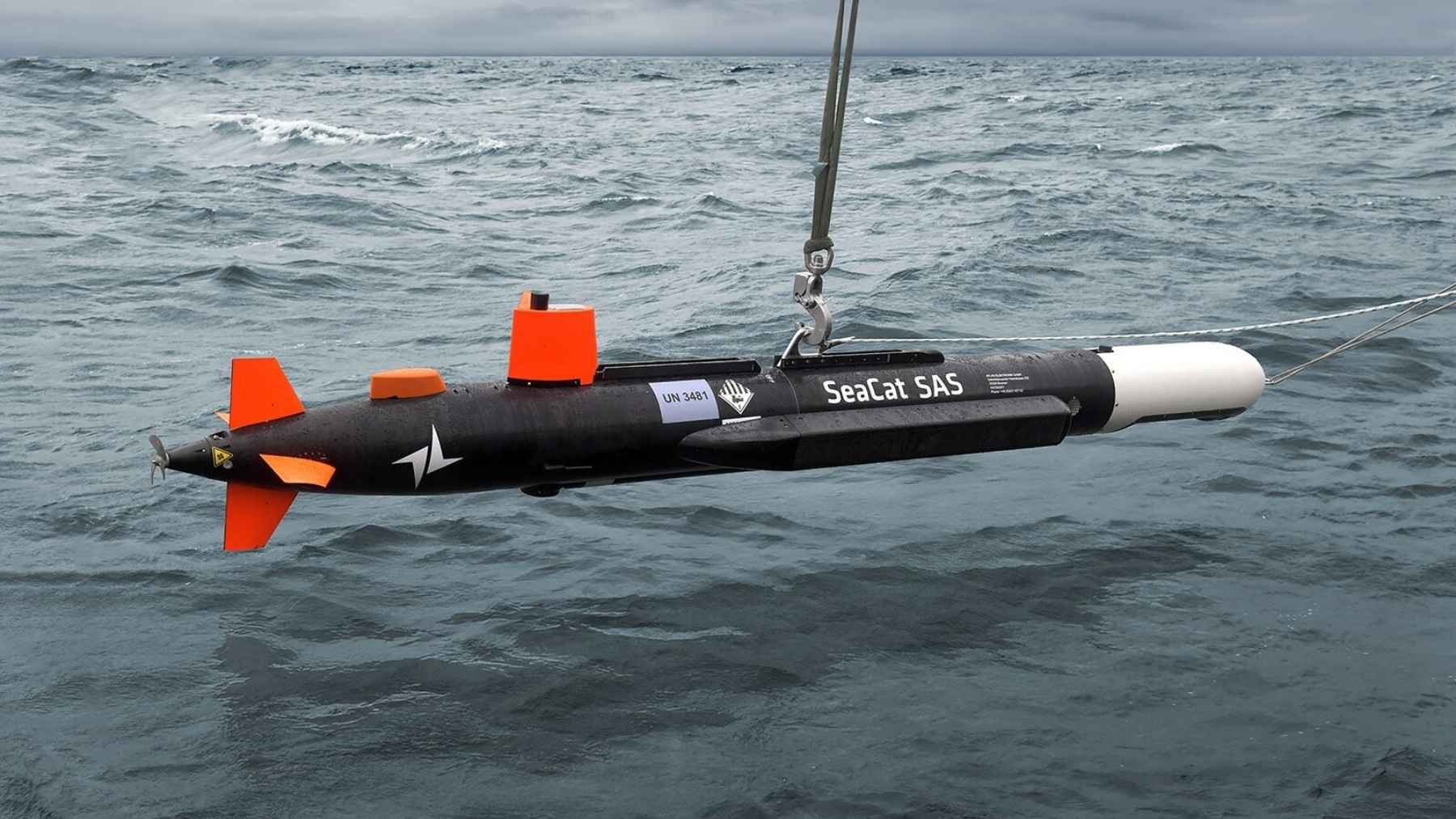
The SeaCat is a torpedo-shaped machine 3.0 to 4.5 meters long, which is roughly the range between a big kayak and a compact car. Diameter: 324 millimeters, or 12.75 inches. Weight: 200 to 350 kilograms, or 440 to 770 pounds, depending on how it’s configured. Those numbers come straight from the TKMS datasheet.
If 12.75 inches sounds oddly specific, it is. That figure is the NATO standard caliber for lightweight torpedoes. The MU90 that German frigates carry measures 323.7 millimeters across and weighs 304 kilograms; the American Mk 54 is 324 millimeters and 276 kilograms. The SeaCat sits in exactly that size and weight bracket, so a navy that already stores, moves and launches lightweight torpedoes is handling a shape it has known for 50 years. Same shelf, different job.
The job is looking, not exploding. The vehicle tows nothing and carries no warhead. Its nose section is the interesting part: Atlas built it around a swappable head, so crews can pull off a sidescan sonar and bolt on a synthetic aperture sonar, a multi-beam echosounder, a sub-bottom profiler or a camera package depending on the mission. TKMS rates the hull to 600 meters, close to 2,000 feet, with endurance from seven hours to more than a full day and a typical working speed of 3 to 4 knots. That is a brisk walking pace, held underwater, for 24 hours straight.
It runs in three modes. On the surface, an operator can steer it over WiFi. For close inspection work it trails a fiber-optic cable up to 1,000 meters long and behaves like a tethered inspection drone, sending live video and sonar back to the boat. And for the main event, survey runs, it goes fully autonomous: it gets a search box, disappears, flies its pattern on inertial navigation, and processes the sonar data onboard while the mission is still running. One more detail from the spec sheet that defense buyers notice: TKMS registers the SeaCat as a dual-use good, exempt from US ITAR export restrictions, which is part of why it keeps showing up in navies beyond Germany.
Germany bought four, and the deadline was the middle of this year
The framework agreement was signed on October 20, 2023, by the president of Germany’s BAAINBw procurement office, and the Bundeswehr’s own announcement laid out an unusually concrete schedule. First drone by the end of 2024. System acceptance on the first boat in spring 2025. And by mid-2026, the full package in the fleet’s hands: four drones, transport and storage containers, spare parts, documentation, and a rebuilt training and testing facility in Kiel. German defense outlet ESuT reported in February that the type has been entering service since 2025, and describes it as the Navy’s step from remote-controlled underwater vehicles toward genuinely autonomous ones.
The mission profile Germany bought is reconnaissance, and the Bundeswehr is specific about what that means. The drones are unarmed. They carry high-resolution synthetic aperture sonar and search the seabed for mine-like objects at depths down to 300 meters, which covers the Baltic operating areas these boats live in. And according to the manufacturer’s figures quoted by the Bundeswehr, one boat working with the drones covers three times the search area of the same boat hunting alone. That last number is the entire business case in one line.
The contract is also built to grow. It’s a blanket agreement, so additional drones can be ordered at short notice, and German procurement reporting has the requirement at five systems, with five of the class being fitted to operate them, wired into the Atlas IMCMS combat system the boats already run. Running costs are listed at around 100,000 euros per system per year. For the shipbuilding group behind all this, the SeaCat is a rounding error next to the Canadian submarine order TKMS landed this year, up to 12 crewed boats. It’s the small product that changes how the existing fleet works, rather than the giant one that builds a new fleet.
The boat it rides on was built to be invisible to a mine
The Frankenthal class, Type 332 in German service, is one of the odder warship designs still working. The boats are 54.4 meters long, about 178 feet, displace around 650 tons, and their hulls are welded from non-magnetic steel, because a magnetic mine is listening for exactly the signature an ordinary steel hull throws off. For the final approach to a suspected contact they shut down the diesels and creep in on electric motors. Everything about them is an exercise in not being noticed by an object with no eyes. Japan wrestles with the same physics, which is why its steel frigates send a drone ahead to do the listening too.
Ten of the boats remain in German service, commissioned between 1992 and 1998 and based in Kiel. Over the years they’ve accumulated a small zoo of uncrewed helpers. The Seehund surface drones, up to four per boat, are remote-controlled vehicles that fake the magnetic and acoustic signature of a full-size ship until a mine takes the bait. The SeaFox handles the other end: a fiber-optic-guided drone about four feet long whose combat version carries a 1.4-kilogram shaped charge to the mine and does not come back.
The SeaCat slots in as the eyes of that operation. It maps, the crew reads the map, and the expendable hardware gets sent to whatever looks wrong. The division of labor is blunt: the cheap drone dies, the expensive drone comes home with the data, and the 650-ton boat with people aboard stays as far from both as the geometry allows.
Then an actual minefield showed up
For most of this program’s life, the operating assumption was the Baltic: old ordnance, training areas, alliance patrols. Then Iran mined the Strait of Hormuz during this spring’s war, and mine countermeasures went from a specialist backwater to the thing shipping insurers were publicly begging for. On June 18, German Defence Minister Boris Pistorius told reporters the minehunter Fulda and the supply ship Mosel were sailing through the Suez Canal toward the Red Sea, positioned for a possible clearance mission. In early July, The National reported that more than ten European NATO members, Germany among them, had committed ships and minehunters to a UK- and France-led effort to reopen the strait, the same waters where the US Navy’s Knifefish drone has been hunting buried mines.
The Fulda is a Frankenthal-class boat, commissioned in 1998. When the Bundeswehr published its own write-up on the boat waiting for the Hormuz call this May, it walked through the familiar toolkit, Seehund, SeaFox, and then flagged the new item: the SeaCat, described as brand new, notable for running for hours at a time with no cable back to the boat.
Which is the quiet punchline of the whole program. Germany spent three decades building boats that could survive being near a mine. It spent 52.5 million euros so that, more and more, they don’t have to be. The boat turns 28 this year; the thing swimming ahead of it is the part nobody had when it was launched.
 @negarosenberg ROOKIE2 months ago