
Breakwaters are pretty unglamorous as far as infrastructure goes. They’re basically long piles of rock and concrete that stick out into the sea and take a pounding so the ships behind them don’t have to. In the US, one guarding a river mouth would probably get called a jetty, and most people only notice it when they’re fishing off the end.
Every so often, though, the boring stuff gets its moment. Last week it was a Norfolk museum nudging a battleship four feet off her pier to swap two rubber fenders. Now it’s a breakwater in northeast England.
On September 16, PD Ports, which runs Teesport and is legally responsible for keeping the River Tees entrance safe for ships, said work has started on South Gare, the breakwater that guards the river mouth. The first phase calls for around 15,000 metric tons of Norwegian granite (about 16,500 tons), and a barge is putting it in place one rock at a time.
Those aren’t small rocks, either. Each one is about 8 feet (2.5 meters) across and weighs up to 33 tons (30 metric tons), according to PD Ports, and most of them will end up below the waterline where you’ll never see them.
South Gare has been taking a beating
PD Ports says the breakwater is more than 150 years old. Local histories say it was built largely out of blast furnace slag, the leftovers from Teesside’s iron industry, which the ironworks reportedly paid to have hauled away. So a big chunk of what’s held back the North Sea all this time is recycled industrial waste. That’s kind of impressive, when you think about it.
If the name rings a bell, South Gare turned up here recently as one of the beaches where blue rubber cleaning balls from a power station kept washing ashore. This problem is a lot heavier.
Storm Babet did real damage to the structure in 2023. PD Ports said at the time that concrete slabs of up to 50 metric tons (about 55 tons) were “tossed about like pebbles,” and the last of the repairs from that storm wrapped up earlier this year. The company expects more storms like Babet in the years ahead, and that’s what all this granite is for.
So if a storm can shove 55-ton slabs around, what good is a 33-ton rock?
Rock piles are better at this than you’d think
It’s a fair question, and the answer is mostly about where the rock sits. A wave that slams into a solid face dumps its energy into it all at once. Put a sloped pile of big rocks in front of that face, and the wave has to run up over them, break and drain back through the gaps. It loses a lot of its punch along the way. That’s why the new granite is going in at the foot of the breakwater, out where the waves hit first.
Mark Pearson, PD Ports’ director of project engineering, summed it up as “taking energy out of the water” before it gets to the structure, which in turn means less pressure on the old breakwater.
Weight still matters, of course. Decades ago, the US Army Corps of Engineers worked out a formula for sizing this kind of rock (the Hudson formula, if you want to look it up), and engineers still use it as a starting point. Basically, the rock you need grows with the cube of the wave height, so if you double the design wave, you need a rock roughly eight times as heavy. The formula also has a fudge factor for how well the pieces lock together, and that’s a big reason placement matters so much.
Density helps too. A denser rock keeps more of its weight once it’s underwater, which is presumably why the port operator went out of its way to call this high-density granite.
There’s a 1:50 model behind the layout
Formulas only get you so far, though. They don’t know anything about the real seabed off the Tees or the shape of a breakwater that’s been patched and battered for generations. So PD Ports had the design tested at HR Wallingford, an engineering research outfit in Oxfordshire with some very large indoor wave tanks, on a model built at 1:50 scale.
According to PD Ports, the model went through simulated conditions from a one-in-200-year storm, including a wave 30.2 feet (9.2 meters) high. The company likened that to a stack of three double-decker buses, which is a little generous, since a double-decker stands just over 14 feet tall and two would get you closer. If you don’t ride those much, think of a three-story building.
A one-in-200-year storm doesn’t mean one shows up every two centuries, by the way. It means there’s roughly a 0.5% chance of one in any given year. Stretch that over the 150 years the port operator wants out of this breakwater, and by my math the odds of it seeing at least one come out a bit better than a coin flip. That’s before you factor in the company’s own expectation that big storms will get more frequent.
I ran the numbers on the model too, because I couldn’t help myself. At 1:50, an 8-foot rock shrinks to about 2 inches across, a bit bigger than a golf ball, and that 30-foot wave comes out at a little over 7 inches. So somewhere in Oxfordshire, engineers spent a good while watching tiny waves roll over golf balls to work out where the real boulders should go. It sounds silly. It’s also a lot cheaper than learning the same lesson in the North Sea.
PD Ports hasn’t published the test results. So I can’t tell you how many storms the model sat through or whether any rock shifted in the tank. And whatever happened in there, the real breakwater still has to get through real winters. Still, the tank testing is arguably the most interesting piece of this whole project, and a pretty sensible thing to do before anyone starts setting giant rocks in the sea.
Most of the work will be underwater
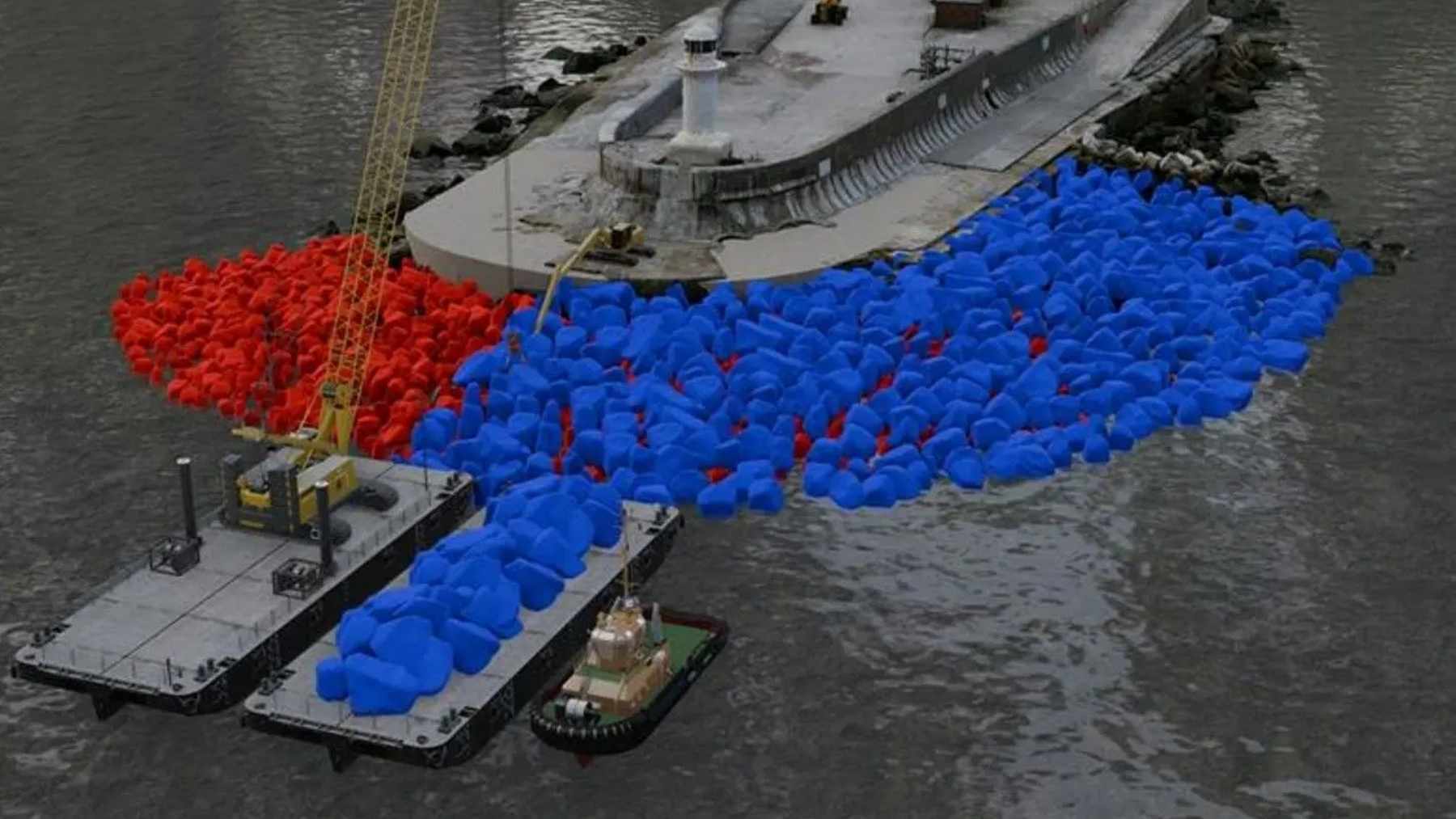
Contractors McLaughlin & Harvey and Herbosch-Kiere are handling the placing, working from a specialist installation barge. PD Ports says each rock gets positioned individually, mostly below the waterline, in a pattern the engineers worked out ahead of time. Photos the company released show individual rocks being loaded onto the barge, though I haven’t seen it say exactly what’s doing the lifting.
The company hasn’t said how many rocks the first phase adds up to, either. If every one were a 33-tonner, you’d need about 500 of them, and since 33 tons is the top of the range, the real count should be higher. Setting hundreds of boulders exactly where they’re supposed to go, underwater, in a spot you’ll never see, is frankly a pretty thankless job.
The company also released renderings showing both phases in bright red and bright blue, then felt the need to point out that the real rocks will be rock-colored. I’m glad someone cleared that up.
The bigger half comes next summer
The 16,500 tons going in now are only phase one. PD Ports plans to add another 40,000 metric tons (about 44,000 tons) next summer. CEO Paul Foreman says it’s the biggest job anyone’s done on South Gare since it went up.
PD Ports hasn’t put a price on any of this beyond calling it a multi-million-pound project (and yes, that’s pounds as in money). The company also says it designed the upgrade with the aim of keeping South Gare on the job for another 150 years. I’d treat that as an ambition rather than a warranty, and to be fair, that’s pretty much how the company words it.
If the company’s renderings are anything to go by, the barge has September and October to get the first 16,500 tons in, and the other 44,000 tons are penciled in for summer 2027.