
Anyone who’s tried to hang a shelf on a brick wall with a hardware-store drill knows the moment. The bit stops biting, starts squealing, and you’re basically polishing the brick while the drill gets hot in your hand. Now imagine the bit is 12¼ inches across, it’s hanging off the end of 2,000 feet of steel pipe, there’s a river sitting on top of it, and the brick is limestone that tests at up to 25,000 psi.
That’s roughly the job a Minnesota drilling contractor took on in Grundy County, Illinois, about 60 miles southwest of Chicago. The company, North Country Directional Drilling, had to get a 20-inch steel natural gas line under the Illinois River without digging a trench across it. The only way to do that was to bore a 2,204-foot hole under the riverbed and drag the pipe through.
Its president, Josh Ugrich, wrote the crossing up for the September issue of Trenchless Technology, the trade magazine for people who put pipe in the ground without opening the ground, and the piece went online on October 5. I’ve read it a couple of times now, and the interesting thing isn’t the length of the hole. It’s that the crew drilled it from one bank, then packed up a 600,000-pound rig and hauled it across the river to finish from the other one.
So why is there a gas line under the Illinois River at all?
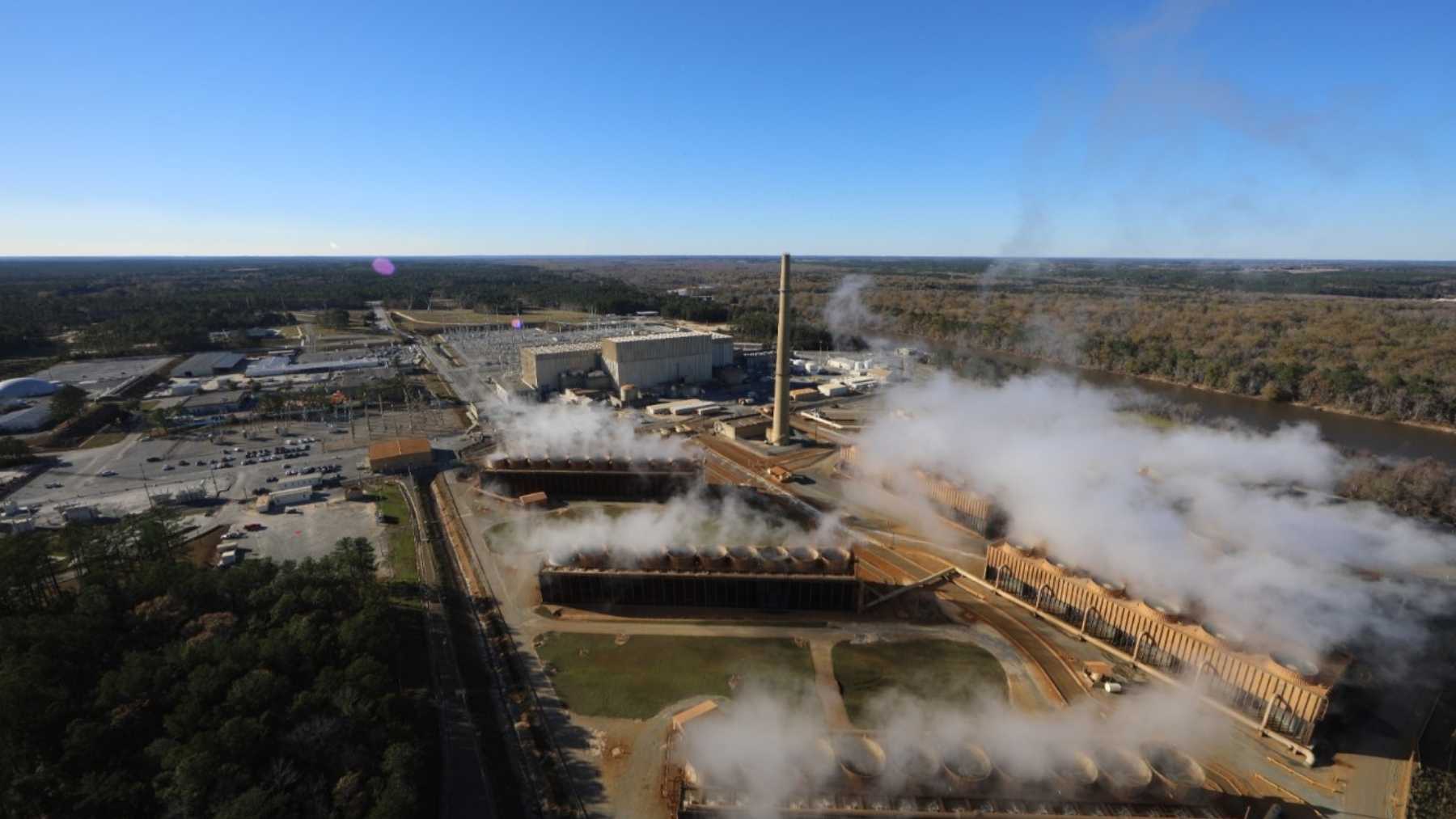
The pipe is the Three Rivers Interconnection, a spur of about 2.9 miles that Alliance Pipeline built off its 36-inch mainline to feed the CPV Three Rivers Energy Center, a 1,250-megawatt gas-fired power plant a couple of miles south of the river near Morris. The plant’s been up and running for a few years now, and according to FERC’s filings it can power roughly 1.25 million homes. It already had a 36-inch Kinder Morgan line crossing its site. The Alliance spur gives it a second supply, up to 210 million cubic feet of gas a day, which is the kind of backup you want when a plant that size is the thing keeping the lights on.
Between Alliance’s mainline and the plant sit the river, the old Illinois & Michigan Canal, a railroad and a road called Lock Road, and the pipeline had to go under all four. So four horizontal directional drills, all for 20-inch steel pipe, all in rock. NCDD did the drilling as a subcontractor to U.S. Pipeline, the prime contractor on the line.
The drilling itself isn’t from last week, by the way. Gas has been flowing to the plant for a while now. What’s new is the contractor explaining how the river crossing went, and in this business the write-up tends to show up long after the mud has dried.
What makes a river crossing hard when the rock is this hard?
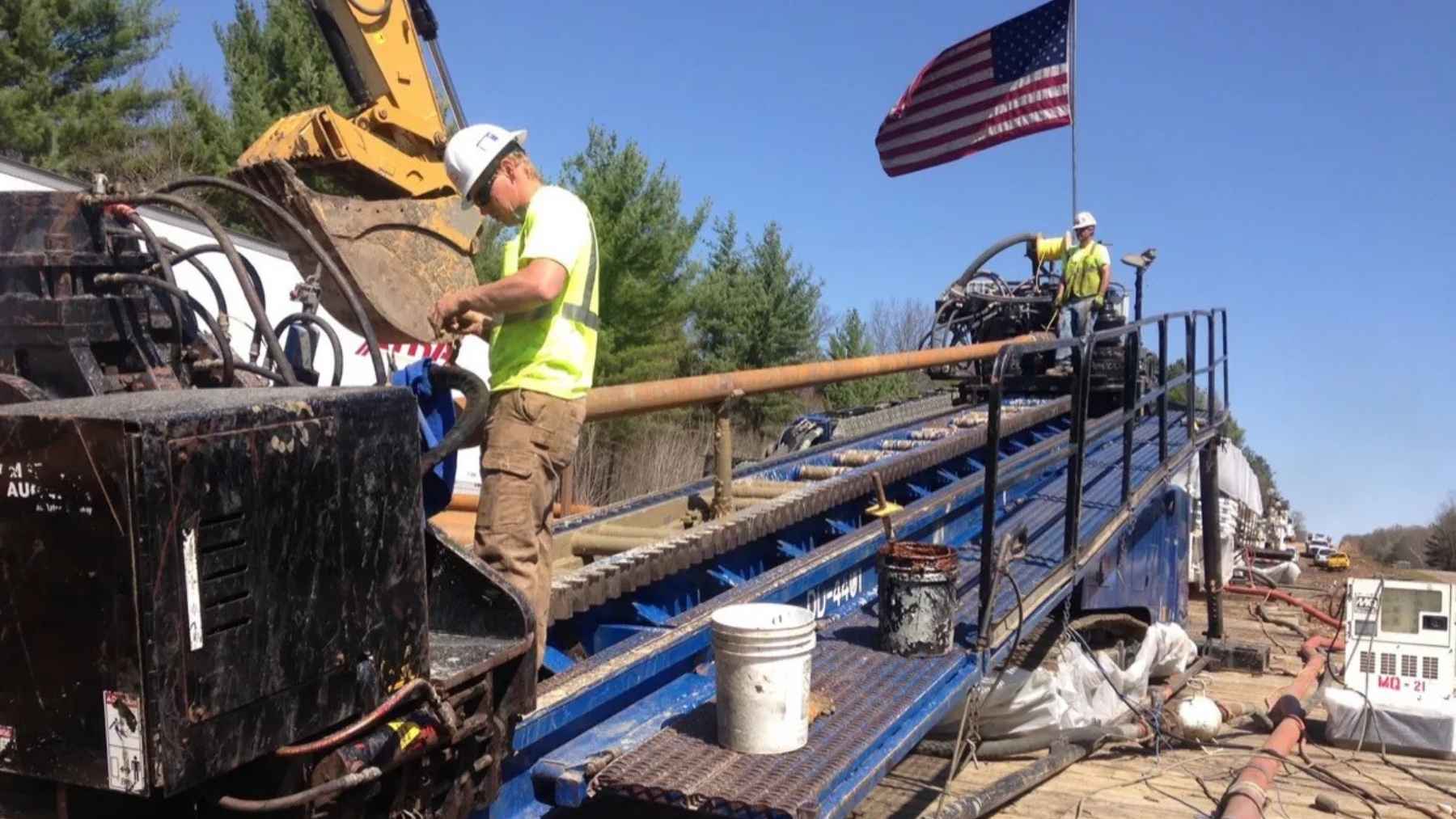
Quick version of how horizontal directional drilling works, if you haven’t run into it: a rig on the surface pushes a steerable bit into the ground at a shallow angle, the hole curves under whatever’s in the way, and the bit pops out on the far side. Then the crew swaps the bit for a reamer, which is a much bigger cutting head, and drags it back through to widen the hole until the pipe fits. We covered a 5,883-foot version of this under an English beach yesterday, and that one was in sand and gravel. This one was in rock.
Under the Illinois River the ground changes three times on the way down. Ugrich says the first 25 feet or so is clayey sand and silt, which is the easy stuff. Below that comes claystone and mudstone rated at 5,000 to 10,000 psi down to about 70 feet, and under that the limestone, at 15,000 to 25,000 psi. For reference, the concrete in your driveway is somewhere around 3,000 to 4,000 psi. So the bit started in dirt and finished in rock four to eight times harder than your driveway, and the hole had to curve through all of it.
The rock was only half the problem. The other half was a 35-foot difference in elevation between the two ends of the crossing. That doesn’t sound like much over 2,204 feet, and as a slope it pretty much is. But it decides where the drilling fluid ends up.
Here’s why that matters. HDD runs on mud, a water-and-clay mix that gets pumped down the drill pipe to cool the bit, carry the ground-up rock back out and hold the hole open. Mud flows downhill. A hole with one end 35 feet higher than the other is a hole where the fluid, and the cuttings riding in it, want to collect at the low end. Ugrich doesn’t spell out every step of the logic in his write-up, but as far as I can tell that slope is the reason the crew did the job the way they did.
Why haul a 600,000-pound rig across a river in the middle of the job?
NCDD set up on the low side first, the side where the pipe was going to be staged. From there the crew drilled the pilot hole, the first skinny pass, with a 12¼-inch rock bit and a mud motor. A mud motor, if you’ve never seen one, is a motor that sits right behind the bit and spins it off the pressure of the drilling fluid, so the pipe itself doesn’t have to turn to chew through rock. The pilot punched out on the high bank, and at that point the crew rigged the whole machine down, moved it to the high side and started reaming from there.
Why not just ream from where they were? Ugrich’s reasoning is that with the rig on the high side, the crew could pull the reamer toward the machine for the entire reaming phase, which gave them a steadier cut and a steadier pull. Pulling a reamer keeps the drill string under tension. Pushing one is a bit like pushing a rope, and 2,000 feet of drill pipe will happily bend somewhere you can’t see.
I get the logic.
The 600,000 figure, by the way, is how the industry sizes these rigs, and from the looks of things it refers to the machine’s pulling capacity rather than what it weighs on a trailer. Ugrich doesn’t say which rig it was. Either way, that much pull on a 20-inch pipe is the reason the second decision happened.
On a lot of rock crossings the hole gets opened in steps, say 18 inches, then 24, then 30, with a separate pass for each. Every pass through ground that changes from mudstone to limestone is a chance for the reamer to carve a little ledge at the transition, and a ledge is exactly where a pipe gets stuck on its way in. Because the product was only 20 inches and the rig had 600,000 pounds to work with, NCDD skipped the steps. The crew ran a single 30-inch rock reamer through the whole 2,204 feet in one pass. Then a swab pass to clean the hole, and then the pipe.
What’s a dry hole, and why did they stop for it?
Ugrich mentions a dry hole section, which is drilling slang for a stretch where the mud you pump in doesn’t come back. In limestone that usually means the fluid is leaking into cracks in the rock. That’s a problem, because the cuttings have nothing to ride out on, so they stack up in the bore.
Before the tooling reached that stretch, the crew pulled everything out of the hole to inspect it and to clear leftover debris, so the cuttings wouldn’t pile up and flush out through the pit on the low side. While the reaming was still going on, NCDD also trucked a second mud recycling system over to the high side so it would be ready for the pullback. And the 20-inch pipe was welded into one continuous string, using every foot of workspace the client provided, so the pull could run start to finish without stopping. Stopping in a dry section is the thing you really don’t want, because the hole can settle around a pipe that’s sitting still.
The whole crossing took roughly 50 days and came in ahead of schedule, according to Ugrich. He doesn’t say how deep under the riverbed the bore ran, how long the pilot hole alone took, or how much force the pipe needed on the way in, which are the three numbers I’d have put in the headline if I had them.
Is 2,204 feet a big deal?
Not for length, frankly. Drillers have gone a lot farther. We wrote about a 9,695-foot bore under a river in Alberta last month, and the two plastic ducts under that English beach were each more than twice this long. The rock isn’t a record either. A microtunneling machine under a river in Winnipeg chewed through 36,000-psi stone, though that one had a steel sleeve protecting it the whole way.
What I find pretty interesting is the method. A crew drilled the pilot from the wrong side on purpose, moved a maxi rig across a river to ream from the right one, and opened a hole in hard, changing rock to 30 inches in one pass instead of three. That’s a set of calls you make when you’re fairly confident in both the machine and the ground, and the 50-day finish suggests the confidence was earned.
Ugrich’s account of the crossing went online at Trenchless Technology on October 5, and it’s the only public write-up of the job so far.