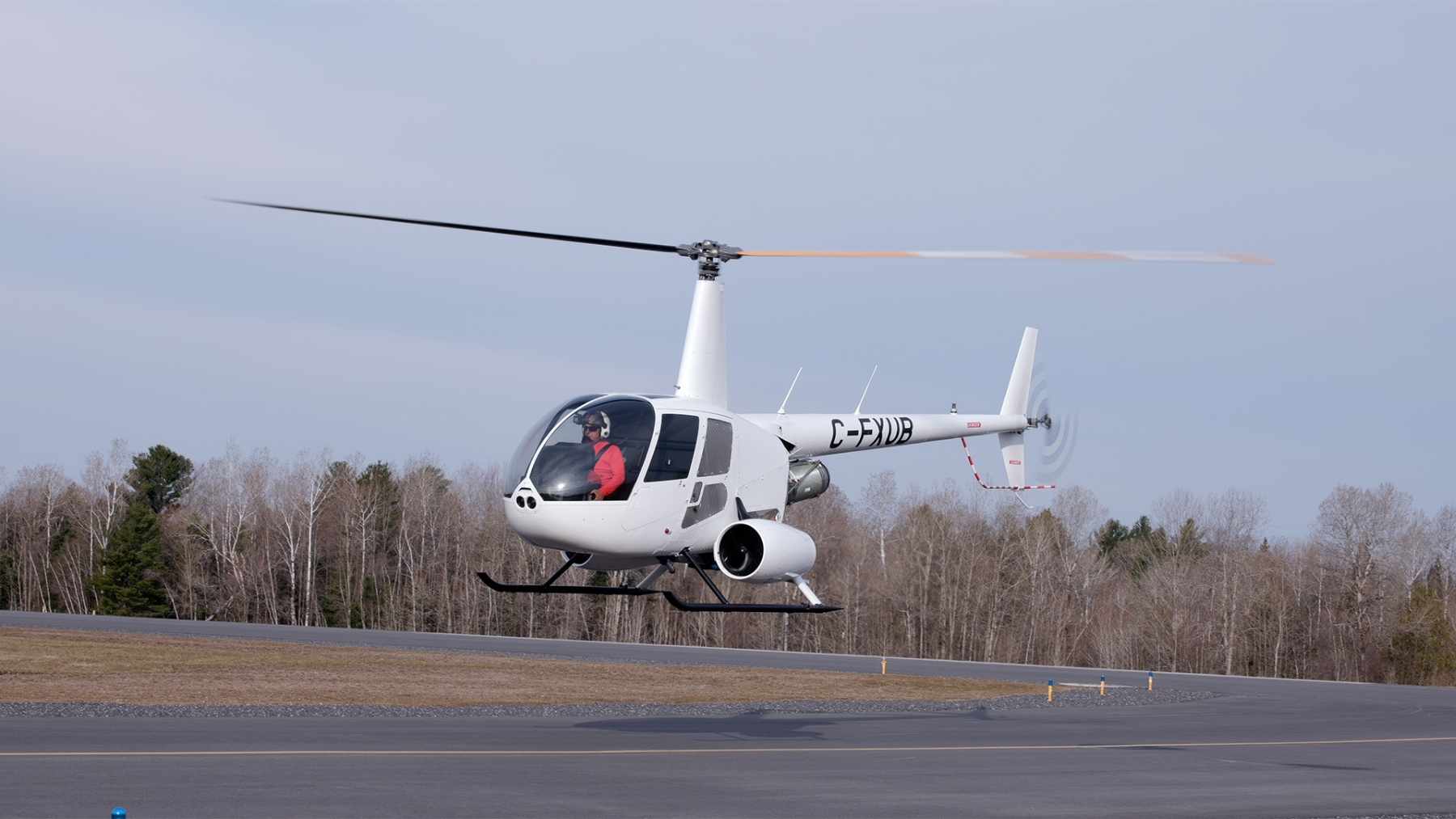

The exhaust from a Robinson R44 helicopter is normally hot, oily, and smells like burnt aviation gasoline. The exhaust from the modified R44 that test pilot Ric Webb set down at Roland-Désourdy Airport in Bromont, Quebec, on April 10, 2026 was a faint trail of warm water vapor, vented out a stack at the back of the aircraft. The flight before that landing — takeoff, climb, pattern, approach, full circuit — was the first time any piloted hydrogen-powered helicopter has flown a complete operational circuit, anywhere. The announcement came three and a half weeks later, on May 7, from Canadian Advanced Air Mobility, the Vancouver-based industry association of which the operator, Unither Bioélectronique, is a board member.
Unither is not an aviation company. It is a Canadian subsidiary of United Therapeutics, a Maryland biotech firm that builds drugs for pulmonary hypertension and, more relevantly here, manufactures lab-grown lung tissue intended for human transplant. The reason it owns and flies a hydrogen helicopter is that the eventual product it wants to sell — manufactured organs for emergency transplant — requires a delivery system that does not exist yet. Most of the time, today, a donor organ is moved between hospitals by some combination of a cooler, a black SUV, a Learjet on a regional airfield, and another black SUV. The Learjet is the part Unither wants to replace.
What the demonstrator is, and what it isn’t
The aircraft Webb landed in April started life as a normal piston Robinson R44 Raven II. Unither and its powertrain contractors stripped out the Lycoming IO-540 engine that came in the engine bay and replaced it with three things that don’t usually live inside a helicopter: two low-temperature proton exchange membrane fuel cell stacks, mounted in the rear cabin where passenger seats normally go; a magniX electric motor sized roughly to the rotation speed of the original Lycoming, sitting in the original engine bay; and a small lithium-ion booster battery whose job is to smooth out transient power spikes when the pilot adds collective or hits anti-torque pedal. There is a cylindrical compressed hydrogen tank beneath the tail boom and two round cooling nacelles on the sides, which from a distance make the modified airframe look like it sprouted ears.
During the April 10 circuit, peak power output was around 178 kW, or about 239 horsepower. Roughly 90 percent of that came from the two fuel cell stacks. The battery handled the rest, and when Webb taxied back to the hangar, its state of charge was still well above 80 percent — which is to say, the helicopter flew the mission almost entirely on hydrogen and never came close to running the battery flat. The fuel being burned, or rather catalyzed, was compressed gaseous green hydrogen produced locally in Quebec. The exhaust was water vapor. There was no other exhaust.
What this is not, yet, is a certified aircraft, a production aircraft, or a particularly long-legged one. The compressed-gas hydrogen tank only carries a few kilograms of fuel — enough endurance to fly an airport circuit and gather data, not enough to fly anywhere useful. Mikaël Cardinal, who runs the program for Unither under the title of vice president for program management and business development, organ delivery systems, told Vertical Magazine in May that the circuit was specifically about validating “consistent, robust, repeatable, and safe performance” through the most power-demanding phases of helicopter flight, particularly hover and climb. It was about proving the powertrain works in the hard parts. The long flights come later, on a different airframe, with a different kind of hydrogen.
Why a biotech company is building a helicopter
I’ll admit I had to read the executive titles at Unither twice. The man running the hydrogen helicopter program is called the VP of Program Management and Business Development for Organ Delivery Systems. The CEO of the parent biotech is Dr. Martine Rothblatt, a former satellite-radio entrepreneur (she founded Sirius) who now also runs a publicly traded company manufacturing lung tissue. The line connecting all of this is that United Therapeutics’ long-term commercial bet is on manufactured organ alternatives — lungs in particular — and on a delivery network that can move those organs from a manufacturing facility to a patient’s hospital fast enough to matter.
That bet has been running in the open for nearly five years. In September 2021, Unither flew an unmanned electric drone carrying a pair of donor lungs about 1.2 kilometers across downtown Toronto, from Toronto Western Hospital to Toronto General Hospital, in a flight that took under ten minutes and was, as far as anyone has been able to verify, the first lung transplant in history where the organ was delivered by drone. The recipient, a 63-year-old Ontario engineer named Alain Hodak, lived. He had asked specifically to be on the drone delivery trial because he was, in his own words, an engineer who loved technology. The lead surgeon on that project, Dr. Shaf Keshavjee at University Health Network, has been working on the problem of organ transport for his entire career; he is on record observing that it has always seemed wrong to charter a Learjet to move something that weighs two kilograms.
The piloted hydrogen helicopter is the next step along the same line. The drone was for short urban hops. The R66 is for the 200-nautical-mile (370 kilometer) regional leg that, today, gets done by a chartered light jet.
The powertrain, and where the suppliers came from
The motor in the engine bay of the H2R44 is a magniX 250, made by a company based in Everett, Washington, that has spent the past several years quietly becoming the default electric powertrain vendor for aviation retrofits. The same magniX product family powered the first all-electric Cessna 208 Caravan that flew in 2020 and has been used in a number of regional aircraft electrification programs since. Putting it inside an R44 was, by Cardinal’s account, mostly a matter of matching shaft speeds with the original Lycoming, since the rest of the airframe was built around a piston engine spinning at a particular rate.
The two PEM fuel cell stacks sitting where the passenger seats used to be are low-temperature units — the more mature class of automotive-grade hydrogen fuel cell — chosen over the higher-temperature, higher-power-density designs that companies like HyPoint and ZeroAvia are pushing toward certification on competitor aircraft. The trade-off, in plain terms, is that low-temperature PEM is more proven and has a slower power response; high-temperature PEM can deliver more power per kilogram but is harder to engineer and harder to certify. Unither has chosen the proven path, and the booster battery covers the response-time gap. Cooling the low-temperature stacks during hover, when the rotor is pulling maximum power and air movement around the helicopter is at its lowest, was, Cardinal has said, one of the principal engineering challenges in getting to flight at all.
Where this sits among other hydrogen aircraft
Unither is not the only player. Joby Aviation, the California eVTOL company, flew a hydrogen-electric conversion of its battery-electric air taxi 523 miles non-stop in June 2024, using a liquid hydrogen fuel cell powertrain built by H2FLY, the German startup Joby acquired in 2021. That flight was longer, faster, and demonstrated an entirely different class of aircraft — a tilting-rotor eVTOL, not a conventional helicopter. Piasecki Aircraft, working with first HyPoint and now ZeroAvia on a 650-kilowatt high-temperature PEM system, is pursuing a hydrogen-powered version of its slowed-rotor compound PA-890. That aircraft, designed to seat seven passengers and a pilot and to fly under existing FAA Part 27 certification standards, has yet to perform a piloted hydrogen flight. The prototype is targeted for 2028.
Which is to say: the Joby aircraft has flown further on hydrogen, but it isn’t a helicopter. The Piasecki design is a helicopter, but it hasn’t flown on hydrogen yet. Unither’s R44 has flown on hydrogen, and it is a helicopter. As of late May 2026, those three sentences are simultaneously true.
What comes next
Over the next six months, Unither plans to install a 1,500-US-gallon (5,700-liter) liquid hydrogen storage tank next to its test hangar in Bromont. That ground tank will fill a new onboard cryogenic tank, replacing the current compressed-gas system on the H2R44, which is expected to fly with liquid hydrogen later in 2026. In parallel, the company is finishing the design of the H2R66 — a hydrogen conversion of the Robinson R66 turbine helicopter — and has already begun modifying the R66 currently used as a chase aircraft for the program. The R66 was chosen because it has a higher gross takeoff weight than the R44, 2,700 pounds versus 2,500 pounds, which gives the engineers room for the additional mass of a cryogenic fuel system without forcing trade-offs against payload.
The certification path is dual-jurisdiction. Transport Canada Civil Aviation issued the experimental flight permit that covered the April 10 circuit. The eventual production aircraft, whenever it arrives, will need to be type-certified by both Transport Canada and the U.S. Federal Aviation Administration, neither of which has finalized airworthiness standards specifically for cryogenic hydrogen rotorcraft. JR Hammond, who runs CAAM, made the relevant industry point in the May 7 press release. “Hydrogen flight is no longer a distant concept sitting on a roadmap,” he said. The harder, slower part is building the regulatory framework around it — what Hammond called the work of moving regulation, infrastructure, investment, and public trust at the same urgency as the aircraft itself.
None of which yet means anyone is flying an organ across a border in a hydrogen helicopter. It means a piloted hydrogen-electric helicopter has flown a real airport circuit on green hydrogen with water as its only exhaust, and that the engineering math has stopped being theoretical. Whether the rest of the system catches up — the larger airframe, the cryogenic fuel, the type certificate, the airport hydrogen infrastructure, the trust of the surgeons on the receiving end — is the next several years of the program. The April 10 flight was, by Cardinal’s own deliberately careful framing, the first step. The rest is harder.