
Hydrogen fuel cells have been a flop where most people would actually use them — the passenger car. The Toyota Mirai sits stranded in California, the fueling network is shrinking, and the whole consumer-hydrogen bet is essentially lost. The technology hasn’t died, though; it’s migrated to places where cost isn’t the deciding factor: long-haul trucks, locomotives, defense hardware, and the most expensive objects on the water. But here’s the tell about how far the chemistry still has to go — Lürssen just delivered a 114-metre superyacht designed around methanol fuel cells, and even here, on a nine-figure custom build, the fuel cells aren’t actually installed yet.
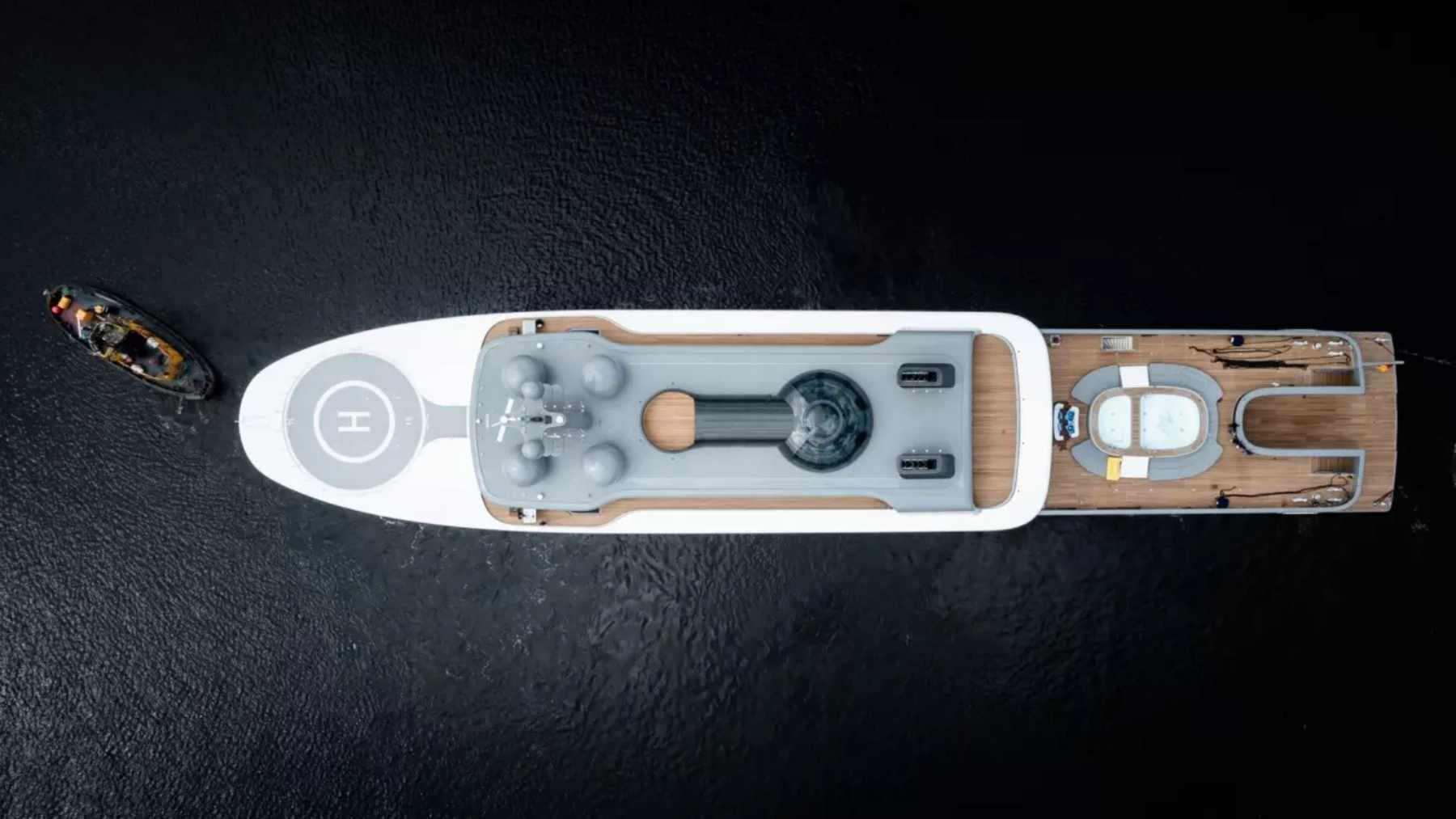
The yacht is Nausicaä, known throughout her build as Project Cosmos, and the German yard handed her over on May 23 after years of sea trials. She’s the third giant out of Lürssen this year, after the 134.2m Deep Blue and the 117m Boardwalk, and she’s the odd one of the bunch — drawn entirely, inside and out, by Australian industrial designer Marc Newson, which is rare at this size and shows.
The fuel cells that aren’t there yet
Let’s be precise about the propulsion, because the headlines have been sloppy with it. Nausicaä was billed during her build as the first methanol fuel-cell yacht. As delivered, she runs on five diesel gensets — two main, three auxiliary — wired to fully electric Azimuth pods, with a battery bank good for up to 2MW. That battery capacity is enough to run all hotel systems at peak load and lets her sit silently at anchor with zero local emissions for stretches. That’s the boat that actually sailed to Gibraltar.
What she has, in Lürssen’s own words, is “provision for a future methanol fuel cell” — the space, plumbing, ventilation and electrical architecture to drop in a pair of 500kW methanol fuel cells later, converting methanol into hydrogen onboard. When (if) that system goes in, it’s designed to push her at around 7 knots for 1,000 nautical miles, or hold her at anchor for up to 15 days, with zero emissions. Lürssen, which has spent more than a decade in a German-government-backed fuel-cell research program and concluded methanol was more practical than storing elemental hydrogen, put it carefully: this is “an emerging technology in yachting… and when it does” arrive, its integration will mark the real step away from fossil fuels. The operative phrase is “when it does.”
That caveat is the actual story. The chemistry works; the economics and the maturity don’t, not even for a buyer who by definition isn’t counting cents. Compare it with the 118.8m Breakthrough, built by Dutch yard Feadship, which in 2025 became the world’s first superyacht with hydrogen fuel cells actually running — sixteen cells for 3.2MW, fed by cryogenic liquid hydrogen stored at -253°C, and it won Motor Yacht of the Year. Feadship installed the future. Lürssen built the slot and sailed on diesel. Between them, those two boats map exactly where ultra-clean marine propulsion sits right now: technically real, commercially embryonic. It’s the same migration playing out in trucks, trains and industrial power, where the serious hydrogen money has gone after passenger cars didn’t pan out — and the same multi-domain story as hydrogen-powered maritime drones.
CEO Peter Lürssen called Nausicaä one of the yachts that “leave an indelible mark on our history.” Coming from a 150-year-old shipbuilder with hundreds of hulls behind it, that’s not throwaway PR — but the mark, for now, is the design and the readiness, not a working fuel cell.
A Marc Newson sketch that survived six years of engineering
Most large custom yachts go through a design grinder. The original concept gets handed to naval architects, structural engineers and classification societies, and what arrives at sea trials usually looks like a cousin of the first drawing, not the drawing itself. Lürssen says that didn’t happen here. In their own words, Nausicaä “has not changed one iota from the digital representation of the design drawn six years ago.”
Newson’s brief was unusually soft for a 114m platform. Rounded forms, curved glazing, louvred detailing, almost no flat planes anywhere — which tracks for a designer best known for work with Apple, Qantas and Louis Vuitton. Lürssen describes the silhouette as sitting closer to industrial design than to the usual architectural language of custom yachts at this scale. The curve-everything approach runs through aft decks, exterior doors, even the exhaust mast. Up forward there’s a glass observation lounge that runs roughly 19 metres beneath a certified bow helipad, wrapped in sweeping glazing so it reads as a floating pod over the water. The yard credits the engineering lineage to earlier large-glass projects like Rising Sun and Kismet.
The Skydome and a main deck that isn’t a salon
The headline structural piece is the glass Skydome perched high in the superstructure. It’s made of seven curved panes — each roughly 3 by 2.8 metres, 62mm thick, and tipping the scales at about a quarter-tonne — capping a 56-square-metre owner’s study tall enough at 3.15m to read as a proper room, with its own terrace off the side. The yard says it took prototype work and full-scale 1:1 mock-ups, with each pane hot-bent by gravity under tightly controlled conditions, before anyone could start cutting glass for real.
Inside, the layout walks away from the standard superyacht playbook. There’s no traditional main salon. Instead, the main deck is given over to a two-storey gallery — sculpture set out where the saloon would normally be, watched over by a ring-shaped balcony on the deck above. The entertaining gets pushed up and aft, to a deck with a sushi bar and built-in lounging. At an estimated 6,593 GT, there’s enough volume to make the gallery-first layout actually breathe rather than feel like a gimmick.
Ice Class 1D, a 12.5m tender, and a dry dock that disappears
Nausicaä is also built as a serious explorer. She carries an Ice Class 1D rating, which means light ice operation is on the menu. Lürssen has said the spec opens up cruising across every major ocean and all seven continents, which is the usual yard language for “she’ll get to Antarctica if the owner wants.”
The aft deck is where the engineering gets fun. Eighteen metres of full-beam leisure space wrap around a pool and Jacuzzi, but the trick sits underneath. There’s a concealed dock built around a 12.5-metre sportfishing tender, carried on a hidden sledge rated to 16 tonnes. Send the tender out, and the rails retract entirely. What’s left behind is a teak-lined guest terrace with zero visible hardware. It’s the kind of solution that probably cost an absurd amount of engineering hours for a feature most guests will never consciously notice, which is sort of the point.
Where she sits in the fleet and what’s next
YachtBuyer reports she’s set to enter the YB100 ranking, which sorts the world’s biggest yachts by gross tonnage rather than length. YachtCharterFleet places her around rank 34 on that list upon delivery, sitting next to the 104.85m Lady Moura. Her owner is reportedly Japanese — widely linked to entrepreneur Yusaku Maezawa, though Lürssen hasn’t confirmed it — and it’s not yet public whether she’ll be available for charter.
The yard’s pipeline isn’t slowing down. Per YachtBuyer’s MarketWatch database, Lürssen currently has nine yachts in build or on order. Still to come this year: the 110m expedition yacht O3 with an X-Bow profile and around 6,300 GT of volume, and the 102.4m Nixie with RWD styling and accommodation for 20 guests across 10 suites. Boardwalk and Deep Blue are recognisably modern custom yachts done very well. Nausicaä is a Marc Newson industrial design object that happens to displace 6,593 GT, carry a sportfish boat in a disappearing dry dock, and hold an empty bay where the future of marine propulsion is supposed to go. Whether the soft-form aesthetic catches on with other owners is one question. Whether methanol fuel cells ever actually fill that bay — on this boat or any other — is the one that matters more, and right now even the billionaires are waiting to find out.
Credit Photo: Tom van Oossanen