
Solar panels have gotten cheap enough that making electricity is no longer the hard part. Making it at 9pm is. That gap is the only reason anyone still builds the other kind of solar plant, the one with a field of mirrors aimed at a tower, because heat sits in a tank overnight far more happily than electrons sit in a battery.
Australia had a bet running on that idea, and it was an odd one. Every commercial solar tower built so far moves its heat with steam or molten salt. Vast Solar’s VS1, a 30-megawatt plant planned for a stretch of scrub north of Port Augusta, South Australia, was designed around liquid sodium instead.
The receiver got built. The engineering got finished. The federal government committed up to A$180 million, which is roughly US$118 million and, for the record, every dollar figure below is Australian. Not one mirror went into the ground.
On November 13, 2025, KPMG partners Peter Gothard and Amanda Coneyworth were appointed voluntary administrators of Vast Renewables Limited and ten Australian subsidiaries, including the company set up to own VS1. What the administrators have proposed since then ends somewhere failed energy startups almost never end: with the government taking the patents.
Liquid metal was the entire point
Sodium melts at about 208 degrees Fahrenheit and stays liquid all the way up to 1,621. Solar salt, the sodium and potassium nitrate blend the tower industry standardized on, sets solid at around 430 degrees. Every pipe, valve and tank in a salt plant has to be kept warm so the working fluid never turns into a plug.
Sodium is also a far better conductor of heat than salt, and that is the property Vast built its whole machine around. It is not a free lunch. Sodium reacts hard with water and with air, so a sodium plant is a plumbing problem before it is anything else, and Vast’s own engineering documentation describes sloped piping runs designed so that more than 1,600 feet of sodium line could be drained.
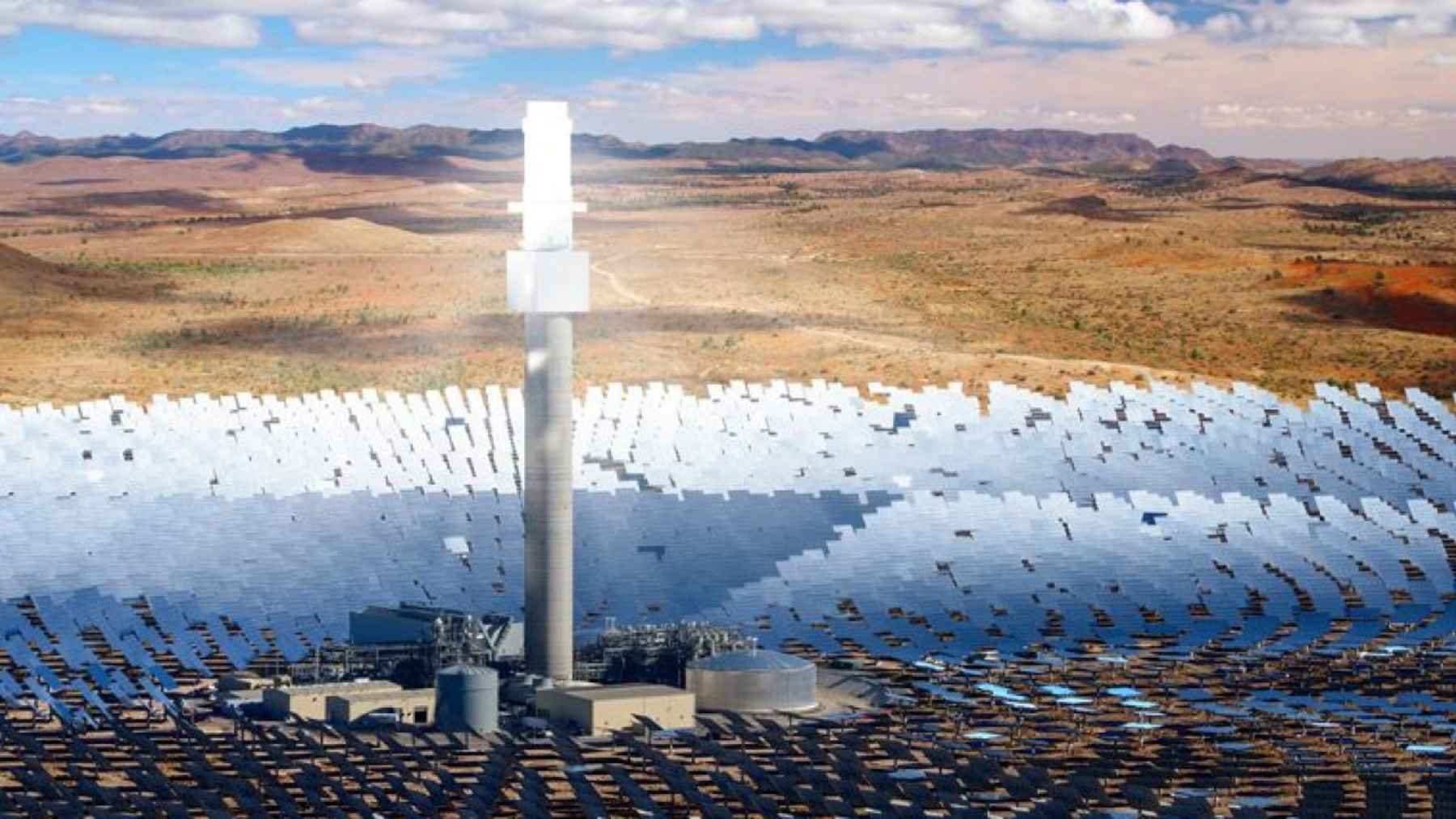
VS1 was never going to be one big tower. The design called for eight modular arrays, each with its own mirror field, its own receiver and its own controls, all feeding a shared insulated header. Concentrated sunlight heated sodium at the receivers, a heat exchanger handed that heat over to molten salt, and the salt sat in tanks rated at 288 megawatt-hours feeding a steam generator and a 30-megawatt turbine.
Mirrors that steer sunlight onto a single point are not new, and at small scale they do genuinely absurd things. The 57-year-old solar furnace in the French Pyrenees concentrates a full megawatt of sunlight onto a spot the size of a dinner plate. The engineering problem has never been collecting the heat. It has been moving it, storing it, and doing that for thirty years without the plant eating itself.
The pilot that got Vast this far was small: 3,500 mirrors in five arrays around 88-foot towers at Jemalong, near Forbes in New South Wales, good for 1.1 megawatts. It ran for 32 months and won the International Energy Agency’s SolarPACES innovation award in 2019.
The receiver for the real thing was designed and built in Goodna, a suburb of Brisbane, and finished in February 2025. It is still there. The administrators’ February 2026 report says they stopped running the business after December’s creditors meeting, except for keeping up the leased Goodna premises, which hold plant and equipment tied to the group’s intellectual property.
The same ground already lost a much bigger tower
Port Augusta has done this before, at larger scale and with a louder ending.
In 2017 the South Australian government signed a 20-year supply deal with American developer SolarReserve at A$78 a megawatt-hour, for a 150-megawatt tower with 1,100 megawatt-hours of molten salt storage north of the city. The project was costed at around A$650 million and carried a A$110 million federal concessional loan, negotiated that year as part of a deal with independent senator Nick Xenophon.
SolarReserve got development approval in January 2019. On April 5 of that year, then state energy minister Dan van Holst Pellekaan announced the project was over, because the company could not reach financial close. Adelaide firm 1414 Degrees bought the site later that year for about A$2 million.
Here is the part that ties the two failures together. That A$110 million concessional loan did not die with SolarReserve. It was recommitted in 2022 for Vast’s much smaller plant on the same ground, and it was still sitting there unspent when ARENA topped the package up in March 2025 with up to A$180 million in grant funding, replacing an earlier A$65 million commitment.
Two companies, two technologies, one paddock, one pot of federal money, nothing built. The grant was conditional anyway. Vast still had to raise the rest of the A$360 to A$390 million the plant was costed at, and it never did.
ARENA is the largest single creditor, and the proposal hands it the patents
The numbers in the administrators’ supplementary report of February 17, 2026 are blunt. Unsecured claims against the group came to A$58.4 million. ARENA, the federal agency that had backed the project since 2023, is owed A$24.5 million of that, more than 40 percent.
The deed of company arrangement put to creditors was proposed by Nabors Lux 2, the Luxembourg entity through which Houston-based drilling contractor Nabors Industries lent money to Vast. It puts A$100,000 of fresh cash on the table, half from Nabors and half from Taloumbi Station Pastoral, a company the report links to two former directors and officers, Alec Waugh and Craig Wood.
The mechanism that makes it work for everybody else is subtraction. ARENA and Nabors agreed not to take a cent out of the deed fund, which drops the pool of participating claims from A$58.4 million to A$30.6 million and lifts the estimated return for remaining unsecured creditors to somewhere between 3.2 and 4.2 cents in the dollar. Straight liquidation was estimated at 1.6 to 2.9 cents. Employee entitlements, about A$2.1 million of them, were expected to be paid in full either way.
In exchange, the intellectual property goes to ARENA or an entity ARENA nominates. The report gives the reason in a single line, saying the transfer is meant “to maximise the chances of its commercialisation in Australia.”
The administrators were straight about the trade-off. Signing the deed means creditors give up any claim on recoveries a liquidator might have chased, including any possible insolvent trading action against directors. No such claim has been made and the report does not allege one.
A second sales process had already run, reopened on December 22 with binding bids due January 14. Indicative offers came in for the intellectual property, for some plant and equipment, and for Vast’s 50 percent share of the joint venture that holds the land. None of them turned into a binding bid, and the administrators put a value of A$260,000 on the joint venture shares.
Creditors were due to vote on February 25, 2026. The outcome has not been announced publicly, and the most recent document on KPMG’s creditor page for the group is still that February 17 report.
The mirrors never came. A data center operator did
The land itself is doing fine, which is the strangest part of all this.
The Aurora precinct is held by SiliconAurora, a joint venture between 1414 Degrees and the Vast subsidiary now in administration. In January 2026 the 140-megawatt, 280-megawatt-hour battery approved for the site cleared the Australian Energy Market Operator’s generator performance standards, the last technical gate before transmission negotiations.
Then on July 27, 1414 Degrees told the market it had signed a heads of agreement with an unnamed Australian data center operator to build up to a gigawatt of AI computing capacity there. The operator gets exclusivity over an initial 40-hectare parcel, just under 100 acres, inside a landholding of 15.8 square kilometers, about six square miles.
The staging is modest at the front and enormous at the back. A 17-megawatt starter campus on an existing 33-kilovolt connection, a 200-megawatt anchor campus once the 275-kilovolt line is hooked up, then a longer path to a full gigawatt as generation gets built out. 1414 Degrees brings the land, the power and the fiber. The partner brings the money and knows how to run the racks.
It is a heads of agreement, not a contract. Definitive terms covering land access, behind-the-meter power, storage, grid connection and precinct services all still have to be negotiated, and the company said as much in its own announcement.
Put the two storage numbers on that site side by side and the whole shift is right there. VS1’s salt tanks were rated at 288 megawatt-hours, roughly nine and a half hours of output. The lithium battery that actually cleared its approvals is rated at 280 megawatt-hours, eight less, delivered in two.
That is the trade the solar tower business keeps losing. Longer storage on paper, for a plant nobody will finance. Shorter storage on the grid, for a plant a bank already understands. Tower advocates argue the technology gives you something batteries do not, a real spinning turbine holding the grid’s frequency steady, which is the same job Australia now pays for with 300-ton machines built to spin in place and generate nothing at all.
The counterargument is sitting in California, where a $2.2 billion tower plant that opened in 2014 now spends its time being talked about by regulators rather than by engineers.
The receiver in Goodna is the piece anyone would actually want. Under the proposal it goes, along with the patents behind it, to the agency that helped pay for it, which beats a scrap merchant and falls a long way short of a working power station. Two companies have now tried to put a tower on that ground, and both got stuck at exactly the same step, the one where somebody has to sign the check.
 @stewarteastman ROOKIE1 month ago