
Every kid with a magnifying glass learns the same lesson in about four seconds. Point it at the sun, hold it over a dry leaf, and the leaf starts smoking.
Now scale that lens to 13.9 feet across and bolt it to the top of a volcano. The party trick becomes an engineering problem, because the instrument you built to look at the sun is also an instrument perfectly designed to destroy itself.
That is the daily situation at the Daniel K. Inouye Solar Telescope, which sits just above 10,000 feet on Haleakalā, on Maui, and is the largest solar telescope on Earth.
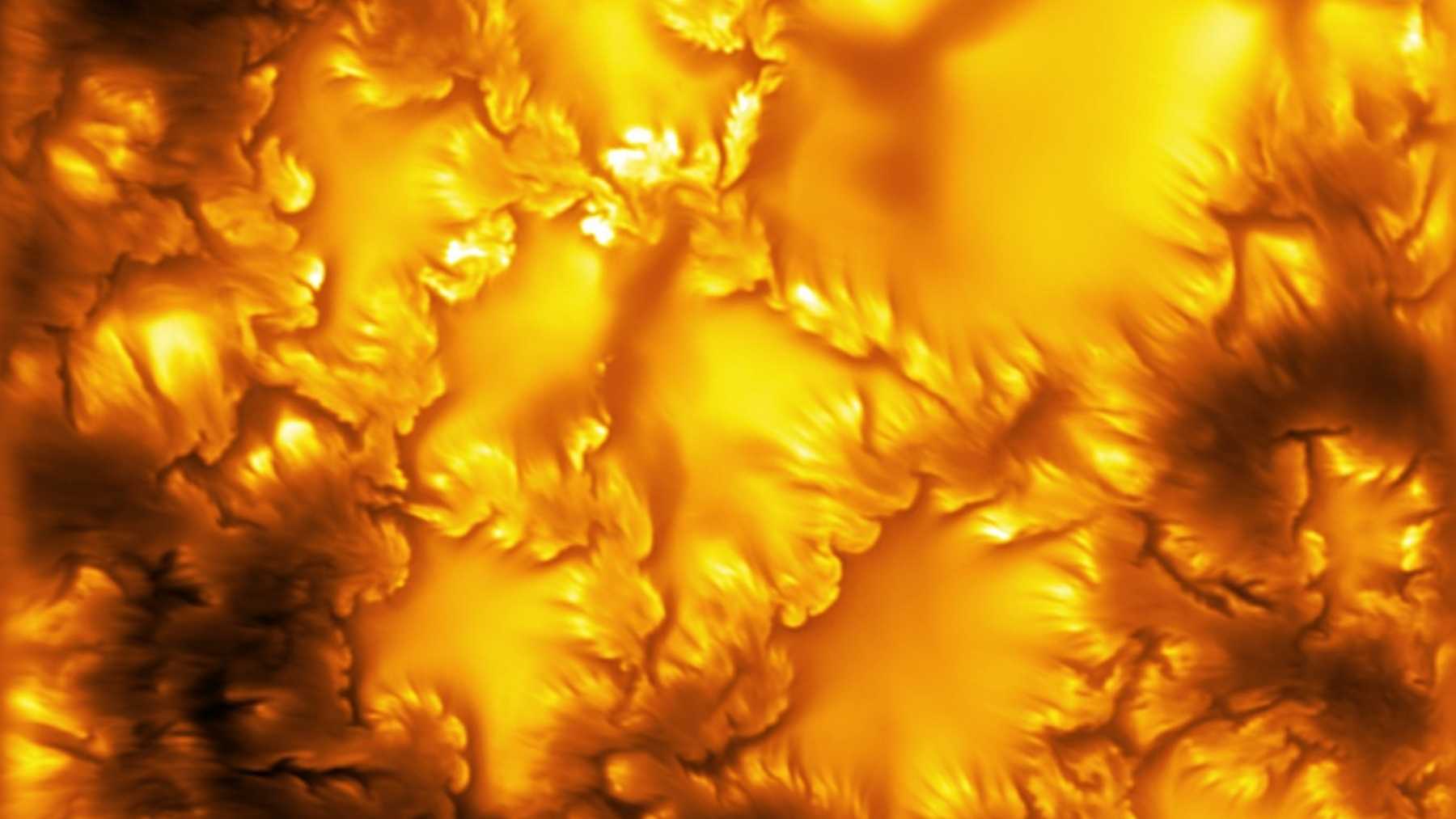
On August 5 the National Solar Observatory announced that the machine had caught something on the sun’s surface nobody had ever photographed. Swirling vortices at the edges of magnetic structures, the fluid-dynamics effect called Kelvin-Helmholtz instability. The paper ran in Nature the same day.
Everyone covered the swirls. Almost nobody covered the machine, which is the better half of the story, because nearly nothing about it works the way you would assume a telescope works.
Ten mirrors, and the second one is off to the side on purpose
Sunlight enters through the dome aperture and hits the 13.9-foot primary. In most big telescopes the second mirror hangs directly in the incoming beam, held in the middle of the aperture on struts.
Not here. The Inouye is an off-axis design, so the primary throws the light sideways to a secondary mounted at an angle, out of the path. Nothing blocks the incoming beam and nothing scatters off support struts.
That matters because stray light is what stops you seeing the corona, the faint outer atmosphere sitting right next to a surface a million times brighter. Killing scattered light is the difference between an image and a smear.
From there the beam runs down through the Gregorian optical system and a series of flats. Ten mirrors in total move the light through the building before it reaches a camera.
Its destination is the Coudé Laboratory, a 150-ton physics lab that rotates. It has to. As the Earth turns, the sun’s image rotates with it, so the cameras turn with the image to hold it still.
The lab is also a cleanroom, more than ten times cleaner than ordinary air, entered in full coveralls, hood and booties. Which creates a real problem, because a cleanroom needs a sealed barrier and a sealed barrier is normally glass or acrylic, and glass absorbs the light you built the whole observatory to collect.
The fix is an air knife: a fast, steady jet of air forming a curtain the beam passes straight through, holding temperature and cleanliness stable without a single pane of anything in the way. NSO says it is the first time the technique has been used in a solar telescope.
A mirror that changes shape 2,000 times a second
Here is the part that actually explains the 12-mile detail, and it has nothing to do with the big mirror.
Light crosses 93 million miles from the sun without trouble, clean for 99.9999% of the trip. Then it hits Earth’s atmosphere in the last sliver of the journey and gets shredded by turbulence, the same effect that makes a coin at the bottom of a swimming pool wobble.
Inside the Coudé lab is a deformable mirror. Sixteen hundred pistons push on the back of it, while a wavefront sensor reads how badly the incoming light has been mangled, sampling the beam at 1,521 separate points.
A computer calculates the exact shape that would cancel the distortion, and the pistons bend the mirror into it. Then the whole cycle runs again. Two thousand times a second, all day.
The atmosphere never stops churning, so the correction never stops either. Every image this telescope has produced is the output of a mirror being deliberately warped thousands of times a second to undo the sky.
The corrected beam then reaches FIDO, the Facility Instrument Distribution Optics, which works like a traffic controller and splits wavelength bands off to different cameras, so several instruments run at once on slices of the same light. The observatory produces about 9 terabytes of data a day doing it.
Seven miles of coolant and a disc that dumps 95% of the sunlight
Now the heat, which governs everything above it.
Once the primary focuses what it has collected and aims it at the secondary, that beam carries 12 kilowatts of solar power. NSO’s own fact sheet on heat reaches for the kitchen: 12 kilowatts pops a bag of popcorn in 20 seconds.
Twelve kilowatts landing on optics that must sit at exactly ambient temperature is not a heat management issue. It is a fire.
So more than seven miles (11 km) of piping run coolant through the building. The fluid is dynalene, held at 13 separate temperatures, each maintained independently all day. Some track the outside air. Others hold a fixed value no matter what the mountain does.
The dome gets its own treatment: fans 21 feet (6.5 meters) across at the top of the enclosure flush hot air out, and gates in the dome skin open to let the trade winds through.
Then the blunt solution. Just in front of the secondary, where the beam is most concentrated, sits a liquid-cooled metal disc called the heat-stop. It passes a narrow shaft of light and absorbs the rest, stripping more than 95% of the heat out of the system before anything reaches a camera.
A telescope built to gather more sunlight than any solar telescope ever built throws away almost all of it. If the heat-stop’s cooling fails, a cover drops over the beam, a second cover shields the primary, and the dome shuts.
The primary itself is 3.6 tons of Zerodur, a glass-ceramic from Schott that barely moves when its temperature swings, and it is only three inches thick. Polishing at the University of Arizona ran 80 hours a week for six months to get the surface under two nanometers of roughness. Scale that mirror up to the size of the Earth, NSO says, and the biggest bump left would be a grain of sand.
A disc that wide and that thin sags under its own weight as it tracks the sun, so actuators push on the back all day, bending it back into shape while it works. Its entire reflective coating is less than two tablespoons of aluminum. The design life is 44 years, which the observatory counts in sunspot cycles. Four of them.
What all of that machinery actually caught
The August 5 image was taken at 416 nanometers, through a broadband imaging camera supplied by the Max Planck Institute for Solar System Research, and it resolves detail down to about 12 miles (19 km). NSO published a version with the Hawaiian Islands overlaid on the solar surface at scale, which is the only sane way to look at it.
What that bought was a first proper look at the edges of granules. Granules are the bubbles covering the visible sun, each one 310 to 1,240 miles (500 to 2,000 km) wide, the tops of columns of hot plasma rising, cooling and sinking. Their boundaries had always looked like boundaries. At this resolution they look like breaking surf.
The finest fringes in the picture run a little over 12 miles (20 km) wide, and the vortices sit 31 to 40 miles (50 to 65 km) apart on average, a spacing the team matched against physics simulations from the High Altitude Observatory and Max Planck.
Michiel van Noort, the MPS scientist who handled the data reduction, said the team had to “resolve structures on the solar surface about 20 kilometers in size”, which he described as the limit of what the largest solar telescope and the best simulations can manage together. Max Planck’s yardstick for the difficulty: picking a coin out of the landscape from 112 miles (180 km) away.
Where the sun stops being astronomy and starts being your power grid
The leading explanation for how the sun stores the energy it later throws at us is flux braiding. Magnetic field lines twist around each other, tension builds, and eventually the tangle snaps and reconnects into a lower-energy arrangement. That release is a flare, a jet, or a coronal mass ejection.
The hole in that story has always been the first step. Something has to do the twisting, constantly, everywhere the magnetic field is strong enough. The new observations put a candidate on the table, because the vortices appear to be doing exactly that, all over the surface, all the time.
Thomas Rimmele, the observatory’s chief technologist, reads Kelvin-Helmholtz instability as “likely a mechanism that contributes to the heating of the outer atmosphere”, which would also chip at the old question of why the corona runs at a million degrees when the surface below it does not.
Flares and CMEs are what hit satellites, GPS, radio and transmission networks. Working out what winds the spring is the front end of forecasting when it lets go.
On August 12 a total eclipse crosses Greenland, Iceland and northern Spain, and grid operators there have spent months planning how to dim a continental solar fleet and bring it back. Parts of the eastern United States get a partial. The star that runs the power system is having a busy couple of weeks.
The budget request has this telescope running at reduced tempo
The FY27 President’s Budget Request, released April 3, proposes cutting the Inouye Solar Telescope’s line from the $26.4 million Congress enacted in FY25 to $13 million, a 51% reduction. The National Solar Observatory as a whole would drop from $32.7 million to $17 million.
In the American Astronomical Society’s breakdown of the request, the telescope is grouped with facilities the document says would be “operated at a reduced tempo”.
A budget request is a proposal, not an appropriation. Congress writes the checks, and last year it declined to make the equivalent FY26 cuts. None of this has been enacted.
But it does mean the machine that just produced the sharpest image of the sun ever recorded is a line item proposed at half its enacted funding, in the same fiscal year the result landed in Nature.
The wind tunnel NASA opened in Virginia last month replaced two that had run since the 1930s and 40s. The French solar furnace at Odeillo is still the hottest thing of its kind after 57 years because nobody built a replacement. Instruments like these are cheap to let slide and brutally expensive to rebuild.
Ten mirrors, a curtain of air standing in for a window, 1,600 pistons rewriting a mirror’s shape 2,000 times a second, and seven miles of pipe holding the whole thing below its own melting point. That is what it takes to see a 12-mile ripple on a star. What it costs to keep doing it is now a question for appropriators rather than engineers.
 @cowboymatt ROOKIE1 month ago