
Solar panels are at their worst on exactly the day you want them at their best. Heat makes a panel’s voltage sag, so a blistering August afternoon can turn out less power than a cool, bright morning in April. Most of the industry treats that heat as a loss to be shed and forgotten.
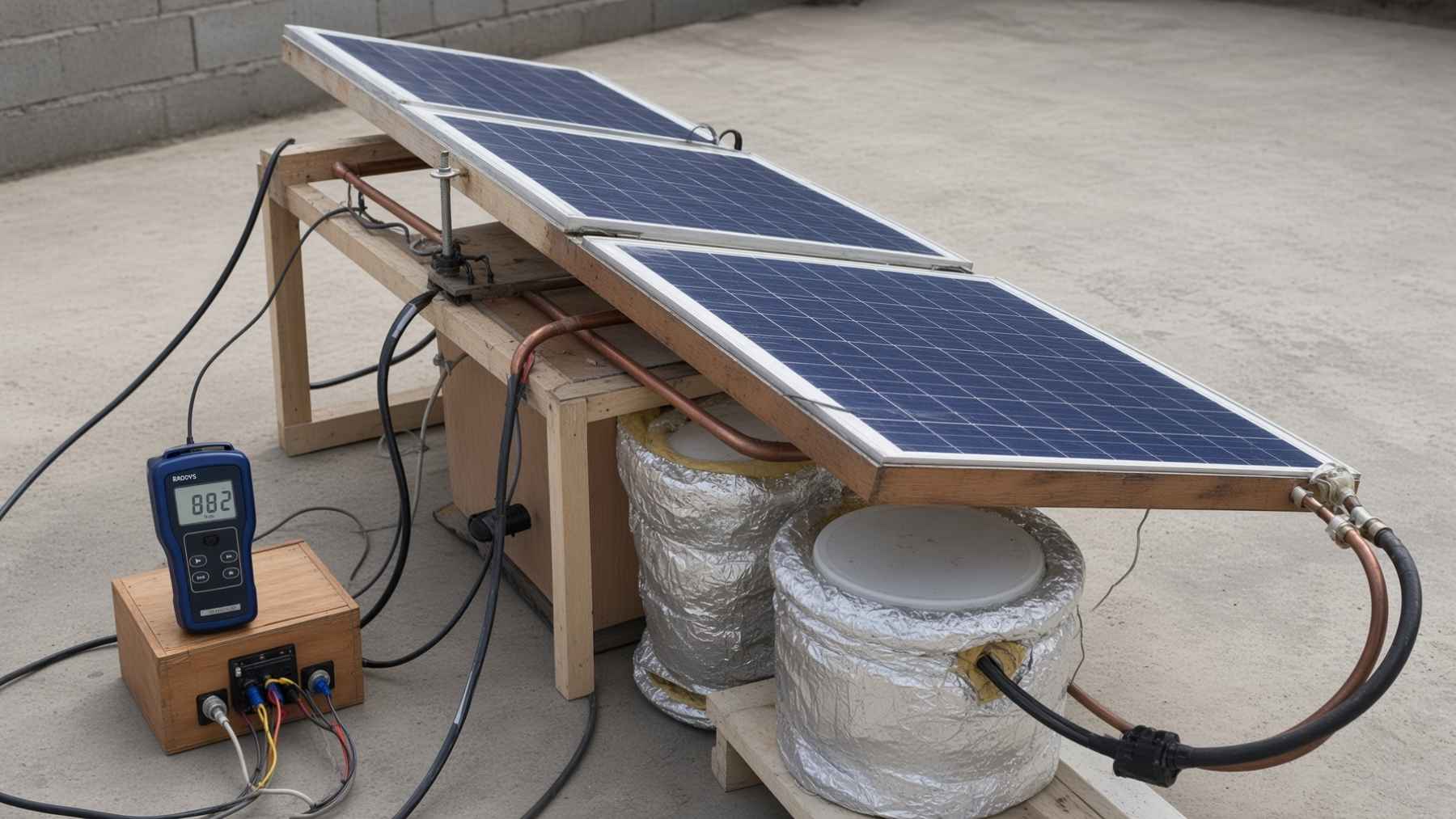
A group at Stanford bolted a copper tube cold plate to the back of a panel and pointed the heat somewhere useful instead. The panel put out 59.3% more power, because the plate was cooling it.
The heat the plate carried away went into a small electrochemical reactor. That reactor was busy pulling ammonium sulfate fertilizer out of real human urine.
The result landed in Nature Water on August 19, 2025, under a title nobody was ever going to read at a bus stop: “Prototyping and modelling a photovoltaic–thermal electrochemical stripping system for distributed urine nitrogen recovery.”
A year on, the paper is not the interesting part. The interesting part is that the process behind it has walked out of the lab, picked up a Department of Energy program slot, and started shopping itself to slaughterhouses.
The cold plate is doing two jobs at once
Start with the panel, because the panel is the machine here. Photovoltaic cells lose efficiency as they warm up, and according to Stanford, roughly 80% of the sunlight hitting a panel never becomes electricity at all. It becomes heat, and the heat then makes the panel worse at its only job.
The usual fix is to get rid of it. If you have panels on your roof, they are shedding that heat into the air right now and nothing at all is catching it.
Stanford’s rig catches it. A copper tube plate sits against the back of the module, coolant runs through it, and the panel runs cooler and stiffer as a result.
So far this is ordinary photovoltaic-thermal engineering. It has been done in various forms for decades, usually to preheat somebody’s shower water.
The twist is where the warm coolant goes. It goes into a reactor that needs to be warm, and that reactor is separating nitrogen out of urine.
Against earlier versions of the same setup, with no heat transfer and no current control, the paired system produced 59.3% more power and recovered ammonia 22.4% more efficiently. Both numbers carry error bars, 3.6 points on the power figure and 7.4 on the recovery figure. That second band is wide, and worth keeping in view.
Ammonia leaving the liquid was the slow step
The chemistry is called electrochemical stripping, and it is older than the solar wrapper around it. Urine goes into a cell divided into chambers by membranes. Electricity drags the ammonium ions across, the chemistry flips them to ammonia gas, and the gas gets trapped on the far side in acid as ammonium sulfate.
Ammonium sulfate, for the record, is a boring, bagged, entirely normal fertilizer. Nothing exotic comes out the end of this.
The bottleneck is the gas step. Ammonia has to actually leave the liquid, and that is the part setting the pace for everything else.
Heat speeds it up. That is the whole reason the cold plate points where it points, and it is why this counts as a genuinely two-sided machine rather than a solar panel with a science project taped to the back of it.
The team also put charge controllers in the way, to stop the panel dumping excess current into the cell. That sounds like housekeeping and is not. Shoving more amps at an electrochemical cell than it can use burns energy without moving any more nitrogen.
The paper puts the saving at 2.24 kilojoules per gram of nitrogen for every excess milliamp per square centimeter avoided. That is a slope rather than a headline number, but it points the right way.
Lead author Orisa Coombs, a mechanical engineering PhD student at Stanford, framed the appeal in the university’s announcement: “You don’t need a giant chemical plant or even a wall socket.”
Some of the runs used synthetic urine. Several used the real thing, which matters, because real urine is a chemically messy input full of things that foul membranes.
The money number is a model, not a receipt
The paper models net fertilizer revenues of up to $2.18 per kilogram of nitrogen in US markets, and up to $4.13 in African markets. Stanford’s writeup ties the higher figure to places like Uganda, where fertilizer is expensive and the grid is thin.
Those are modeled ceilings under the paper’s own assumptions, not sums anybody has been paid. Read them as the top of a range in a spreadsheet.
Here is what that range is sitting next to. DTN’s retail survey for the second full week of August 2026 put urea at $678 a ton and anhydrous ammonia at $964 a ton. Per pound of actual nitrogen delivered, that is $0.74 and $0.59.
Convert to the paper’s units and an American farmer is currently paying roughly $1.63 per kilogram of nitrogen bought as urea, and about $1.30 bought as anhydrous. The modeled ceiling clears both.
It clears them in a year when prices have been on a rollercoaster, too. Anhydrous hit $1,118 a ton in May before falling back. Urea ran from $611 in late February to $866 in April, then drifted down to where it sits now.
Those swings happen because industrial nitrogen is a natural gas product wearing a different name. The International Energy Agency’s ammonia roadmap puts ammonia production at around 2% of global final energy consumption and 1.3% of energy-system carbon dioxide, roughly 450 million tonnes of direct emissions a year.
At about 2.4 tonnes of CO2 per tonne of product, the IEA rates ammonia as nearly twice as emissions-intensive as crude steel, and four times as intensive as cement.
Against that, the nitrogen already dissolved in human urine worldwide comes to about 14% of annual fertilizer demand. Nobody is claiming a panel and a copper plate replaces the Haber-Bosch process. The claim is narrower and more interesting, which is that a decent slice of the nitrogen the world buys is being flushed away by the people who need it.
The process has already left the lab
This is the part an anniversary write-up would miss. Electrochemical stripping was invented by Will Tarpeh during his PhD at UC Berkeley, and he spent years developing it in his own lab after that.
Tarpeh, now an associate professor of chemical engineering at Stanford, is the senior author on the Nature Water paper. In October 2025 he was named a MacArthur Fellow, which comes with $800,000 paid out over five years.
The lab work has since been spun into a company called Recovered Potential, run out of Menlo Park by two people who came straight from that lab. Kindle Williams, a former Tarpeh postdoc with a chemical engineering PhD from MIT, is CEO. Jinyu Guo, who did her Stanford PhD in the same lab, is CTO. Tarpeh is the founding scientific advisor rather than an operator.
The company says its system has hit better than 95% ammonia removal in real municipal and industrial wastewater, and has run continuously for more than 600 hours on real urine. It claims a working range from 50 to over 7,000 parts per million of nitrogen, and says it performs best at the high end.
Two outside markers back up the timeline. In October 2025 the Department of Energy’s advanced research arm announced ten winners under RECOVER, a nearly $25 million program aimed at pulling ammonia and critical minerals out of American wastewater.
Recovered Potential says it is one of them, working with Tarpeh’s Stanford lab and the Guest lab at the University of Illinois to recover ammonium, phosphorus and magnesium from anaerobic digestate. This summer, Williams and Guo were both named to Activate’s 2026 fellowship cohort, a 50-person class for hard-tech founders.
Toilets were never going to be the first customer
Read the company’s target list and the off-grid framing quietly drops away. It wants anaerobic digestate, meat and poultry processing waste, and fertilizer plant waste.
Those are high-strength streams, meaning the nitrogen arrives already concentrated. That is exactly the condition the chemistry likes, and exactly what a flushed toilet is not.
The business logic follows from there. Ammonia is a compliance problem for whoever has to discharge it and a product for whoever wants to grow corn with it, so the recovered fertilizer offsets part of the treatment bill rather than being the point of the exercise. The customer is buying a smaller nitrogen problem and getting a bag of fertilizer thrown in.
Which makes the solar version the long game rather than the near one. Bolting a cold plate to a panel is what you do when there is no grid and no plant, and Coombs is building a follow-up prototype with triple the reactor capacity to push in that direction.
The near version plugs into a pipe at a rendering plant and never sees the sun.
Durability is the question nobody has answered yet
Waste heat off a panel is not a new idea, and the industry has spent years finding places to put it. We have covered Target’s roof panels that make zero watts and dump heat into space instead, and the seven miles of coolant pipe keeping a Maui solar telescope mirror from cooking itself.
Heat rejection is a solved engineering problem. Heat as a feedstock is not.
A copper plate bonded to the back of a module is also one more thing to fail on a component otherwise famous for lasting. Swiss data on panels still feeding the grid decades on, while their inverters were swapped five times, is a decent reminder that panels tend to outlive whatever gets attached to them.
The plate is the cheap part anyway. Membranes, sulfuric acid, and somebody willing to collect the urine in the first place are where distributed nitrogen has always gotten stuck, and none of that got solved in the last twelve months.
What changed is that the people who ran the experiment now have a company, a DOE program number, and a prospect list that starts with a slaughterhouse instead of a toilet.