
Every solar panel sold in the US comes with a performance warranty, usually 25 years, sometimes 30. Most buyers read that number as a lifespan. It isn’t one.
A performance warranty is a financial promise about power output, written by a manufacturer’s legal department, and it stops having anything to say the day it expires. What happens in year 31 is a separate question, and paperwork can’t answer it. You need a roof that has already done it.
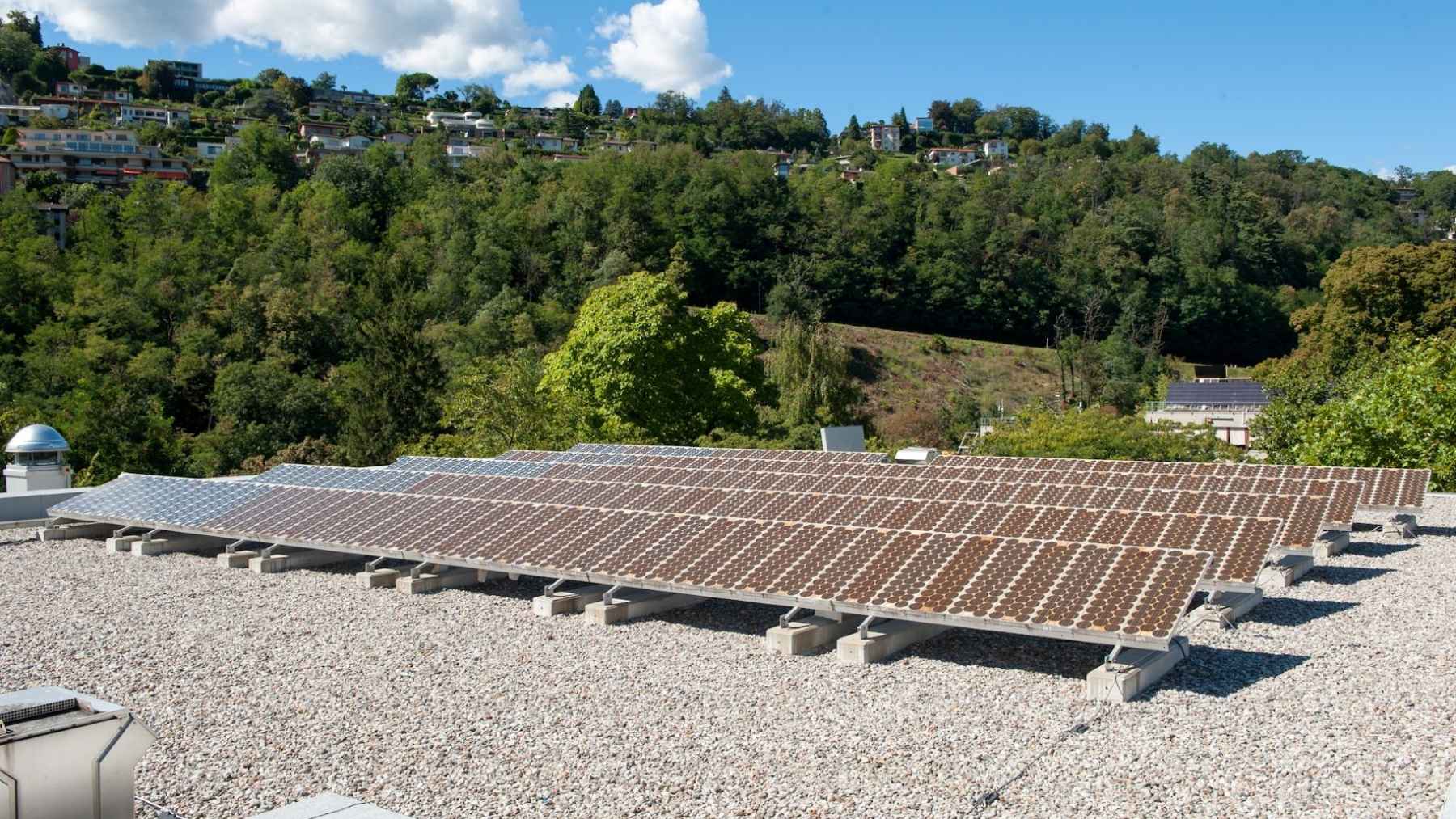
There is one, in a village called Canobbio just outside Lugano, in the Italian-speaking corner of Switzerland. On May 13, 1982, shortly after 7 a.m., an array of 288 panels rated at 10.6 kW started feeding the Swiss grid.
It is still there in 2026, still connected, and it was built with panels made by an oil company. The array is called TISO, short for Ticino Solare, and it is the longest continuous field record anyone has of what happens to a solar panel left outdoors for four decades.
An oil company built the panels, and in 1982 that was the normal way to do it
The modules came from ARCO Solar, the manufacturing arm of Atlantic Richfield. That was not a fluke. Atlantic Richfield spent the late 1970s diversifying away from crude, buying into copper, aluminum and coal, and expanding into solar panel manufacturing along the way.
Charlie Gay, who spent much of his career at ARCO Solar and later at Siemens Solar Industries, wrote the ARCO chapter of SUPSI’s own 40-year history of the plant. His account is blunt about who bankrolled early photovoltaics. Atlantic Richfield, BP, Exxon, Mobil, Shell, Amoco and Total were all in it, and their money and their polymer chemistry gave the technology a running start.
The 288 modules bolted to the Trevano roof were ASI 2300s, rated at 37 W apiece. They were built to the Jet Propulsion Laboratory’s “Block IV” design rules, with a tempered glass front and a backsheet of steel foil sandwiched between layers of Tedlar.
The cells sat in polyvinyl butyral, and the lamination process was lifted straight from the way car windshields were being made. That detail matters more than it sounds. Three different suppliers provided that PVB, and forty years later it is the single thing that decided which panels survived.
The project belonged to Mario Camani, an energy official in the canton of Ticino who wanted to prove a grid-tied array could be safe and boring. Construction started in December 1981. The panels went up on three planes spaced 10 meters apart, tilted at 65 degrees to grab the winter sun.
By 2 p.m. on the first day, 52 people had already turned up to look at it, driving over from the European Community’s photovoltaic conference running that week in Stresa, just across the Italian border.
One honest asterisk on the “first in Europe” line, and it comes from SUPSI’s own book. David Stickelberger, managing director of the Swiss solar association Swissolar, notes that researchers at the Swiss Federal Institute for Reactor Research had already pushed 1.2 kW into the grid from a tool shed roof in April 1981.
Those modules are long gone. TISO’s are not, which is why the literature treats it as the first grid-connected PV plant in Europe.
Forty-eight of the original 288 panels are still working
This is the part that usually gets flattened into a nicer story than the truth. The array is not a sealed time capsule of 288 panels humming along untouched since the Falklands War.
Mauro Caccivio, who runs SUPSI’s photovoltaic sector, put a number on it in a 2024 interview with the Swiss construction journal Espazium: 48 of the original 288 modules are still active and still performing. SUPSI’s institute lists the plant as operating at Campus Trevano, even though the lab itself has since moved to a newer campus in Mendrisio.
The array has also been rebuilt more than once. The wiring layout changed repeatedly as inverters were swapped. At the end of 2008 the whole thing came down for a site change and went back up about 18 months later on a different roof in a new configuration.
Then there is the inverter count. Over the plant’s life the inverters were changed five times. The original Abacus unit lasted around a decade before an Invertomatic replaced it, with longer strings and slightly fewer modules wired in. SMA hardware came later and the design went back to the full 288.
The modules are the only components in the entire system that were never replaced. A handful had junction boxes and bypass diodes swapped out. None were refurbished, none were revamped, and all of them aged together in the same weather.
Domenico Chianese, who joined the project in 1988 and spent his career on it, summed up four decades of maintenance logs by pointing out that the panels were always more reliable than the electronics.
The gap between a good panel and a bad one came down to one supplier
In 2017 the Swiss Federal Office of Energy paid to find out what had actually happened. Alessandro Virtuani of EPFL and Caccivio at the SUPSI PVLab pulled every module off the roof, measured them indoors, and spent roughly two years digging through 35 years of paper records.
The first of their two papers in Progress in Photovoltaics split the array into two populations. About 21.5 percent of the modules had degraded at a mean of 0.2 percent per year. The other 72.9 percent formed a longer, uglier tail: a mode of 0.54, a median of 0.62 and a mean of 0.69 percent per year.
The second paper explained why. It wasn’t the cells, the glass, the mounting angle or the Swiss winters. It was the encapsulant.
All three formulations were polyvinyl butyral built on the same base polymer, but three separate suppliers used different additives. One of those formulations, present in roughly a tenth of the modules, held the loss to 0.2 percent a year. That is under 10 percent of total power gone in 35 years.
You could see it without instruments. The good panels barely yellowed. The bad ones went brown.
Measured as total power lost between 1982 and 2017, the three classes came in at 4.9 percent, 19.1 percent and 26.1 percent. Around 60 percent of the array was still above 80 percent of its original output after 35 years, or roughly 70 percent once you allow for the three-point measurement uncertainty.
Virtuani’s takeaway was that the bill of materials matters, which reads like a platitude until you remember it means a purchasing decision made in California in 1980 is still visible on a Swiss roof today.
The failures were not all cosmetic. Around 87.5 percent of the modules showed minor delamination at the front, and junction box problems turned up across all three groups. What the array never showed was water getting in. That steel foil backsheet behaves closer to a modern glass-glass panel than to the glass-and-plastic sandwich that replaced it.
A second Swiss study came back this year with even better numbers
TISO is one array, which is a fair objection. So in January a SUPSI-led team published a broader answer in the Royal Society of Chemistry journal EES Solar, covering six grid-connected Swiss systems installed between 1987 and 1993.
The average system-level performance loss came out at 0.24 percent per year, give or take 0.16. The figure normally quoted in the literature is 0.75 to 1 percent.
The hardware is familiar. Every system used ARCO AM55, Siemens SM55, SM55-HO or SM75 modules, all built at the Camarillo, California plant that Siemens Solar acquired along with ARCO Solar in 1990. Atlantic Richfield’s exit from solar was permanent, and BP finished the job by absorbing what was left of ARCO itself in a $27 billion deal that closed in April 2000.
The interesting result is where the panels aged best. The team split the sites by altitude: rooftops at Möhlin and Burgdorf between 310 and 552 meters, the Mont-Soleil plant at 1,270 meters, and two facade-mounted arrays at Birg and Jungfraujoch, the second of those sitting at 3,462 meters.
The low-altitude systems ran up to 20 degrees Celsius hotter, which accelerated encapsulant breakdown and acetic acid formation and produced localized corrosion. Heat is what kills panels. Cold, steep and high is a good place to be, which is the same physics that makes the 4,872 panels bolted to the face of the Muttsee dam deliver 43 percent of their annual output in the winter half of the year.
The inverter is still the weak link, and the US just made new ones harder to certify
Every long-term study lands on the same practical point. The silicon is fine. The box on the wall is not.
Which makes the timing of the current American fight over inverters worth a look. On July 29 the Federal Communications Commission’s Public Safety and Homeland Security Bureau added foreign-produced power inverters to its Covered List, on national security grounds.
The scope is narrower than the headlines suggest, and worth stating precisely. It applies to prospective equipment authorizations for new device models, not to hardware already holding an FCC grant, which can still be imported, sold and installed.
It targets networked inverters with remote communications or firmware update capability, and equipment with no remote control features falls outside it. There is a conditional approval route through Homeland Security and the Pentagon for manufacturers willing to open their supply chains and move assembly onshore.
It still leaves a hole. Department of Energy figures put domestic manufacturers at roughly 7 percent of the US inverter market. The determination rests on the risk of remote firmware pushes rather than physical tampering, after a DOE analysis in January inspected 30 Chinese inverters and found no definitive evidence of hidden devices.
Set that against a Swiss roof that has burned through five inverters while the panels underneath never moved, and the priorities look a little strange. The component the US is now rationing is the one with a documented habit of dying first.
What 44 years of data actually tells a panel owner
The warranty question is having a moment in the research too. A paper published this year in the International Journal of Energy Research argues the industry keeps inferring module lifespan from manufacturer warranties, and that this distorts the picture, because panels get pulled for economic reasons long before they stop working.
The warranty is a commercial instrument. It was never a measurement.
There is a smaller irony underneath all of this. The US lab whose fleet data everyone cites for degradation rates, which puts the median real-world loss at 0.75 percent a year, was renamed in December 2025. The National Renewable Energy Laboratory is now the National Laboratory of the Rockies, with “renewable” taken out of the title. The datasets did not change.
Switzerland, meanwhile, keeps running the long experiments. Panels on a dam face, panels locked between the rails of a working railway line that 11,000 trains have now rolled over, and a 1982 array nobody ever got around to switching off.
None of it tells you which group your own panels are in. The decision that mattered at Trevano was made by a purchasing manager picking an encapsulant supplier before the pallet ever shipped, and nobody prints that on the frame. The recycling plants now going up in Georgia exist because plenty of panels do not make it.
What you can check is the inverter. On the evidence of one Swiss roof, that is the part you will buy four or five times before the panels ever give up on you.
 @backcountry164 ROOKIE1 month ago