
Solar farms need land, and a lot of it. The usual move is to find a stretch of desert or scrubland nobody is using, bolt down panels by the acre, and call it progress. California just tried the inverse.
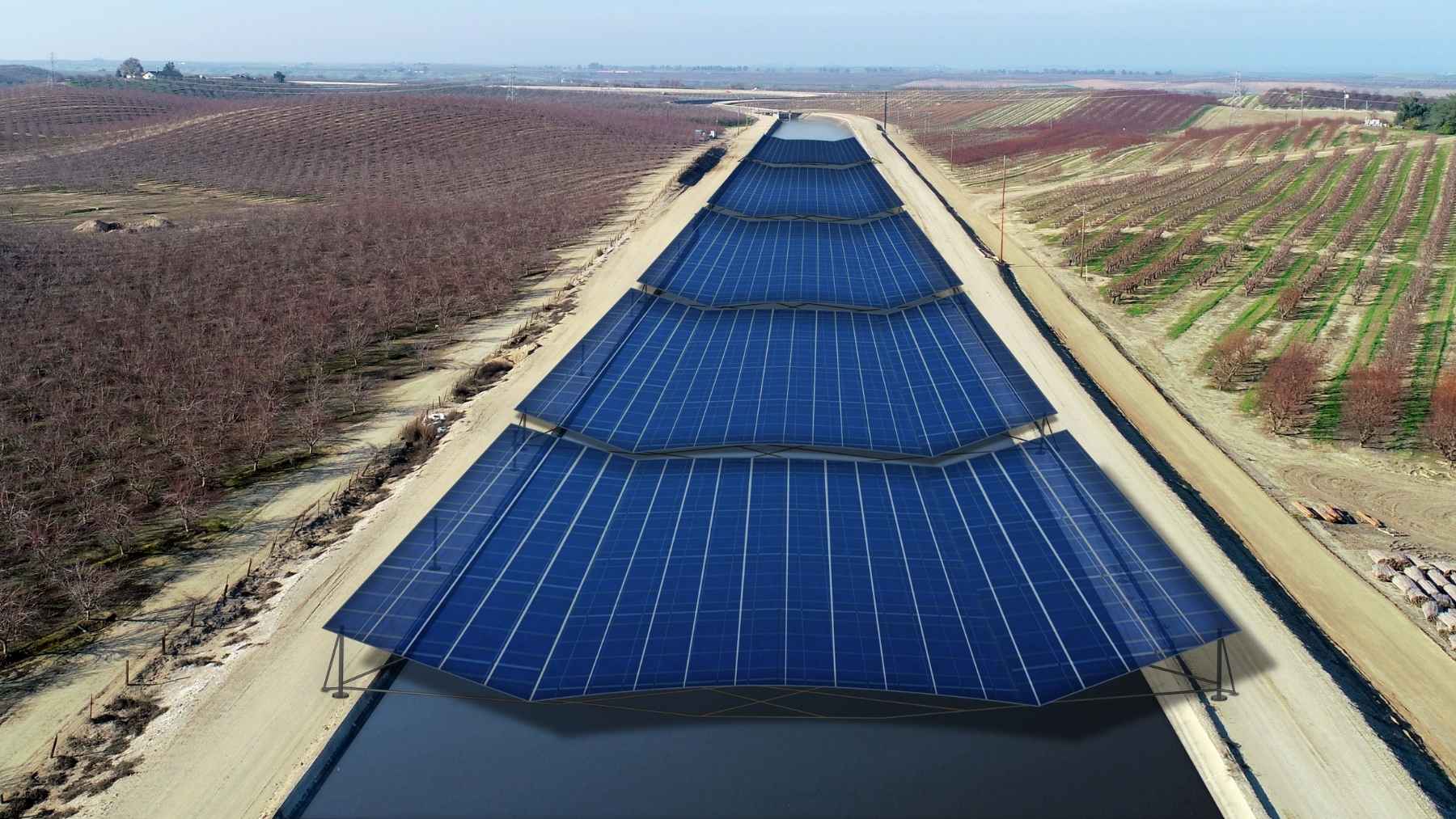
Instead of laying panels over dirt, it strung them over moving water, roofing a pair of irrigation canals in the Central Valley with solar that makes electricity and keeps the water underneath from evaporating before it ever reaches a farm or a faucet.
The state is calling the result first-of-its-kind, which is true in one narrow sense and a generous stretch in a couple of others.
The project is called Project Nexus, it cost $20 million in state money, and it sits on canals run by the Turlock Irrigation District south of Modesto. California formally marked its completion at the end of April, after the panels had been going up over the past year. The idea was never just to generate power.
It was to do two jobs with one piece of infrastructure, on land the state already owns, and then measure exactly how well the second job actually works. After one full irrigation season, the first hard numbers are in, and they are good enough to make a lot of people outside California pay attention.
Two canals, 1.6 megawatts, and one season of data
The build itself is small and deliberately varied. Researchers ran steel scaffolding over two very different canals: a narrow one no wider than an alleyway, and a wide one roughly the span of an eight-lane highway, testing coverings at about 30 feet and 130 feet across.
The panels face south and west and sit on a rail system that lets workers slide them aside to get at the water below, which matters if you ever want to dredge or repair the thing you have just covered. Put together, the two installations cover an area about the size of one and a half football fields and generate a combined 1.6 megawatts.
The water results are where it gets interesting. Sensors in the canals recorded evaporation dropping by 50 to 70% beneath the panels over the season, with the shade also choking off the light that algae and aquatic weeds live on. Weed and algae growth fell by about 85%, according to UC Merced, which runs the science side of the project.
There is a bonus on the power side too: water sitting under the array keeps the panels cooler than they would run over hot ground, and cooler panels are slightly more efficient, nudging output up a few percent. It is the same physics that makes putting solar panels over reservoirs and lakes appealing, just applied to a skinnier strip of water that happens to run past farms and power lines at the same time.
California is first in the state, not first in the country
Here is where the first-of-its-kind label earns its asterisk. Project Nexus is genuinely California’s first solar-over-canal project, and it is the first real-world test tied to the state’s enormous public water system, so the framing is not wrong so much as easy to misread. What it is not is the first time anyone has done this.
Two canals in Gujarat, in western India, were roofed with solar more than a decade ago, back when the people now running Project Nexus were still arguing over whether the idea could pencil out. And much closer to home, the Gila River Indian Community built a solar-covered stretch along Interstate 10 south of Phoenix in 2024.
The Arizona project is worth dwelling on, because it quietly beat California’s headline numbers. It generated 1.5 megawatts, about 25% more than the engineers expected, helped along by that same cooling effect. The water temperature dropped a full degree as it ran through roughly 3,500 feet of shaded canal, and the covered section grew no algae at all.
So the novelty California is being credited with is really a novelty of scale and bookkeeping, not of concept. The genuinely new thing is not that someone put panels over a canal. It is that a state with 4,000 miles of canals spent real money to measure, season by season, whether doing it everywhere would be worth it.
The prize is the other 4,000 miles
The reason a football-field-and-a-half pilot gets national press comes down to the math behind it. Project Nexus grew out of a 2021 UC Merced study, published in the journal Nature Sustainability, that modeled what would happen if California covered all roughly 4,000 miles of its open canals with solar.
The projections were big enough to get the governor’s office on the phone: up to 63 billion gallons of water saved every year, enough for 2 million people or 50,000 acres of farmland, plus around 13 gigawatts of generating capacity, which is close to half the new solar the state figures it needs to hit its climate targets.
By one framing in the study, that is enough clean power to run a city the size of Los Angeles for nine months out of the year.
Those are ceiling figures, not forecasts, and the researcher who ran the numbers is the first to say so. California’s canals come in wildly different widths, conditions and locations, and steel over water costs more than panels on flat desert. “It’s still really early to say what the economic feasibility of this is,” Brandi McKuin, the UC Merced project scientist who led the original study, told The New York Times.
She has also been blunt that nobody is realistically going to cover every mile. The land logic is still what makes the whole thing attractive, though. California already makes so much midday solar that wholesale prices sometimes go negative, and the cheap, flat, sun-soaked land sitting near the cities and farms that actually need the power has mostly been spoken for.
That scarcity is the same pressure pushing solar into odd places elsewhere, from reservoirs to a gigawatt of panels bolted into the open sea off China. A canal is just a strip of public land that happens to be wet and already wired into the grid.
Whether Turlock builds more comes down to cost
For all the encouraging numbers, the people who would actually have to pay for the next stretch are still doing arithmetic. Putting solar over a canal is more expensive than dropping it on an empty patch of desert, so for an irrigation district to expand, the extra construction cost has to be offset by the combined value of the water saved, the land it never has to buy, and the money it stops spending fishing weeds out of its canals.
A new UC Merced report, due in the coming months, is the document Turlock is waiting on before deciding whether to build more, according to the district’s director of external affairs, Josh Weimer.
The bigger audience is the California Department of Water Resources, which is watching to see whether solar canals make sense for chunks of the State Water Project, the network that moves water to 27 million people.
The agency’s climate action manager has said the data coming out of this little pilot will be essential to figuring out how the concept holds up outside a modeling study. So two canals near Modesto are effectively standing in for a decision about water and power across most of the state.
None of that requires California to have been first, and it wasn’t. Gujarat roofed canals before half the team had the idea, and Arizona beat the state to it on this continent by two years.
What California has that the others didn’t is 4,000 miles of canal worth covering and $20 million spent finding out, in actual gallons, what a solar roof over moving water really buys you.
The panels are already up and the first season’s numbers are on the table. The only open question is whether the spreadsheet says to build the next stretch, and that answer is still a UC report away.