
Say the word “bomber” to most Americans and a B-52 shows up in their head. Eight engines, a bomb bay the size of a small garage, and roughly 70,000 pounds of ordnance according to the Air Force’s own fact sheet. The thing has been flying since the Eisenhower administration.
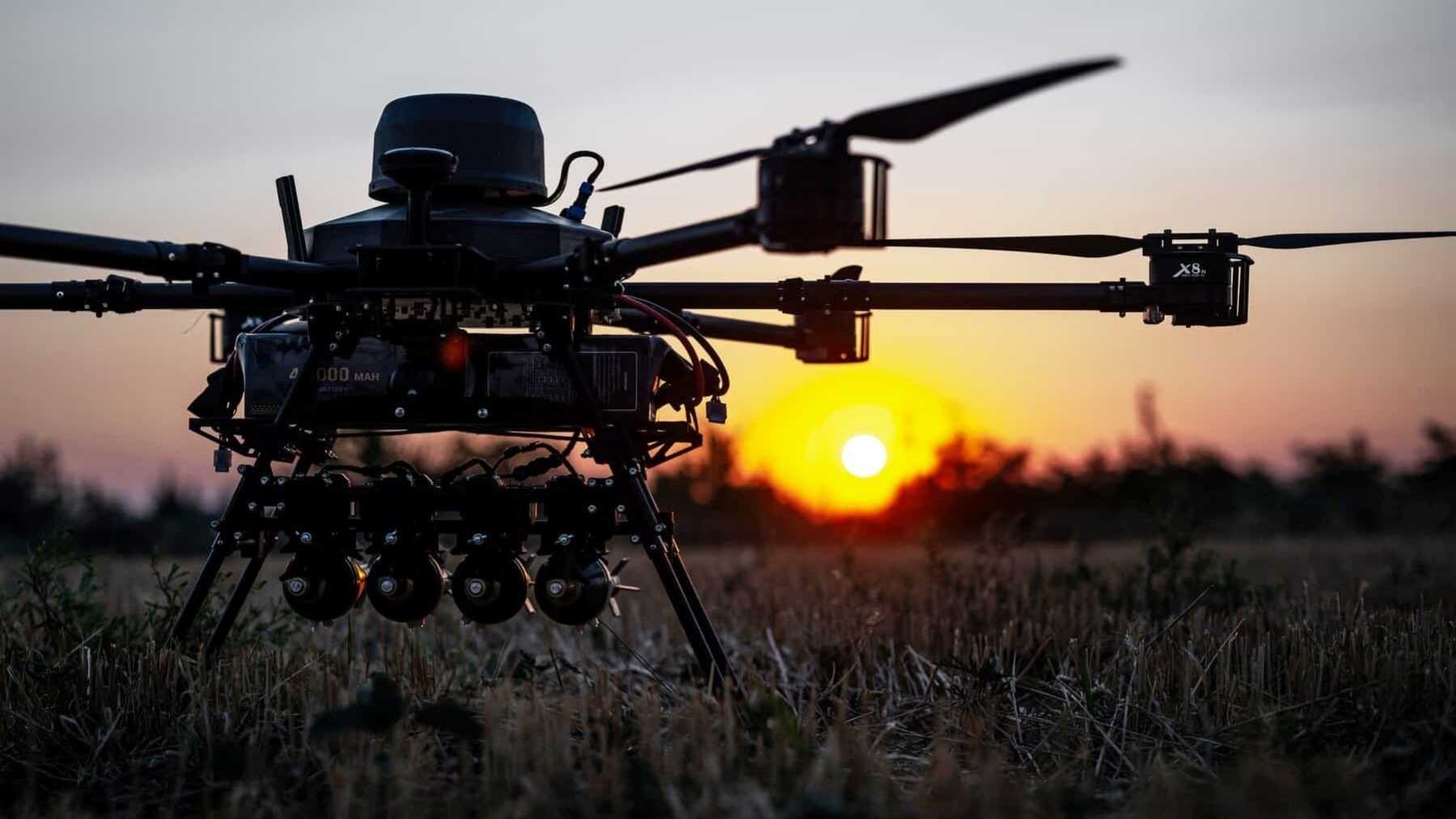
The newest aircraft the Pentagon is calling a bomber weighs less than a Labrador retriever and carries about as much as two mortar rounds.
Bidding on it closed yesterday at noon Eastern. The Department of War posted a request for solutions in late July under its Drone Dominance Program, opening a category it calls Mission C: reusable bomber and dropper platforms. DefenseScoop’s Jon Harper reported the solicitation on July 22, and vendors got roughly two weeks to answer it.
What the government is buying is a small multirotor that flies out 15 to 30 kilometers, drops several munitions on several targets, and then comes home so a soldier can reload it and send it back.
The spec sheet reads like a Ukrainian shopping list
The 16-page request for solutions is public, and it is worth reading if you want to know what three years of watching drone war actually taught American procurement.
Mission range is 15 to 30 kilometers at mean sea level, against targets beyond visual line of sight. Packability is “platoon, man-packable preferred,” and the aircraft must fit on a light-duty combat vehicle either way. The government does not set a size limit, but it assumes most entries will come in at 55 pounds gross takeoff weight or less, not counting payload.
Target sets run from enemy personnel and light armor up through maritime landing craft and heavy armor. The drone has to work in rain, wind and heat, in daylight and in the dark, with what the document flatly calls a “dirty” electromagnetic spectrum, meaning jammed radio and denied GPS.
Night vision or low-light capability is not a bonus feature. It is a delivery requirement.
Then there is the detail that most coverage skipped. Test sites may sit as high as 6,500 feet above sea level, so the government suggests vendors bring high-altitude props. That is not a line you write unless you have watched somebody’s quadcopter fail to get off the ground at elevation.
Eight kilograms is a floor, not a ceiling
Several outlets have framed this as a bomber that “only” carries 18 pounds. That reads the number backwards.
The requirement is a total payload of at least 8 kilograms, spread across multiple warheads, and the pass-fail gate at the qualifier demands the aircraft carry at least two inert payloads simultaneously. Eight kilograms is 17.6 pounds. It is the minimum a system needs to avoid instant disqualification, not the most it is allowed to lift.
The reference munitions named in the document are 60mm and 81mm mortar rounds, both already sitting in Army ammunition depots. A US 81mm high-explosive cartridge, the M821A1 or M889A1, weighs 4.14 kilograms. Two of them come to 8.28.
Which is a fairly direct answer to the question of where the number came from.
The math on $32 million is tighter than the headlines suggest
The figure quoted everywhere is approximately $32 million in initial prototype orders. That number comes from the narrative section of the solicitation.
The overview table on page two of the same document lists the Phase 2.5 Mission C budget as $30 million. Run the posted price sheet and $30 million is exactly what 1,200 units cost: $20,000 for the aircraft plus $5,000 for the logistics package, times 1,200.
There is also a separate line of spending. Vendors who survive the qualifier each receive a $150,000 delivery order covering six aircraft, two sets of ground equipment and 300 inert payloads, due within 90 days. About eight vendors are expected to advance, which is another $1.2 million. The document does not reconcile the two totals.
This pricing model is the part that makes Drone Dominance unusual. The Department posts quantities and prices before anyone competes, then commits to buying from whoever clears the bar. It calls this an advanced market commitment, and it is the same structure that has already moved 30,000 one-way attack drones out of the first round at Fort Benning and put 60,000 more on the table for Gauntlet II, which runs this month at Fort Carson, Colorado with 19 companies still standing.
Reusable changes the reliability bar, and the government knows it
Every previous Drone Dominance mission area bought aircraft designed to die on impact. That includes the $35,000 LUCAS one-way attack drone the military has been wiring up with autonomy software.
Mission C is the opposite bet, and the paperwork reflects it. Each bomber is expected to fly a minimum of 30 missions, with the government stating a preference for 150 before the airframe is lost. Any component with a failure rate under 30 missions has to ship with spares in the logistics package.
The document is blunt about the standard: because bombers are reusable, it expects higher reliability and capability than one-way attack systems, and it expects entries with real autonomy to beat manual FPV quadcopters that need constant operator input.
The features it says will separate the winners are pixel lock, object tracking, aided target recognition, aim-point stabilization and predictive impact point estimation. None of those are mandatory. All of them are scored.
Live explosive payloads are not permitted at all in October. Everything flies inert, with the payloads preferably filled with paint or coloured powder so evaluators can see exactly where each one landed. Live munitions integration is scheduled for Phase III.
The application form asks whether your drone has fought in Ukraine
Buried in the required attachments checklist, alongside the bill of materials and the six photographs of your factory floor, is a question the government wants answered in writing: “Has it been used in Ukraine or other combat areas?”
That single line explains the entire specification. Ukrainian units have been flying reusable heavy multirotors since 2022, and Russian troops named them Baba Yaga after the witch that flies at night. Forbes contributor David Hambling, who has tracked the category closely, reported in July that the most common type, SkyFall’s six-rotor Vampire, delivers a 33-pound bombload around 20 miles, while the Kazhan series carries up to 66 pounds.
Put the numbers side by side and the Pentagon’s floor is roughly half of what the most widely used Ukrainian bomber already lifts. Which suggests the requirement was written to be clearable by American manufacturers today rather than to match the state of the art.
Hambling also reported that Ukraine has approved mass production of Firefly, a bolt-on guidance kit for 2 to 20 pound munitions that costs about $240 a unit at a stated capacity of 10,000 a month. The American equivalent named in the solicitation is MALET, an Army-developed payload interface and fuzing system that the program expects to adopt from Phase III onward.
The October events are 48 hours apart
Applications are reviewed within four weeks, so vendors know by early September whether they are invited. The qualifier and the Gauntlet both happen in October, at a location the Department has not announced, roughly two days apart.
At the qualifier, vendor pilots fly scripted test lanes with a minimum of six aircraft and 30 inert payloads on hand. One complete drone and ground control station has to be shipped to the Defense Contract Management Agency 30 days beforehand so an assessor can take it apart and check the supply chain claims.
Then the vendors spend two days training up to three teams of American warfighters, hand over the controls, and watch soldiers fly their aircraft through scenarios nobody showed them in advance. Roughly three companies walk out with delivery orders. Everyone else gets a line on a public leaderboard.
The industrial side of this is moving on its own track. On July 31, the Department’s Office of Strategic Capital signed a conditional loan commitment of up to $820 million with Performance Drone Works to build domestic manufacturing capacity for drone components. Emil Michael, Under Secretary of War for Research and Engineering, said the mandate for drone dominance “requires a secure and resilient industrial base here at home.”
Conditional is doing some work in that sentence. The commitment still has financial, legal and technical due diligence to clear before it closes. It also sits under Executive Order 14307, signed June 6, 2025, which is the document this entire program traces back to.
Vendors hear back within four weeks. The delivery clock after that is already fixed: half the order inside two and a half months of the delivery order, the rest inside five, and the government reserves the right to cancel whatever shows up late.
That is an aggressive schedule for an aircraft category the American military was not buying at all a year ago. It is also, give or take, the schedule Ukrainian workshops have been running on since 2022, which is presumably the whole idea. Whether US manufacturers can hit it while the counter-drone side of the house is still arguing about how to shoot these things down is a separate question, and one nobody answers in October.