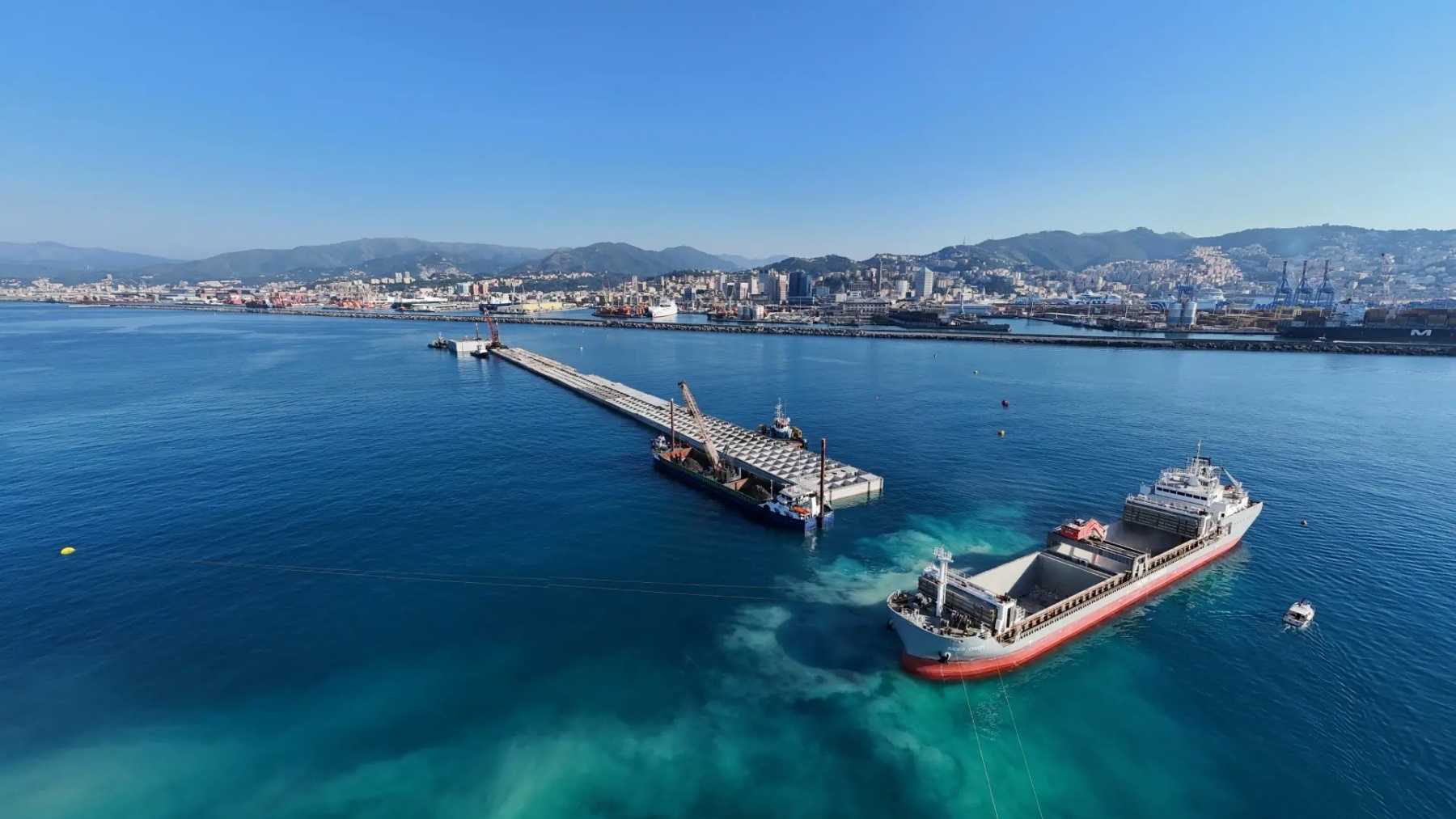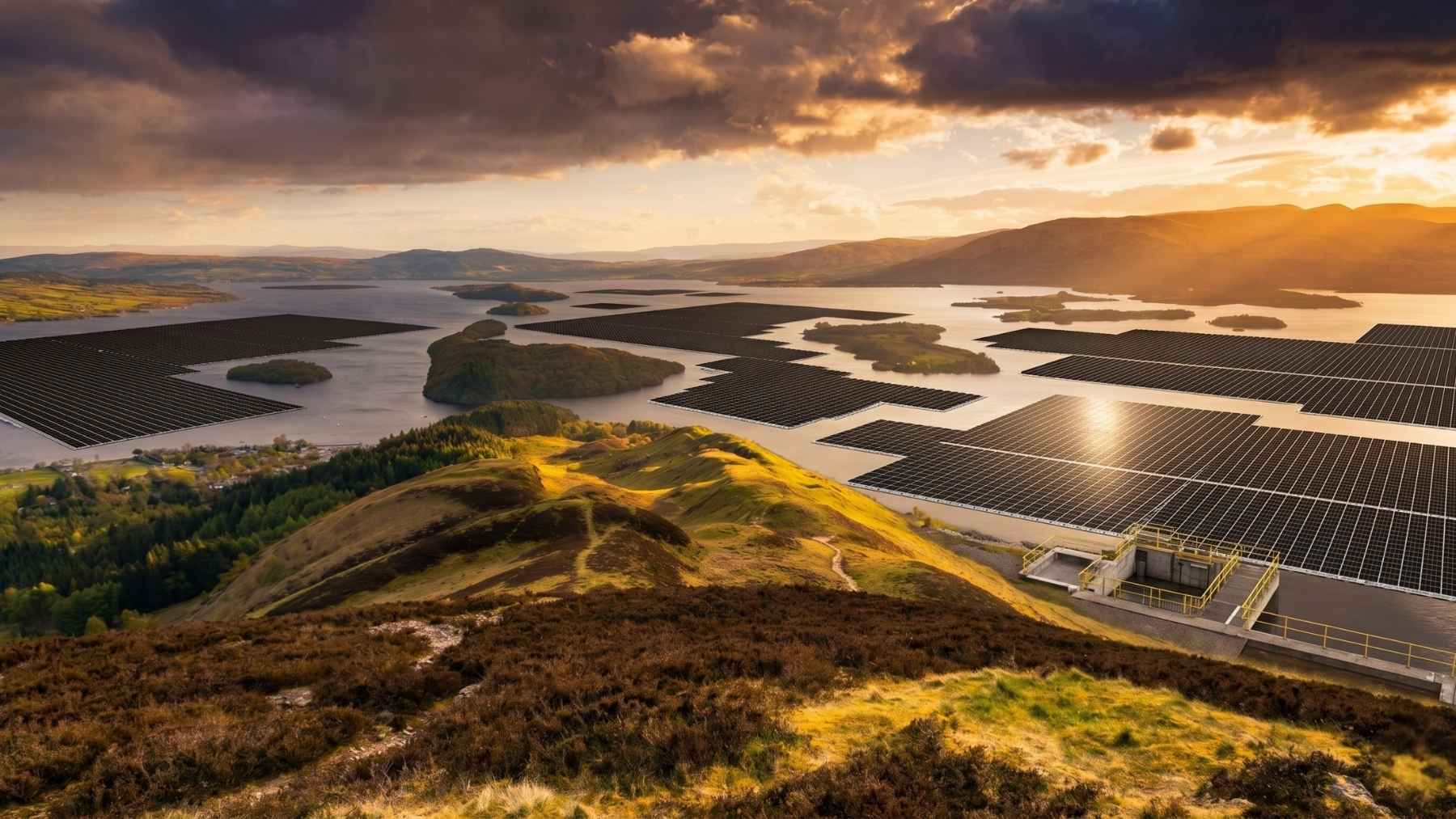

Britain’s Energy Secretary Ed Miliband announced on April 30, 2026, that he would launch a public consultation to fast-track floating solar farms on UK reservoirs and lakes. The Telegraph carried the story under the headline that Labour was planning to “blanket lakes with floating solar panels.” The number that did not make most headlines was the one in the report Miliband was endorsing. According to research commissioned by the energy investor Bluefield and modelled by CBI Economics, British inland water could host up to 58.6 gigawatts of floating solar capacity by 2050. The most ambitious scenario in that report would cover roughly 33,500 hectares of British water, an area about five times the surface of Loch Lomond.
Two months earlier, the U.S. National Renewable Energy Laboratory had quietly published its own report on the same subject. The NREL title was less catchy than the Telegraph’s. It read “Floating Solar in Hydropower Reservoirs in the United States.” The numbers underneath were not small.
What the NREL paper actually says
The NREL February 2026 assessment mapped the potential for floating photovoltaics on federally regulated reservoirs across the continental United States, covering the dams operated by the Bureau of Reclamation, the U.S. Army Corps of Engineers, and reservoirs licensed by the Federal Energy Regulatory Commission. The headline finding, summarized in Inside Climate News a few weeks later, was that floating solar on the reservoirs behind federally owned dams could provide enough electricity to power roughly 100 million American homes a year if every developable surface were built out. That is a ceiling figure, not a forecast. It still tells you the shape of the resource.
The reservoirs that show up in that NREL inventory are not abstract. They are Lake Mead, Lake Powell, the Tennessee Valley Authority system, the Columbia River impoundments, and the smaller Bureau of Reclamation reservoirs across the Mountain West. They are sitting on more than 80 years of federal hydropower infrastructure that already has the grid connections, the substations, and the transmission rights-of-way that ground-mounted solar projects spend a decade fighting for in places like Will County, Illinois, or McDermitt, Nevada.
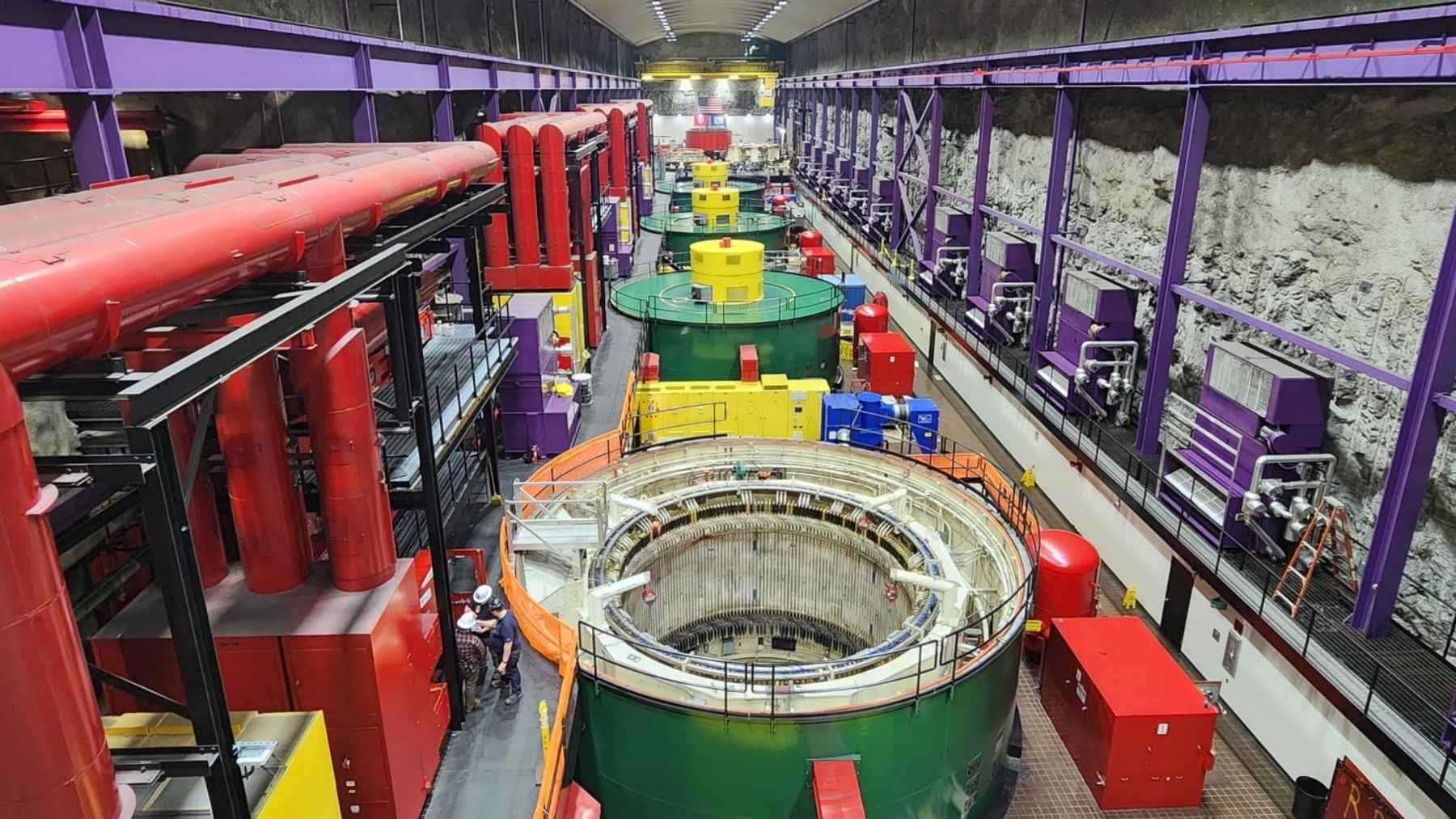
The grid is also exactly where the math is starting to move in the United States, and not in the direction the Bureau of Reclamation would prefer. On April 17, 2026, Reclamation announced that proposed drought response actions could cut Hoover Dam’s hydropower generating capacity by as much as 40 percent as early as this fall. That is roughly 830 megawatts of firm, dispatchable, federally owned electricity that is in the process of going off the regional grid, mostly because Lake Mead is running too low to spin the turbines properly. Lake Powell is in similar shape. Reclamation has acknowledged that hydropower at Glen Canyon Dam ceases if Lake Powell drops below 3,490 feet, and the agency has put a 10 percent probability on that happening by September 2026.
Why floating solar is the obvious answer Britain is now writing into policy
Land-based solar in the U.S. has a permitting problem and a politics problem. Both are well documented. The McDermitt Caldera lithium project in northern Nevada has spent five years in tribal and BLM litigation. The Will County, Illinois solar buildout has been slowed by rural opposition. Texas farmland is increasingly contested between row-crop production and gigawatt-scale photovoltaic leases. Most of the cheap, easy, uncontroversial land for utility-scale solar in the lower 48 was permitted and built between 2015 and 2023. What is left is hard.
The American floating solar resource is the photographic negative of that problem. The federal reservoirs are already federal. The grid interconnection at the dam is already there. The water cools the panels, which boosts efficiency by a few percentage points in summer, exactly when the grid needs the most power. The panels reduce evaporation on reservoirs that the Colorado River Basin can no longer afford to lose. The 2021 NREL cost study found floating solar runs about 20 percent more expensive to install than land-based, and the cooling efficiency gain offsets part of that delta. The economics are not perfect. They are also not the bottleneck. The bottleneck is permitting.
The British plan, in that sense, is interesting less as an energy story and more as a regulatory one. Miliband is not proposing a new technology. Floating solar is a mature category, with more than 2.6 gigawatts deployed globally as of last year, mostly in China, Indonesia, Singapore, and the Netherlands.
What he is proposing is to remove the planning friction that has kept British FPV stuck at roughly 100 megawatts of operational capacity by the end of 2025, against a project pipeline of 1.5 gigawatts that has not yet cleared the consenting regime. The U.S. equivalent of that friction lives mostly inside FERC, the Bureau of Reclamation, and the Army Corps. Each of those agencies has the legal authority to license floating solar on the dams they already operate. None has so far written the consenting regime that would let it happen at scale.
The Gila River precedent
The closest U.S. analogue to what Miliband just proposed is happening on tribal land. The Gila River Indian Community in Arizona is currently developing floating solar on its own reservoir, with explicit support from federal infrastructure funding, after a 2023 bipartisan bill from Senator Angus King and Representatives Paul Tonko and Jared Huffman, called the POWER Our Reservoirs Act, ordered DOE and Reclamation to study exactly this question. The NREL February 2026 paper is part of that study program. The Gila River project is not the largest floating solar deployment in the United States, but it is the first on a federally regulated reservoir, and the people watching it most closely are the Bureau of Reclamation engineers who have just had to publish a 40 percent hydropower cut forecast for Hoover Dam.
If the Gila River pilot performs the way NREL’s model expects, the same engineering can be specified for Lake Mead, Lake Powell, the TVA reservoir system, and the Columbia River dams. Whether it will be specified, in volumes that mean anything against an 830 megawatt Hoover shortfall, depends almost entirely on whether the federal agencies decide to write the consenting regime. That is a procedural question, not a technical one. It is the same procedural question the British government has just decided to answer, in public, in the opposite direction.
The reason any of this matters for a Tesla owner in Phoenix or an F-150 Lightning owner in Las Vegas is that the grid those vehicles charge from is the same grid Hoover Dam has been feeding for almost a century. The Western Interconnection is losing hydropower at roughly the same rate it is gaining EV charging load. The arithmetic of replacement, between now and 2035, is the entire story of how cheap or expensive overnight residential charging gets in the Southwest. Floating solar on the federal reservoirs is one of the few options on the menu that does not require buying farmland, displacing a tribal claim, or building a new transmission corridor through a rural county that does not want one.
Britain just put a number on what that option looks like at national scale. The Energy Minister Michael Shanks, endorsing the Bluefield report, said it was time Britain “stopped letting our solar potential float on by.” Whether that line lands as ambition or as parody depends on which side of the rural-planning debate the reader sits. The phrase has the merit of being literally accurate.
The reservoirs are already federal. The grid is already there. What is missing is the paperwork on about four federal agency desks, and none of them has written it yet.