
It seems like just yesterday that the Corvette was getting a ton of attention for its top speed. That’s because it basically was. Chevrolet announced on June 30 that the 2027 Stingray had been validated at 200 mph, which makes it the cheapest way on the planet to hit that number.
Starting price? $73,495. Not “under six figures.” Under seventy-five grand.
The next cheapest ticket into the 200 club is the Cadillac CT5-V Blackwing, which does 205 mph but flirts with $100,000. A Porsche 911 Turbo S matches the Corvette’s 200 mph and starts at $270,300. So yeah, the Stingray is doing something genuinely absurd here.
Well, Chevrolet is already looking past it toward the ninth generation.
The ninth generation, or C9, arrives as a 2030 model. Sources have told MotorTrend it could break cover as early as 2029, and that it’s getting a completely new look.
The C9 revisits a previous concept
The Corvette may have speed records on its side, but it’s not really the perfect sports car. There have been constant complaints about its proportions, its cabin, and its design.
MotorTrend doesn’t sugarcoat it either, describing the C8 as “neither a classically pretty Corvette nor a well-proportioned mid-engine sports car.” Owners also weren’t thrilled with how closed-in the cabin feels, something the 2026 facelift only partly addressed.
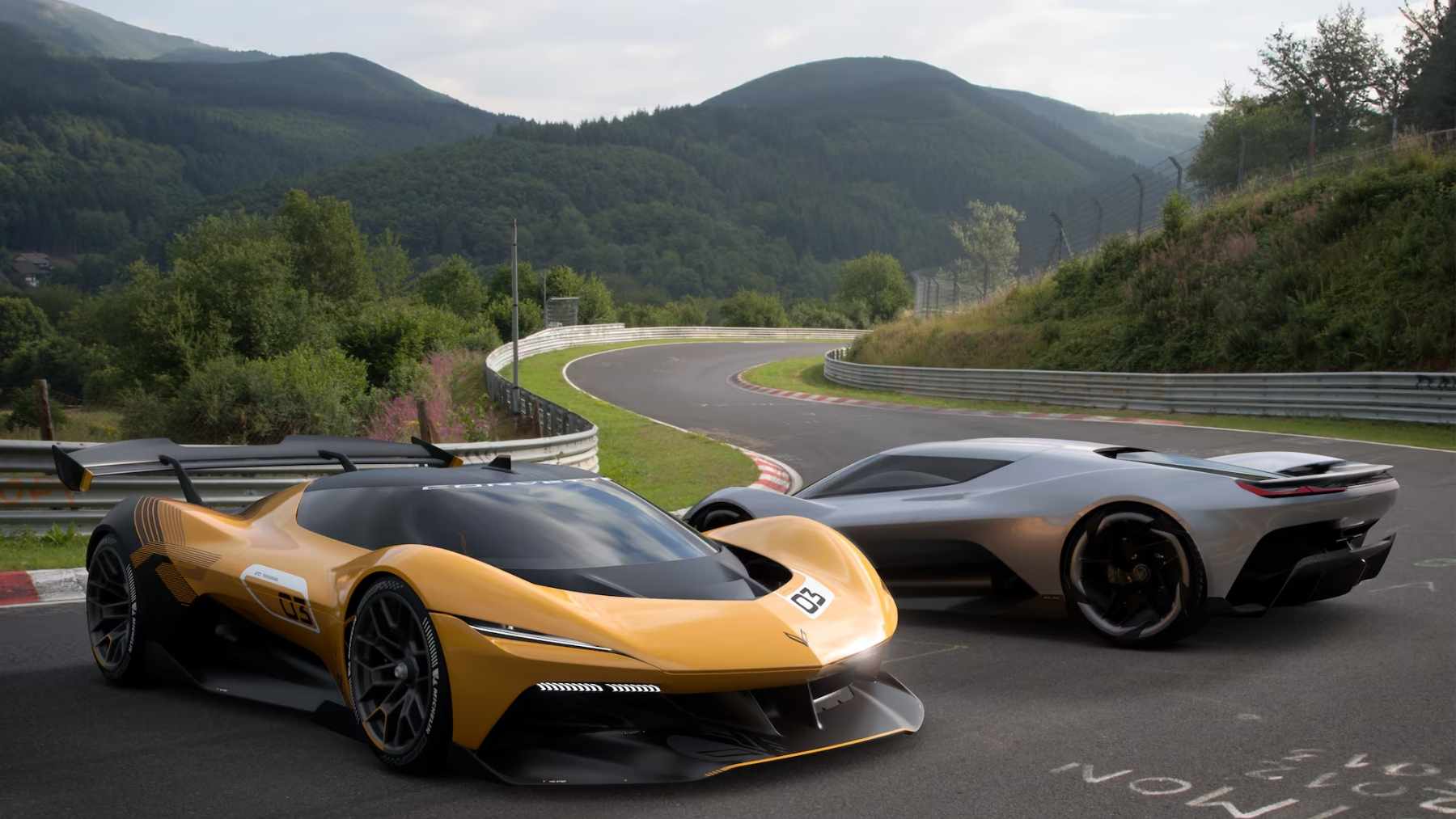
So the sources say the C9 will land with an entirely new look. Well, new for production, anyway. It’s apparently going to draw heavily on the 2025 Corvette CX concept.
Now, a quick note, because the coverage is already muddling this. Chevrolet showed three Corvette design studies in 2025: the California Corvette from the Pasadena studio in April, then the CX and the CX.R Vision Gran Turismo, which debuted together at The Quail during Monterey Car Week in August.
The CX.R is the track one, the hybrid you can drive in Gran Turismo 7. The CX is the road-going sibling, and that’s the one MotorTrend points at.
Which is a curvier, more retro-leaning shape with the Coke bottle hips that front-engine Corvettes wore for decades. I’m sure most enthusiasts will be excited about that.
One catch: the CX is a 2,000-horsepower quad-motor EV with a fighter jet canopy and a ground-effect fan system. So we are strictly talking about the bodywork here. Nobody is putting a fighter jet canopy on a car you can buy at a Chevy dealership. Sorry.
MotorTrend says the production version will be softer and more cohesive than the show car. Underneath, expect an updated and hopefully lighter take on the C8’s architecture rather than a clean sheet.
So what’s actually going to power it?
Unfortunately, not much else is known about this rumored redesign. But the engine question has a pretty satisfying answer already.
MotorTrend expects the C9 to launch with a naturally aspirated pushrod V8, which is good news for anyone who spent the last few years dreading a battery-powered Vette. A fully electric Corvette is still possible, just later, sometime in the early 2030s.
And here’s the fun part. That engine probably already exists.
Chevrolet just introduced the LS6, a 6.7-liter naturally aspirated small-block making 535 horsepower and 520 lb-ft. It’s standard on the 2027 Stingray, the revived Grand Sport, and the hybrid Grand Sport X, and it’s the engine that pushed the Stingray past 200 mph in the first place. I covered it when Chevy finally confirmed the thing was real, after months of it living purely in leaked parts books and blurry spy shots on Angeles Crest Highway.
Quick clarification while we’re here, since even MotorTrend tripped on this one: the Grand Sport’s engine is the LS6, not the LT6. The LT6 is the 5.5-liter flat-plane-crank screamer in the Z06 that revs to 8,600 rpm. Different engine, different personality, confusingly similar name. GM does this to us on purpose, I’m convinced.
The LS6 is a proper piece of engineering, too: 409 cubic inches, a 13.0:1 compression ratio that’s the highest ever for a Corvette V8, and assembly at GM’s Flint plant, where the first Corvette V8s were built back in 1955.
Assistant chief engineer Mike Kociba summed up the philosophy in the press release with a line I think about often: “There is no replacement for displacement.”
While every other automaker shrinks engines, adds turbos and bolts on batteries, Chevrolet went bigger. In 2026. On purpose.
Should you care yet?
Honestly? Only a little. Chevrolet has confirmed exactly none of this, and 2030 is four years out. Plenty of time for plans to change, especially with an EV Corvette floating around in the background.
The C9 will reportedly launch as the base Stingray first, with the Z06, ZR1 and Grand Sport variants filling in as the generation matures. Same playbook as the C8.
But if you’ve got a 2027 Grand Sport on order right now, sorry, your brand new Corvette has roughly three model years before it becomes the old one. That’s just how this works.
For everyone else, the takeaway is simple. The Corvette that people found awkward-looking is getting replaced by one styled after a concept people actually loved, and it’s keeping the big naturally aspirated V8 while doing it. After a decade of everyone assuming this car would end up electric and anonymous, that’s not a bad place to land.
 @dougshanko ROOKIE2 months ago