
Most fights over a wind farm sound the same. Neighbors object to the look of the towers on a ridgeline, or the low hum, or the aircraft lights blinking after dark.
The row now building around a wind farm near Yass, in southern New South Wales, is not that one. Over 18 months, its turbines killed 20 wedge-tailed eagles, the largest bird of prey in Australia, and the number has pulled a question back into the open that the clean-energy build-out keeps trying to walk past: what a turbine is allowed to kill, and who gets to decide.
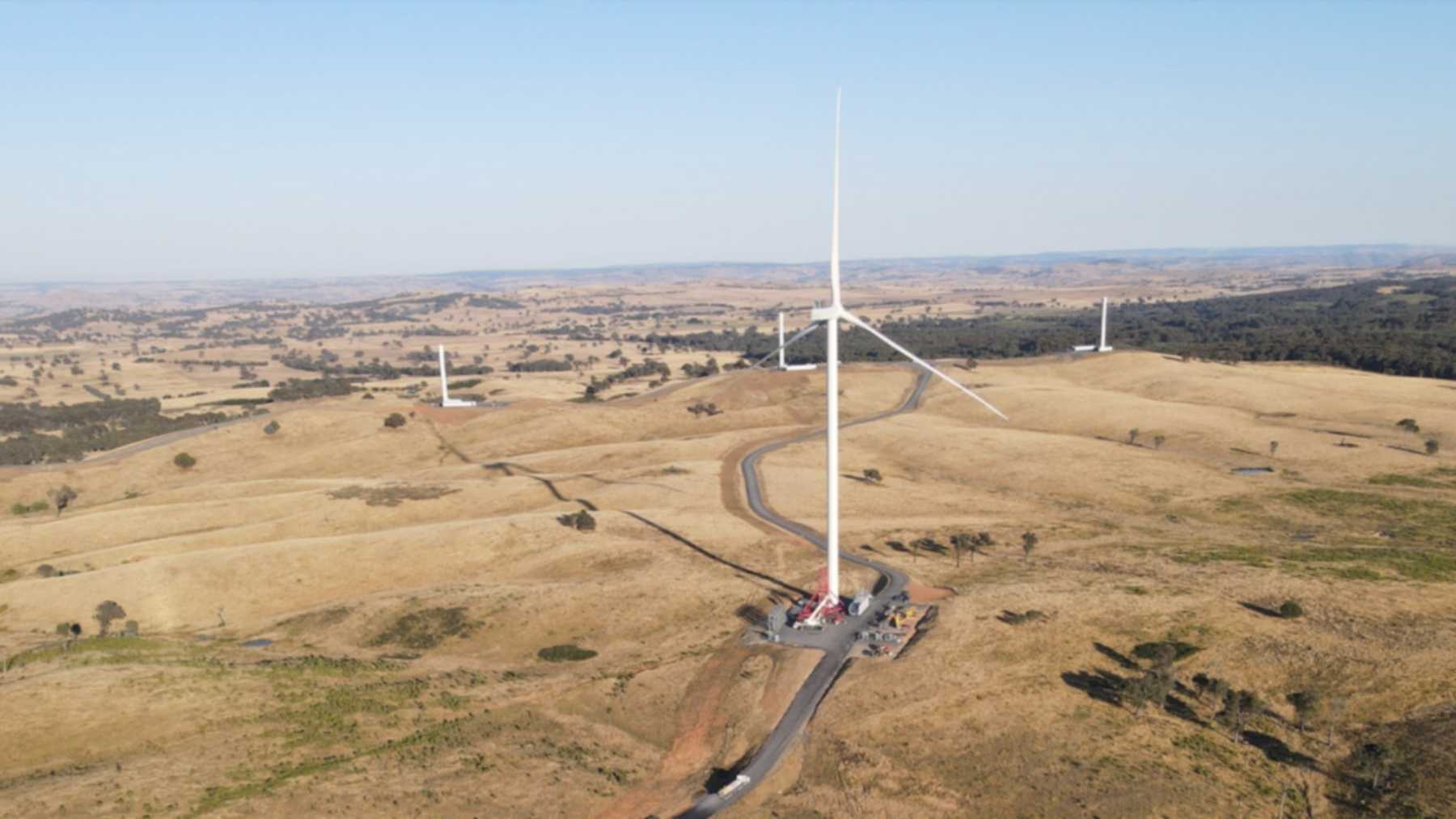
The farm is Rye Park, run by Tilt Renewables. At 396 megawatts and 66 turbines, it is one of the biggest onshore wind farms in the state. It is also, by the company’s own account, the deadliest for eagles that Tilt operates anywhere.
Tilt disclosed the toll at a meeting of the project’s community committee this month. Within days it had hardened into a fresh demand for national rules on how wind farms are built around wildlife.
Tilt says the eagles were dying faster here than anywhere else it runs
Tilt did not bury the figure. A spokesperson said the company takes bird strikes seriously and has monitored them since the farm switched on, using trained detection dogs to search the ground around each turbine and reporting every eagle death to the NSW Department of Planning, Housing and Infrastructure.
What the monitoring turned up was the uncomfortable part. The wedge-tailed eagle deaths, the spokesperson said, were running higher than expected at Rye Park compared with the rest of the company’s fleet, and it was acting on it.
This is not a problem that surfaced last week. Tilt has told RenewEconomy it has been consulting ecologists and government agencies about the eagle deaths for more than a year. The count and the pace of the strikes crossed the reporting threshold written into the project’s approval long ago.
That threshold is specific. Under the farm’s bird and bat plan, two or more eagle carcasses or injured birds found near the same turbines inside any two-month window forces Tilt to notify the state’s conservation regulator within one working day, then file a full report within 15 working days. The system is built to catch a cluster, and it did.
At the community meeting, local representatives wanted more than reassurance. The committee formally asked Tilt to hand over a detailed report in October covering every recorded bird and bat strike at the site, the measures already in place, and whatever else it intends to try.
Yass Valley Councillor Alvaro Charry, who sits on the committee, called the deaths “deeply saddening and concerning.” He noted that the wedge-tailed eagle is a sacred totem of the Ngunnawal people, and argued that clean energy and wildlife protection cannot be run as an either-or.
The eagle is protected, but it isn’t endangered, and that’s the whole argument
This is where it splits. On the mainland, the wedge-tailed eagle is common. The IUCN lists the species as Least Concern, and it soars over farmland across most of the continent, with a wingspan that can reach 9 feet 4 inches (2.84 m).
In New South Wales it is not listed as a threatened species. It is, though, a fully protected native animal, which means killing one is never a free action, even when the bird is abundant.
That gap between “protected” and “endangered” is exactly what people are fighting over. To one camp, 20 deaths across 18 months is a small number against a healthy population, and a thin reason to bolt costly gear onto a working power station. To the other, an apex predator that breeds slowly and patrols a wide territory is worth defending well before the numbers turn bad, and the tools to do it already exist.
The distinction changes what Tilt is actually required to do. Under the farm’s management plan, the automatic shutdown of turbines is reserved for the genuinely endangered species on site: the superb parrot, the large bentwing bat, the white-throated needletail. For the wedge-tailed eagle, the plan leans on other measures instead of stopping the blades.
The math looks different in Tasmania, where the local subspecies of wedge-tailed eagle is endangered and thought to number in the low thousands. There, a run of deaths like this one would land far harder.
The fixes exist, and most of them need a permit first
Tilt’s opening moves are cheap and low-tech. The company has started clearing dead sheep and cattle and collapsing rabbit warrens across the site, on the logic that removing carrion and prey stops drawing eagles down into the rows of spinning blades in the first place.
The heavier tools are the ones conservation and farming groups keep pointing at. Cameras wired to software that halts a blade when an eagle approaches. Radar that tracks birds in flight. And painting one of the three blades black, so the rotor stops smearing into an invisible disc at speed.
That last one has real evidence behind it, though not the kind that ends the debate. In a Norwegian trial at Smøla, painting a single blade black cut the annual death rate at the treated turbines by nearly 72 percent. But the birds saved there were white-tailed eagles, and nobody has shown the trick still works on the far larger rotors going up today.
Farmers for Climate Action, a pro-renewables group, points to Tasmania as proof the camera approach delivers. It says the two farms that fitted AI cameras there, Woolnorth and Cattle Hill, effectively stopped killing eagles without a meaningful hit to output. Its spokesperson, Peter Holding, argued that a wind farm should not clear planning at all unless the mitigation goes in first, and the group put it plainly: the time for consideration is over.
There is a catch that slows every one of these down. Bolting cameras onto turbines or repainting blades counts as a material change to an approved project, which means Tilt cannot simply do it. Each fix has to clear planning on its own.
Some of the industry’s answers run further out, chasing turbine designs that barely sweep any air at all. Those are years away from a ridgeline in Yass, and they do nothing for the eagles dying now.
There’s no standard rule, which is what turned one farm into everyone’s problem
The reason Rye Park’s eagles became a national argument is that Australia has no single rulebook for this. Every project negotiates its own bird-and-bat plan through its own approval, and the conditions drift from farm to farm.
That patchwork is drawing scrutiny at an awkward moment for the industry. The Australian Financial Review reported that the NSW government has floated a crackdown on so-called ghost projects clogging the planning queue, with the Yass Valley, thick with proposals, squarely in frame. The same reporting quoted Goulburn MP Wendy Tuckerman blaming the eagle deaths on rushed planning approvals, and a federal environment spokesperson calling the toll concerning while noting Canberra’s role is limited to nationally protected species.
None of this is unique to wind, or to Australia. The friction between building clean power fast and protecting the wildlife already living where you build keeps turning up wherever the turbines go. Offshore, scientists have tracked seals hunting the exact rows of North Sea foundations, a reminder that these machines reshape the ecosystem around them whether anyone planned for it or not.
What Rye Park adds is a stark version of the trade-off on land, with a bird most Australians recognize on the losing side of it.
October is the real test
The pressure sits on one report. When Tilt returns to the community committee in October with its full strike record and its list of fixes, the argument stops being about a single number and starts being about whether the measures actually move it.
The harder question outlasts that meeting. A wind farm that offsets a lot of carbon is also killing a protected bird faster than its operator expected, and the country still hasn’t decided whether “common but protected” is worth the cameras, the radar, and the black paint. Rye Park just made everyone answer it out loud.