
Run a fish farm far enough out to sea and you run it on diesel. The pens need power for the feed barge and the pumps, and there’s no cable to shore, so a generator sits on the barge burning fuel around the clock.
It’s loud, it smells, and every liter of that fuel has to be shipped out to the site by boat. For decades that was simply the price of farming salmon offshore.
A Norwegian company decided it didn’t have to be. Alotta, the outfit that until 2024 was called Inseanergy, ringed a salmon farm in northern Norway with floating solar panels and a battery, and the diesel generator has barely turned over since.
The site now pulls more than 90% of its power straight off the sun. And having proved that above the Arctic Circle, Alotta is now shipping the same rig to Chile.
The diesel generator has barely run since
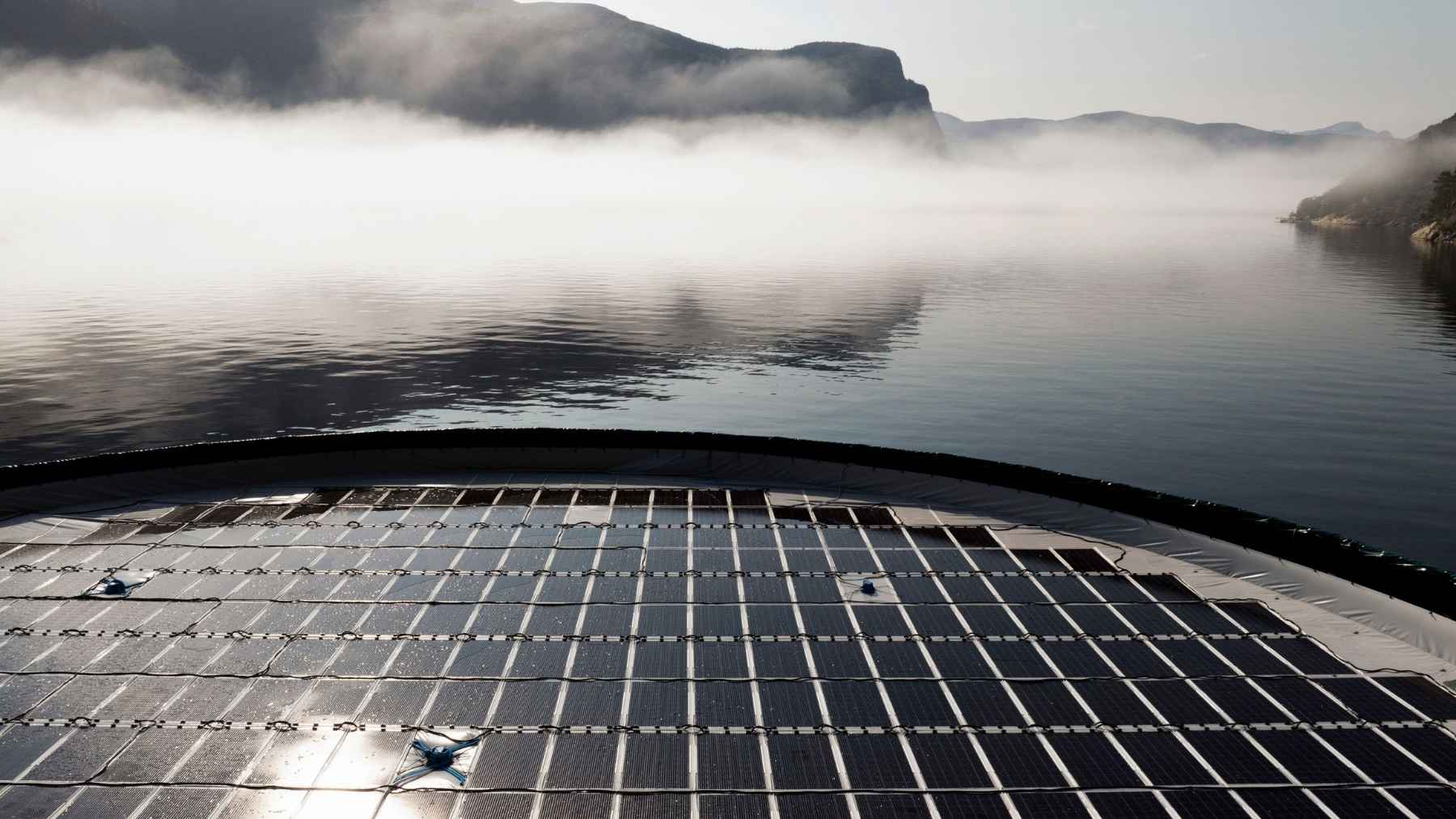
The farm that started it is Emilsen Fisk, a salmon and trout producer working the water at Båfjordstranda in Trøndelag, well up Norway’s coast. Early in 2025, Alotta installed a system it calls the Circle Mc120 on the pens there: floating solar wired to a battery pack.
Since then the site has covered more than 90% of its power from solar and storage alone, according to Alotta, which describes the installation as the world’s northernmost floating solar plant. “We were curious to see how solar power would perform in real conditions — and we got the answer quickly,” Roy Emilsen, the company’s managing director, said in a statement. “The diesel generator has barely been running.”
It isn’t only the fuel. Emilsen has said the site is quieter and cleaner to work on, and there are fewer fuel-delivery runs by boat, which is its own line on the budget.
Solar on a fish farm that far north sounds like a bad joke. Trøndelag gets under five hours of daylight in January.
But it also gets more than 20 hours a day at midsummer, and that, paired with a battery to carry the load into the evening, is enough to keep the generator switched off for most of the year. The math held up well enough that Emilsen Fisk ordered a second unit a few weeks after the first went live, with Norway’s state energy agency, Enova, covering part of the bill through its climate and energy fund.
Alotta’s chief technology officer, Erik Rongved, has said the company sees the same result over and over: size the system right, and solar plus a battery cover most of the load while the generator sits idle.
Panels built on a pen the farm was going to throw away
The hardware leans on something the aquaculture industry already had lying around. Norway retires more than a thousand fish-pen float collars a year, the big plastic rings roughly 120 meters around that hold a net cage open, and Alotta builds its solar platforms on top of them instead of scrapping them.
The panels sit on a flexible membrane licensed from a Norwegian firm called Ocean Sun, floating flat on the sea surface. Resting on the water keeps the cells cool, which nudges their output up, and a battery banks whatever the pens don’t burn during the day.
None of it is a prototype. Alotta wired its first commercial arrays back in 2022 and 2023, a 290-kilowatt system on one salmon farm and a 160-kilowatt rig on a cod farm, before it ever reached Emilsen Fisk.
Floating solar keeps turning up wherever there’s water and a reason to use it. The Dutch have hung fish shelters under a floating solar farm to see what moves in underneath, and China just switched on a gigawatt plant in the open sea with fish farmed below the panels.
Those projects are mostly about sharing space. Alotta’s pitch is narrower, and for a fish farmer it’s more immediate: it’s about the fuel bill.
Chile is the real prize
Norway proved the tech. Chile is where the money is.
It’s the world’s second-largest salmon producer, and by the industry’s count it has more than 600 farming sites with no connection to shore power, each one leaning on a diesel generator. Estimates put the fuel those sites burn at somewhere around 60 million liters a year.
Alotta’s Chilean arm delivered the country’s first at-sea floating solar plant in 2025, on a Mowi salmon farm at Isla Huar in the Los Lagos region, working with the equipment supplier AKVA Group and battery specialist Fjord Maritime. It covers about half the site’s power. Ocean Sun, whose membrane sits under those panels, puts the diesel saved at 139,200 liters a year, about 36,800 gallons, and the carbon avoided at 350 metric tons.
Mowi’s Chilean team called the Isla Huar plant a milestone in its own push toward lower-emission operations.
Then, in October, Alotta signed a fifteen-year deal with Trusal, part of the Chilean producer Salmones Austral, for one floating solar plant with an option for five more.
If all six get built, the company says the farms will cut roughly 10 million liters of diesel and avoid nearly 27,000 metric tons of CO2 over the life of the contract, which Alotta frames as pulling 6,000 cars off the road for a year.
The reason a fish farmer signs up is the way Alotta sells it. The farmer doesn’t buy the hardware. Alotta owns and operates the plant and charges for the electricity it makes, the same arrangement a household gets with a rooftop-solar lease.
That model is what pulled in the cash. The company raised 63.5 million Norwegian kroner, about $6.3 million, in October to push harder into Chile, on the back of a separate fifteen-year power deal with Mowi.
Solar doesn’t retire the generator, it benches it
None of this makes the diesel generator disappear, and Alotta’s own numbers say so. At Emilsen Fisk the sun covers more than 90% of the load; at the Mowi site in Chile it’s about half.
The rest still comes from a generator, and in a Norwegian January, with under five hours of daylight, it comes from the generator a lot. Solar and a battery don’t kill the diesel; they bench it, and they cut how much fuel has to be trucked out to sea.
There’s a business risk baked in, too. Alotta is carrying the cost of building and owning these plants and betting it earns that back over fifteen-year contracts, which only works if the farms stay put and the savings hold.
The company is small, around 15 people. But it has AKVA Group, the largest aquaculture-equipment supplier in the world, and a row of investors standing behind it.
The grid has the same problem, just bigger
Power systems have leaned on fossil plants for a century to do the dull, constant work of keeping supply steady, which is why so much of the energy transition is really about finding something else to do that job. Australia just spent big on a 300-ton machine that spins in place to hold its grid together as coal drops off.
A salmon farm’s version of that problem is smaller and blunter: a generator on a barge, burning fuel to run the pumps. Alotta’s answer is to park solar panels on the water next to the fish and let the generator sit idle.
Above the Arctic Circle it’s kept quiet for most of a year. Whether it does the same across 600 sites in Chile comes down to arithmetic, not ambition — and the fuel bills will have the answer long before anyone else does.
 @paulmockett ROOKIE3 months ago