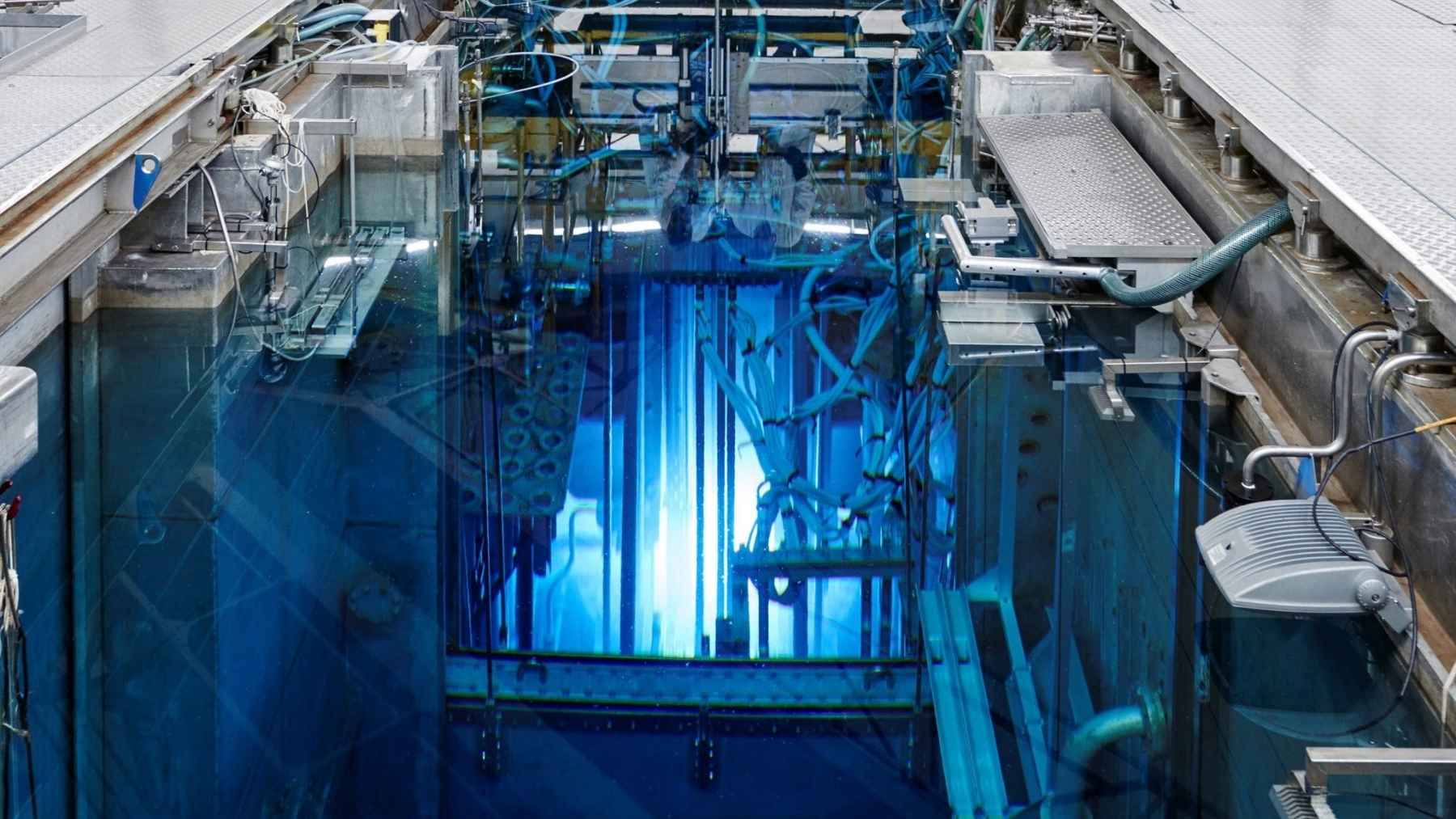

If you have ever had a bone scan, a cardiac stress test, or one of those procedures where a technician injects a tiny amount of something radioactive and then watches it show up on a screen, there is a good chance the raw ingredient started out inside a nuclear reactor. Not a power plant. A research reactor, the kind built to churn out neutrons instead of electricity.
A lot of that raw material still traces back to a machine that has been running since the early 1960s. It sits in the dunes on the Dutch coast at Petten, about 37 miles up from Amsterdam, it is called the High Flux Reactor, and for most of its life it has quietly supplied a large share of the world’s medical isotopes while almost nobody outside the field knew it was there.
The reactor is old, and everyone working on it knows exactly how old. Which is why, a short walk across the same campus, its successor is now rising out of a hole in the ground. And in June the project locked down one of the trickiest pieces it still had to buy.
The replacement just ordered its hardest part
On June 10, NRG Pallas, the group that will run the new reactor, signed an agreement with the Spanish construction firm FCC Construcción to build and install its hot cells, according to Nuclear Engineering International. If that phrase means nothing to you, it is one of the more important sentences in the whole project.
Hot cells are heavily shielded chambers where workers handle intensely radioactive material without ever being in the room with it. Thick walls, thick leaded glass, and remote manipulators, which are basically robot arms operated from the safe side. It is the same handled-by-remote logic behind a US nuclear site where part of the building has not seen a human since 1955.
The reason ordering them now matters comes down to plumbing, more or less. Hot cells are what the industry calls long-lead components. They have to be cast into the concrete structure of the reactor building itself, so there is no adding them later once the walls are up. Order them late and the entire building sits and waits.
What makes the Petten setup unusual is that the whole job happens under one roof, from the reactor pool to the finished shipment, which cuts out a lot of the transport and handling that isotope production normally involves.
The actual fabrication falls to Asturfeito, a Spanish heavy-engineering outfit that also builds gear for particle accelerators and fusion experiments, working as FCC’s specialist subcontractor. Before anything ships to the Netherlands, they will build full-size mock-ups at their own workshops and test the robot arms there, on the sensible theory that you want to find the bugs before the equipment is radioactive.
There is an Argentine thread in here too. The reactor’s design house, ICHOS, is based in the Netherlands but owned by INVAP, Argentina’s state nuclear and aerospace company, which won the design tender on the strength of building research reactors around the world.
“The Hot Cells are technically complex and crucial to the overall functioning of the reactor,” NRG Pallas CEO Maurits Wolleswinkel said, calling the deal the basis for the next stretch of work: manufacturing, installation and commissioning.
Why a Dutch reactor shows up in American hospitals
The link between Petten and a patient in Ohio is the isotope itself. The workhorse product of places like this is called molybdenum-99, which decays into technetium-99m. That second one is the actual star. It is the tracer behind roughly two-thirds of all diagnostic isotope procedures in the United States, according to a National Academies review.
The catch with technetium is that you cannot stockpile it. Molybdenum-99 has a half-life of about 66 hours, and technetium’s is measured in hours, so it starts fading the moment it is made. There is no strategic reserve of the stuff sitting in a warehouse. It has to be produced more or less continuously and shipped fast, which is why a steady reactor matters far more than a big one-time batch ever could.
Only a handful of reactors on the planet make it, and most of them, Petten included, date to the 1960s. On the US side, Mallinckrodt, which supplies a large share of American technetium generators, has long drawn its molybdenum from the Petten site. So a heart scan in Missouri can quietly trace its way back to a reactor in the North Sea dunes.
Across its life the High Flux Reactor has supplied about 30% of the world’s and roughly 60% of Europe’s medical radioactive sources, World Nuclear News reports. It is the kind of infrastructure nobody thinks about until it stops, which has happened. Other reactors handle other isotopes; a Canadian power reactor now breeds a cancer-fighting isotope right in its core, and other teams are busy turning old reactor graphite into diamond batteries. Petten’s job has always been the bread-and-butter diagnostic supply.
A hole 57 feet deep, and divers pouring concrete underwater
The build itself is well past the paperwork stage. The first phase, wrapped up between 2022 and mid-2025, was mostly demolition and groundwork: tearing out old infrastructure, clearing buried cables, rerouting pipelines, and digging the foundation pit.
That pit is the part worth picturing. It is 50 meters square and 17.5 meters deep, or about 164 feet on a side and 57 feet down, a hole deep enough to bury a five-story building before a single wall goes up.
The current phase, running through 2026, is the reactor building itself going in. Crews are pouring the first three underground floors of what the project calls the nuclear island. And in a separate flooded pit next door, divers are doing the civil work underwater for the secondary cooling building, which is exactly as strange as it sounds: people in dive gear, working concrete below the surface, on a nuclear construction site.
After that, the sequence is set by physics. From 2027 to 2030 the hot cells get lowered in and built into the rising structure, because their heavy concrete and lead shielding has to be in place before the roof seals over them. The main reactor building is meant to be structurally finished by 2030, with commissioning and testing through 2031 and commercial operation in 2032.
The whole schedule is built around never blinking
Every one of those dates is bent toward a single goal: no gap in supply. That sounds like boilerplate until you look at what a gap actually does. When Petten’s reactor and a Belgian isotope plant both went offline in 2008, it set off a technetium shortage across Europe and North America that ran for weeks, per the same National Academies work, and scans got pushed back while the supply chain scrambled.
So the handoff from the old machine to PALLAS cannot be a hard cutover with a hole in the middle. The new reactor is meant to be running and proven before the High Flux Reactor, which by 2032 will have been in service for more than 70 years, finally powers down for good.
The point is that you never hear about it
The strange thing about this project is that if it goes exactly right, almost nobody it serves will ever hear about it. The 30,000-plus patients a day who depend on Petten for cancer diagnosis and heart treatments are not supposed to notice that the reactor behind their scan quietly changed.
That is the entire reason for building the successor early and bolting down parts like the hot cells years ahead of the finish line. Get it right and the supply never flickers. Get the timing wrong and it stops being invisible in a hurry.