
Once a year, Salt River Project cracks open the two spill gates on Mormon Flat Dam, checks that they move, and lowers them again. Four or five feet, according to the guy who runs the utility’s hydro plants. That’s the test. Then the gates sink back into Canyon Lake and nobody lays eyes on them for another twelve months.
This fall they’ve gone all the way up.
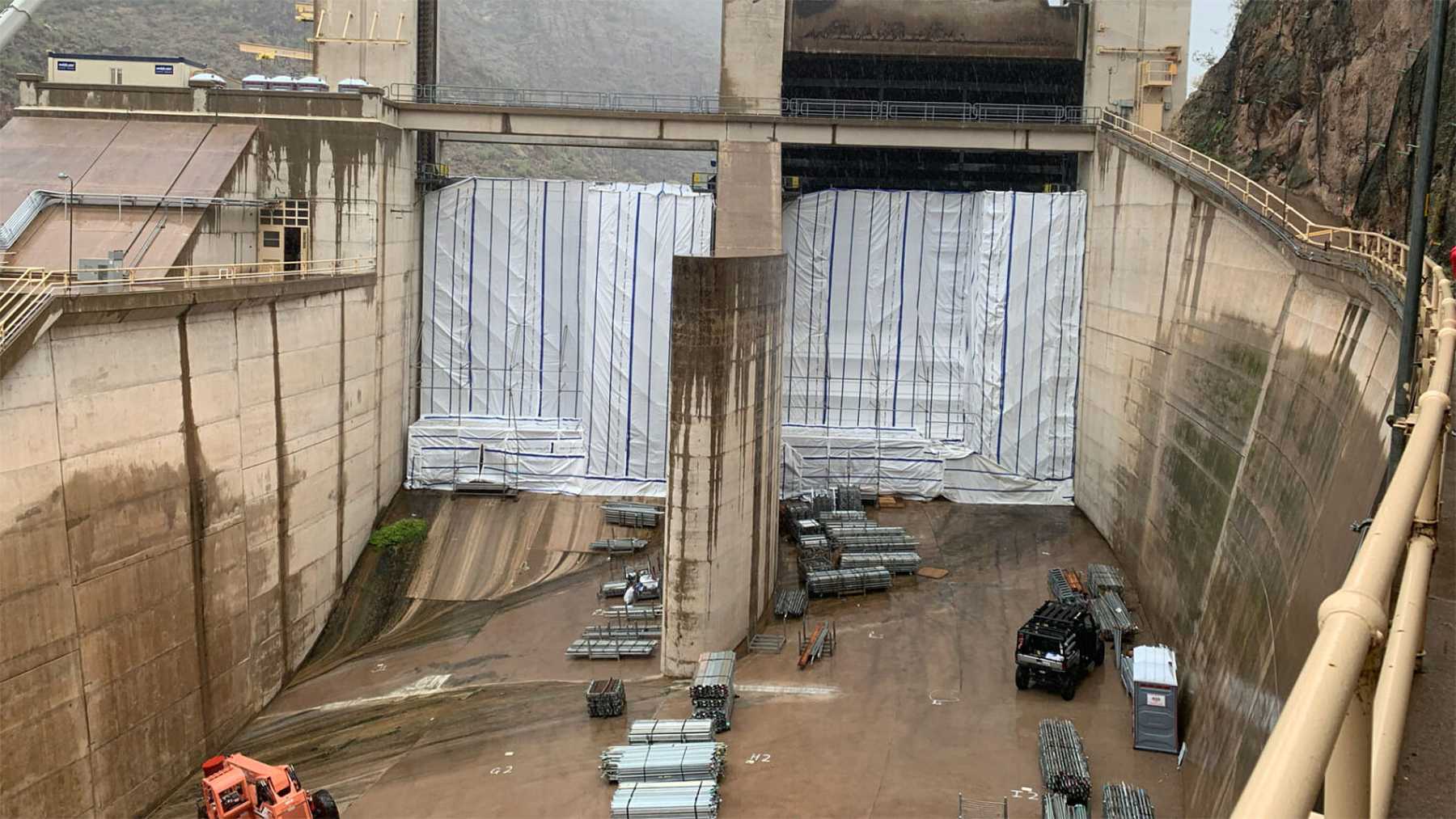
Since September 16, SRP and the U.S. Bureau of Reclamation have been draining Canyon Lake, the reservoir behind the dam about 51 miles northeast of Phoenix, and by mid-October the water had dropped 54 feet. The lake normally runs 142 feet deep at the dam, so that’s a little over a third of the depth, and KTAR puts it at about 65 percent of the lake. Either way, the gates, the spillway and a pile of intake hardware that has sat underwater since 2007 are now out in the open, with a 54-foot bathtub ring on the canyon walls above them, the same kind of ring Lake Mead has been wearing for years, just a lot smaller.
So why drain a lake to look at a dam?
You can look at what’s underwater, but you can’t fix it
Dams get inspected constantly. SRP’s own list goes daily, weekly, monthly, yearly and then every 20 years, which is the one we’re in now. The catch is that a lot of the equipment that matters most on a dam sits below the waterline. SRP sends remotely operated vehicles down to get a look at it, Matt Pendergraft, the utility’s director of hydro generation, told 12News. But a camera on a robot can’t swap out a hydraulic cylinder or repaint 50 feet of steel.
So every two decades the lake comes down far enough to reach everything. The last two drawdowns were 1987 and 2007, which means whoever worked the 2007 job as a rookie is probably running this one, and whoever did 1987 is probably fishing somewhere.
Pendergraft told ABC15 that “this is an every 20-year process,” and that the point is to inspect everything they can’t see so it works when a storm shows up. You and I would call that a very expensive oil change. SRP would call it dam safety, and frankly SRP has the better argument.
Each gate weighs about as much as three tanks
The spill gates are the main attraction. They’re Stoney gates, a roller gate design that goes back to the 1800s, each one 50 feet square, and Reclamation installed the pair in 1938 along with a new gate structure and a concrete-lined spillway channel, about a dozen years after the dam itself was finished. KTAR reports that each gate weighs around 400,000 pounds and that lifting one all the way takes about three hours. For scale, there’s the M1 Abrams tank at roughly 140,000 pounds, so picture three of those hanging off a hoist. Then do it twice.
Why does a dam this size need gates this big? Because when a flood comes down the Salt River, those two gates are the way out, the same job the river valves at Oroville do from the bottom of a much taller dam. Reclamation rates the spillway at 150,000 cubic feet per second. If that unit doesn’t mean anything to you, one cubic foot per second is about 450 gallons a minute, so the full spillway is somewhere around 67 million gallons a minute. Canyon Lake holds roughly 18.8 billion gallons at full pool, which means a spillway running flat out could pass the entire lake in a little under five hours, give or take.
That’s the whole reason for the drawdown, as far as I can tell. A gate that opens five feet every year and 50 feet every two decades is a gate you really want to see go all the way up before you need it to.
The work is mostly paint and hydraulics
Now that the gates are in the open, SRP is doing three things with them, by Pendergraft’s account to KTAR. Lifting each one all the way to prove it works. Washing 19 years of lake off the steel. And then, in his words, “we’ll sandblast everything off and we’ll recoat it with a protective sealant,” which he says should hold up until the next drawdown. Pendergraft told The Arizona Republic the gates hadn’t seen the light in 20 years, and he’d know.
The other job is the intakes. A crane is pulling the hydraulic cylinders that operate the intake gate for the hydro units, and SRP is sending them to a shop in Apache Junction to be rebuilt before they go back in. Mormon Flat runs two generating units, according to SRP: a conventional 10-megawatt unit and a 50-megawatt pumped storage unit that went in back in 1971.
Pumped storage, if you’ve never run into the term, is basically a hydro plant that runs backwards when it needs to. When power is cheap, the turbine turns into a pump and pushes water back uphill. When demand peaks, the same water runs down through it again. It’s the closest thing a 1920s dam has to a battery, and the 1971 unit at Mormon Flat is still doing it, which isn’t bad for something older than most of the people reading this.
Neither unit is spinning right now, though. The Arizona Republic reports Mormon Flat won’t generate any power while the lake is this low, which SRP apparently planned around. It’s the time of year the utility switches its deliveries from the Salt River to the Verde River, per KTAR, and SRP’s own FAQ says the fall slot is chosen so the hydro plants are back online for the summer peak and the work wraps up before the late January rains.
So where did all the water go?
This was my first question too, and the short answer is “to Phoenix.” As Canyon Lake came down, the water passed through Saguaro Lake, the next reservoir downstream, into the lower Salt River and out to SRP’s customers, which is about 2.5 million people in the Valley. SRP’s line is that none of it was wasted, and that’s about right: it went out the taps a few months early. Once the work is done, SRP says it will refill Canyon Lake with releases from Apache and Roosevelt lakes upstream, which should take about four weeks.
The drawdown also reaches the submerged parts of Horse Mesa Dam, the next one up the river, and the channel below it, where rockslides and debris slow the flow and get cleared out. Horse Mesa is the bigger dam, 305 feet tall and 660 feet long, finished in 1927, with three conventional units totaling 32 megawatts and a 97-megawatt pumped storage unit added in 1972. SRP hasn’t said what specifically gets touched at Horse Mesa beyond “the normally submerged portions,” and every camera crew so far has pointed at Mormon Flat, so I can’t tell you much more than that.
What I can tell you is what the deputies found on the lake bed. The Maricopa County Sheriff’s Office has been walking the exposed shoreline, and John Kelly from MCSO told AZFamily what they’d found. Mostly junk, he said: vape pens, keys, sunglasses, a wheelchair, and a suitcase with somebody’s old dive gear in it. At one point deputies had to haul cars off the bottom, according to the station. So if you lost something at Canyon Lake in the last 19 years, this is your window, although you can’t go get it.
The lake itself, including every boat ramp and access point, is closed, and SRP says the exposed bed is off limits on foot too, because the fresh mud and sudden drop-offs are a hazard. If the inspection turns up something that needs more work, SRP has said the timeline could stretch and the reopening could slip, and I’d bet on at least one surprise in equipment nobody’s touched since 2007. As of now, the utility expects the maintenance to be done by mid-December and Canyon Lake to be open to the public again by mid-January 2027, with the gates back underwater and the next look due sometime around 2046.
Image Credit: ktar.com