
Turning captured CO₂ back into fuel is one of those ideas that looks great on a slide and gets ugly the second you cost it out. The standard approach is a two-step slog. First you build an electrolyzer to split water into green hydrogen. Then you run that hydrogen through a separate methanation reactor with your CO₂ to get synthetic natural gas.
Two plants, two sets of energy losses, two capex bills. A team in Austria just published something that could fold that whole flow chart into a single electrode.
Researchers at TU Wien and the University of Innsbruck say they’ve mapped a previously unknown reaction on a nickel-on-zirconia surface that pulls hydrogen out of water vapor and locks it into methane using CO₂, all in one electrochemical step. The CO₂ can come from an exhaust stream or straight out of the air, which is what lets the resulting methane count as climate-neutral. The work ran in Chemistry of Materials and got a public write-up on June 29.
The boring ceramic was the surprise
The catalyst itself is nothing exotic. It’s nickel deposited on yttria-stabilized zirconia, or YSZ, the same ceramic solid oxide fuel cell engineers have been baking into anodes and electrolytes for decades. What’s new is what the Austrian team caught happening on its surface while the cell was running under voltage.
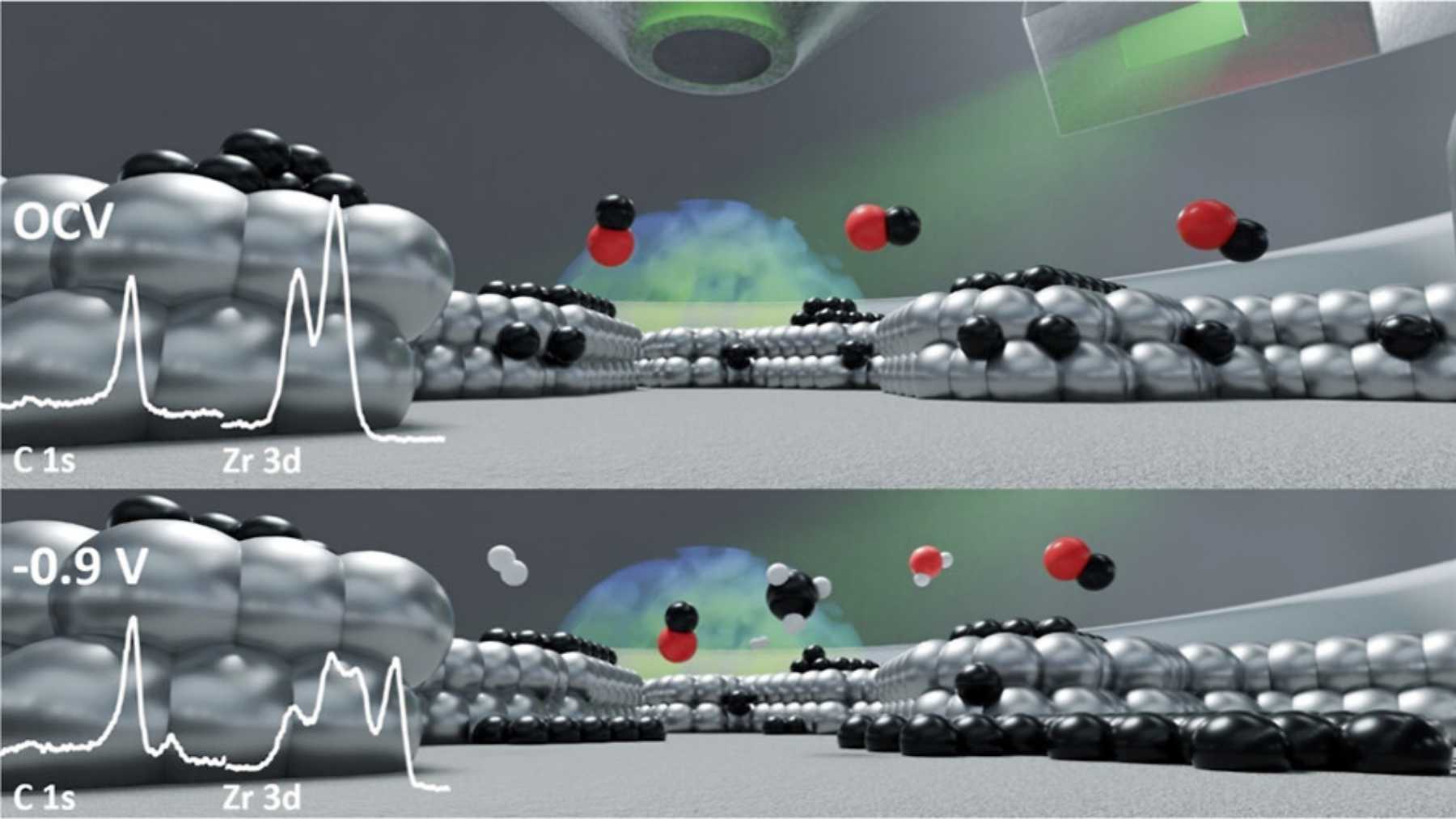
For years the working assumption was simple: the nickel does the chemistry, and the zirconia is basically plumbing for oxygen ions. Some experimental results never quite fit that story. So the team built a porous model electrode and watched it in real time with near-ambient-pressure X-ray photoelectron spectroscopy while feeding it CO₂ and water vapor.
The zirconia, it turned out, was doing actual chemistry, not just shuttling ions around. First author Christoph Thurner says the ceramic “plays a much more active role” than anyone had credited it with. That’s the part that surprised them, and it’s the part that makes the pathway worth a second look for anyone trying to build a cheaper power-to-gas rig.
The coking problem, turned inside out
Here’s the cascade the team pieced together. Under strong cathodic voltage, with a gas phase heavy in carbon monoxide and hydrogen, the CO gets reduced down to elemental carbon on the nickel.
Normally that’s bad news. Carbon building up on a nickel catalyst is called coking, and it’s the classic way these electrodes die — a big reason engineers distrust nickel for long-duration methanation. But in this system the carbon doesn’t sit there and choke the electrode. It migrates.
The carbon spills off the nickel onto the zirconia and forms zirconium carbide, right at the boundary between the two materials. That carbide is the reactive middleman nobody knew was there. It grabs hydrogen split from the water and ends up releasing methane. Carbon lands on the nickel, moves to the zirconia, becomes a reactive carbon-zirconium species, and reacts with water to make CH₄.
One thing the splashier headlines blur: there’s still voltage going in. This is co-electrolysis, so the whole cell is functionally the electrolyzer. The “no electrolyzer” framing making the rounds isn’t right. What’s gone is the second stage. You skip the collect-the-hydrogen-then-methanate choreography and get methane directly at the cathode.
One electrode instead of two plants
The economics of green methane have always been the sticking point, and it starts with a single awkward question. You can split CO₂ and react it with hydrogen easily enough. But as TU Wien’s Günther Rupprechter frames it, “where does the hydrogen come from?”
Right now, most of it comes from steam-reforming fossil methane. That’s gray or black hydrogen, and using it to make “green” gas is chasing your own tail. Actually clean hydrogen, made with renewable power, is the part nobody has managed to produce cheaply or at scale yet.
Doing the water-splitting and the CO₂-splitting on the same electrode, at the same time, on renewable electricity, sidesteps that whole detour. And once you’ve got methane, you’ve got a molecule that drops straight into the pipelines, storage caverns, gas turbines and industrial burners already built. No new distribution network, no liquefaction headache, and the same energy per cubic foot as the fossil version.
Methane isn’t even the ceiling. Run it through a Fischer-Tropsch step downstream and you’re looking at synthetic diesel or jet fuel out of the same feedstock loop.
The catch, because there’s always a catch
This is a mechanistic discovery, not a pilot plant. The porous thin-film electrode was built to be legible to X-ray spectroscopy, not to survive years of duty cycles feeding a gas grid.
Solid oxide cells run hot, roughly 600 to 1,000°C, and the Ni/YSZ system has a long, well-documented rap sheet: nickel coarsening, redox instability, delamination when you push it. Scaling a lab electrode into hardware that runs for years is a different sport entirely.
The encouraging part is that this carbon-spillover pathway might work with the coking problem instead of against it. If carbon that would normally kill a nickel catalyst is instead handed to the zirconia and burned back off as methane, that’s a self-cleaning loop rather than a slow death. Whether it holds up over thousands of hours at scale is the open question — and the reason the work sits inside MECS, an Austrian Cluster of Excellence funded by the Austrian Science Fund.
Power-to-methane has hit this wall before
None of the underlying concept is new. Audi ran an e-gas plant in Werlte, Germany more than a decade ago on exactly the two-stage model this new pathway wants to compress. It’s still running today under new ownership, still one of the largest power-to-methane operations around.
Every project like it slammed into the same wall: too many pieces of equipment, too much round-trip energy loss, methane that came out costing multiples of what pipeline gas costs at the wellhead. Folding the electrolyzer and the methanation reactor into a single ceramic cell is exactly the kind of architectural simplification that can move those numbers, if the durability holds.
It’s also a reminder that catalyst science still has room for genuine surprises. A material combination studied for solid oxide fuel cells since the 1990s just coughed up a brand-new reaction mechanism, for the simple reason that somebody finally built a cell they could watch the chemistry happen on. The nickel wasn’t the star. The boring ceramic support was.
None of this means green methane undercuts Henry Hub next quarter. But if the nickel-zirconia carbide pathway scales, the two-plant model for synthetic natural gas may end up looking like the horse-and-buggy version of power-to-gas.