
Wave energy has spent the better part of fifty years as the renewable that’s always five years away. The pitch never really changes. The ocean holds more raw, predictable power than wind and sun, it runs day and night, and all anyone has to do is build a machine tough enough to sit in it and not die. The machines keep dying.
Pilots from Scotland to Hawaii have been snapped, swamped, or quietly defunded, and the sector’s graveyard is deep enough that “wave energy” turned into shorthand for a good idea that drowns.
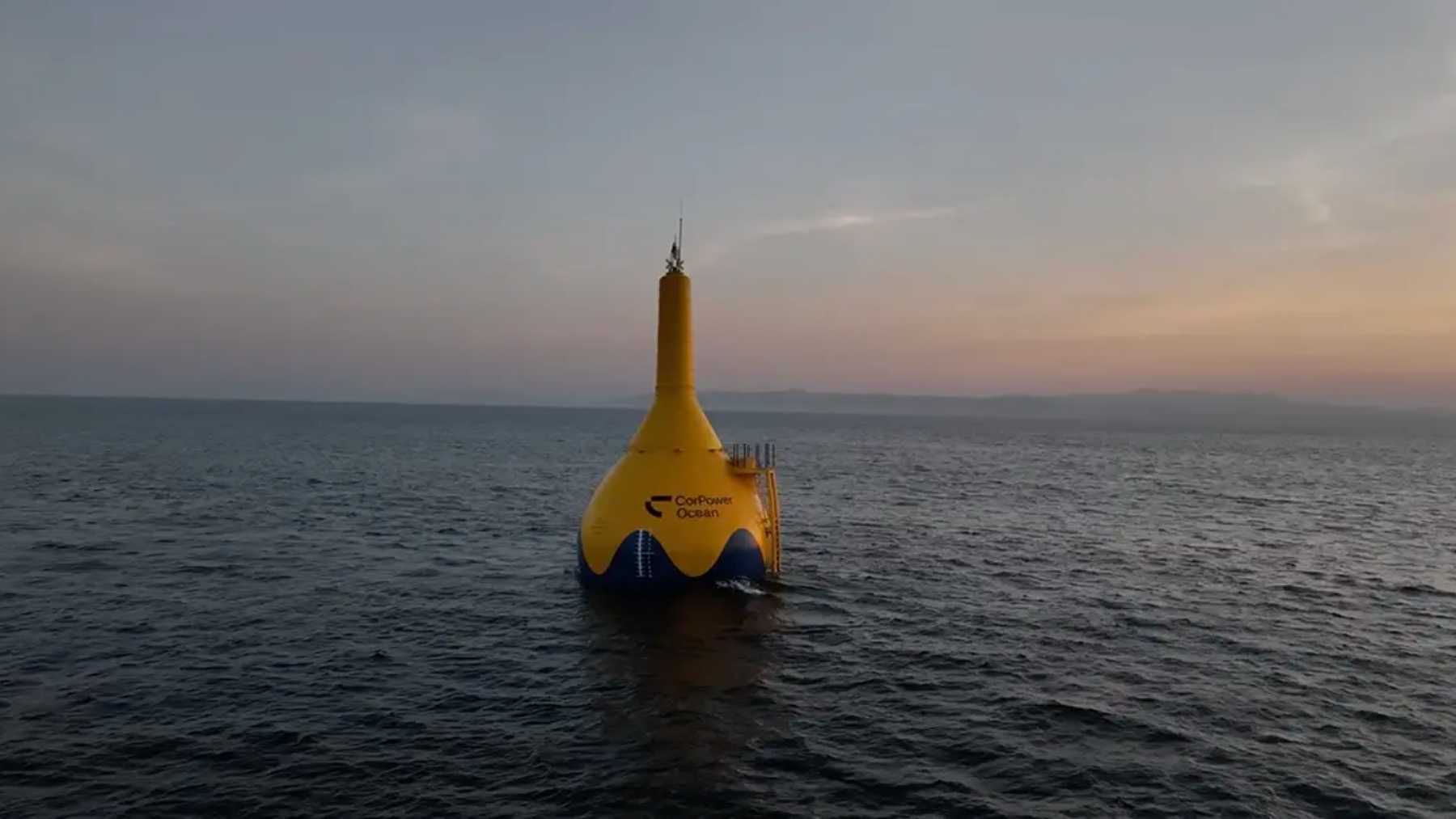
Which is what makes a single buoy off the north coast of Portugal worth a second look. It has been wired into the Portuguese grid since 2023, it rode out 18.5-meter (61-foot) Atlantic storm waves without flinching, and it stores the energy it harvests using roughly the same trick your heart uses to move blood.
The company behind it, Sweden’s CorPower Ocean, spent years proving that one device works. As of late May, it has stopped talking about the one device and started building a fleet, with money from Tokyo Gas sitting on the cap table.
The cardiologist’s idea, anchored to the seabed
The heart part is not a marketing flourish bolted on after the fact. It is where the whole thing started. CorPower’s late co-founder, Stig Lundbäck, was a Swedish cardiologist who spent decades studying how the human heart actually moves blood, and concluded it behaves less like a squeezing fist and more like a pump that stores and releases energy on every beat. He patented that idea, and around 2011 he and entrepreneur Patrik Möller, now CorPower’s CEO, realized the same physics could be pointed at ocean waves.
Here is how that translates into hardware. The buoy floats on a taut mooring line clamped to the seabed. A pneumatic pre-tension unit inside it sits under pressure, holding the buoy balanced at the waterline. When a wave lifts the buoy, the system banks that motion as compressed air, then uses the stored pressure to drive the buoy back down.
That is the same store-and-release rhythm a heart uses, and it means the machine generates power on the way up and the way down instead of only half the time. The payoff is density. CorPower says the design delivers roughly five times more electricity per tonne of machine than earlier wave tech, a figure backed up in peer-reviewed results presented at the European Wave and Tidal Energy Conference.
And about the shape, because the “heart-powered buoy” line invites the wrong mental picture: the thing is not heart-shaped. It is a fat cylinder, circular in plan, about 9 meters (30 feet) across and 19 meters tall, weighing somewhere around 60 tonnes. The heart is in the plumbing, not the silhouette.
WaveSpring, or how not to get destroyed
Storing energy efficiently was never the hard part of wave power. Surviving was. The same ocean that hands you all that free energy on a calm Tuesday is the ocean that, a few times a year, tries to tear your equipment apart, and the history of the sector is mostly machines that captured power beautifully right up until the storm that finished them.
CorPower’s answer is a phase-control system it calls WaveSpring, developed with researchers at Norway’s NTNU. In ordinary seas it tunes the buoy to oscillate in resonance with the swell, which actually amplifies its motion beyond the height of the waves hitting it and squeezes out more power.
When a serious storm rolls in, the system detunes and the buoy effectively goes limp, riding the water instead of fighting it. That is how the C4 sat through 18.5-meter waves in November 2023, taller than anything previously measured at the site, and came out the other side intact.
That survivability story is the same one playing out across marine energy right now. Scotland’s tidal turbines have logged years on the seabed in brutal currents without a repair, and Canada just cleared a floating tidal machine that tows itself home before the Bay of Fundy can wreck it. Different engineering, same core bet: the sea will eventually come for anything you leave in it, so the machine needs a plan for the worst day, not just the average one.
For CorPower the numbers so far are a peak grid export around 600 kilowatts, with the company expecting closer to 850 kW once the buoy runs at full stroke, off a mass-to-energy ratio of roughly 300 tonnes per megawatt. That is an order of magnitude better than the wave devices that came before it.
What the buoy off Aguçadoura has actually proven
The device is the C4, CorPower’s first full-scale commercial machine, sitting roughly 4 kilometers (2.5 miles) off Aguçadoura in northern Portugal. It was launched from the port of Viana do Castelo, towed out, clamped to a seabed anchor, and tied into the national grid through a subsea export cable.
It first started pushing power onto the Portuguese grid in October 2023, and CorPower has since confirmed every core function it set out to test: grid export, automated control and monitoring, storm survival, and the least glamorous and most important one, towing the whole machine back to shore for maintenance and putting it back. That last part is what decides whether a wave farm is affordable to run or a money pit.
The reason any of this matters beyond Portugal is that wave power, if it works, is firm. It does not clock off at sunset like solar or sulk when the wind drops. That is the same argument behind other always-on ocean tech, like the osmotic plant in Japan pulling round-the-clock electricity from the gap between fresh water and seawater. A grid stitched together from intermittent sources needs something underneath it that runs through the night and through bad weather, and waves are one of the few renewable resources that genuinely do.
The expensive part starts now
Proving one buoy works is the cheap half of the problem. The expensive half, the one that has bankrupted CorPower’s predecessors, is turning a single machine into a fleet that survives at scale and pays for itself. That is the phase the company says it has now entered. In its annual report published on May 25, CEO Patrik Möller confirmed CorPower has finished designing and started manufacturing the C5, an industrialized next-generation version of the buoy, with commercialization targeted for 2027.
The money tells you who is taking it seriously. CorPower’s Series B round closed at €53 million, and the new strategic investors are the part worth noticing: Acario, the venture arm of Tokyo Gas, and GTT, a French firm that builds the containment systems used on LNG carriers. When gas-industry money starts buying into a wave-energy startup, it is worth asking what they think is coming.
On top of that, a CorPower-led consortium pulled in €30 million in EU Horizon funding to validate the technology for large-scale deployment, and the company has grown to around 110 staff.
The flagship is VianaWave, a pre-commercial farm planned off northern Portugal and backed by a €40 million ($47 million) EU Innovation Fund grant. The plan is 30 of these buoys generating about 30 gigawatt-hours a year, enough for roughly 7,500 Portuguese homes, with operations targeted for 2028 or 2029. It feeds directly into Portugal’s national goal of 200 megawatts of installed wave capacity by 2030, which makes Portugal a country betting harder on this technology than almost anyone.
None of this means wave energy has arrived. The grid-export box has been ticked for two years now, and ticking it again with one machine does not answer the question the sector has always choked on, which is whether 30 of these can sit in the Atlantic for a decade, survive every storm, and still come out cheaper than the alternatives. The C5 going in the water during this verification round is the test that counts, not the press releases around it.
But a buoy that runs on a cardiologist’s reading of the human heart, has already taken the ocean’s best punch off Portugal, and just convinced a gas company to help pay for the next 30 is a long way from the drowned good ideas that came before it. For once, the five-years-away renewable has a halfway credible reason to think it might actually be five years away.