Most wind turbines go up the same way. Trucks haul in the pieces, a big crawler crane stacks the tower sections, and then the same crane lifts the nacelle and blades onto the top. That works pretty well up to a point, and that point is a long way below 984 feet.
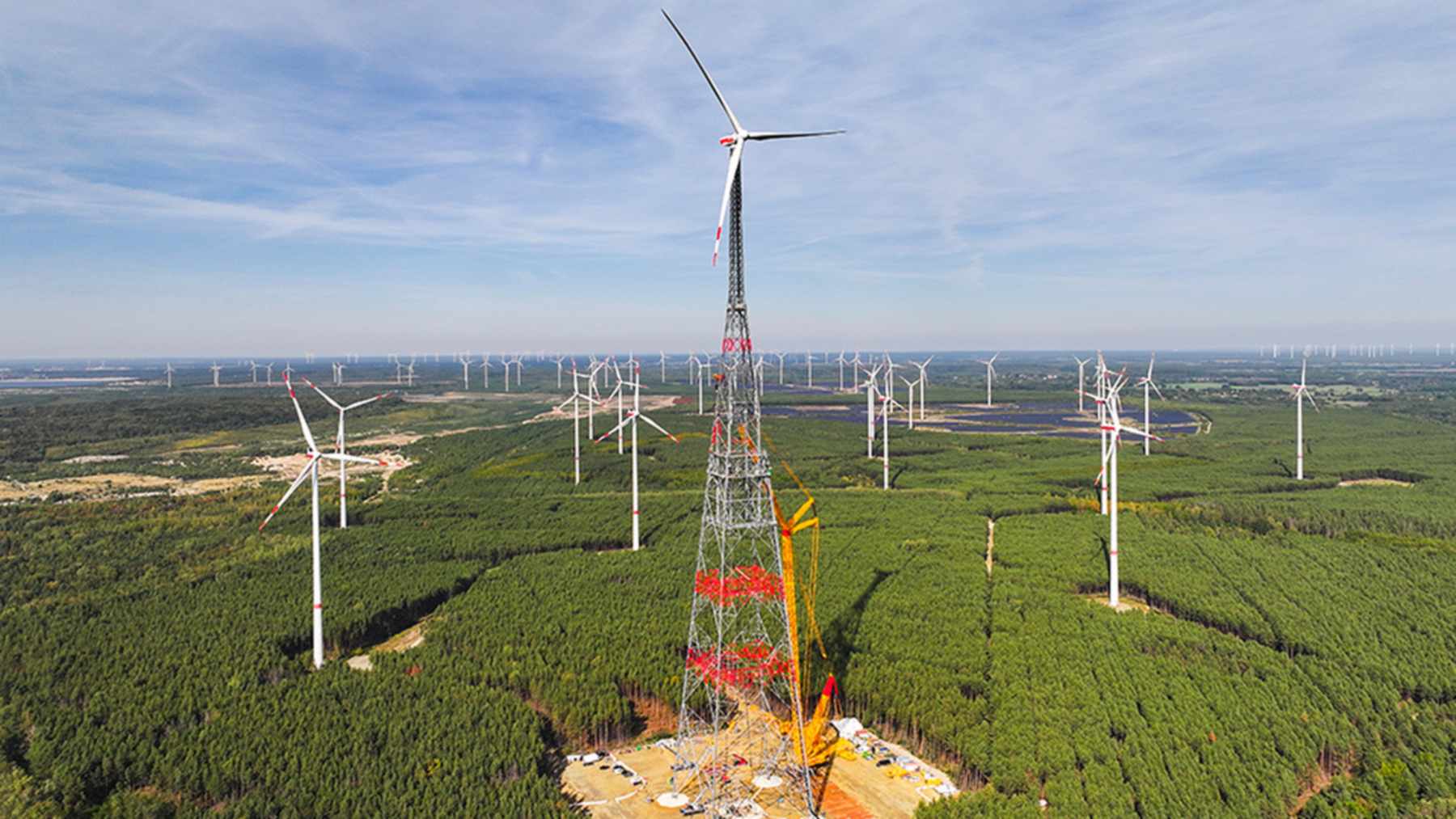
No crane on the market can set a turbine that high. So GICON, an engineering firm from Dresden, assembled its machine about halfway up and had hydraulic jacks push it, along with the inner tower it sits on, through the middle of a steel lattice tower. That moving load came to about 827 tons, and we covered the slow, wind-delayed climb while it was happening. (A Danish company has a different fix, a crane that climbs the tower it’s building, but that’s another story.)
Here’s what’s new. The Schipkau turbine, in the Lusatia region of Brandenburg, went into official service on Thursday, Nov. 19, and it’s now feeding electricity into the German grid. According to GICON, it had already been running at full load for four days by the time anyone held a ceremony.
So what does four days at full load prove?
Full load basically means the turbine is putting out everything it’s rated for, which here is 3.8 megawatts. A turbine only gets there when the wind is strong enough, so it’s the best-case setting for any turbine, and exactly what you’d want from a brand-new machine.
I’d call four days of that a pretty confident way to show up to your own inauguration. But it’s GICON’s claim, and I can’t find independent production data to back it. Ingenieur.de, the news site of the German engineers’ association VDI, points out that independent data on the tower’s output doesn’t exist yet.
Which is fair enough for a prototype that’s only just been switched on. GICON says a pilot phase lasting several months starts now, to measure how much power the tower really makes and what it costs to run.
And that’s the number I’d actually like to see.
So how much faster is the wind at 984 feet?
Before any of the steel went up, a measuring mast on the Schipkau site logged wind for a full year at two heights. At 492 feet, the wind averaged 14.9 mph. At 984 feet, it averaged 19.0 mph, according to the mast data reported by Techzeitgeist.
I ran those two figures myself, and the wind at hub height comes out about 28 percent faster than at half that height. Neither GICON nor the outlet put it as a percentage, so that one’s on me.
A 28 percent jump might not sound like much. But the energy carried by moving air climbs with the cube of its speed, so a little more wind carries a lot more energy. A turbine can’t bank all of that, because it tops out at its rated output no matter how hard the wind blows. Still, that’s the logic behind GICON’s claim that the design can deliver roughly twice the energy of a conventional turbine with the same rotor.
Keep in mind those are wind readings from a mast. The turbine’s real yield still has to show up in operation, and GICON’s own estimate is at least about 18 gigawatt-hours a year. A gigawatt-hour is a million kilowatt-hours, the same unit you see on your power bill.
GICON founder Jochen Großmann sums up the pitch as “Offshore auf dem Land,” which means offshore on land. Wind farms out at sea get stronger, steadier wind than ones on land, and he’s betting height can get you a fair chunk of that without a boat.
So what exactly is standing in Schipkau?
The turbine is a 3.8 MW unit from Vensys with a 413-foot rotor and three blades that weigh about 16.5 tons apiece. Its hub sits 984 feet up, and the blade tips reach 1,197 feet. That leaves Berlin’s TV tower, the tallest structure in Germany, only about 10 feet taller.
The outer lattice tower was built in five segments and stands just under 525 feet. It holds more than 2,200 tons of steel spread across some 22,000 parts, and frankly it looks more like a high-voltage power line tower than anything you’d expect to see spinning on a wind farm. A subsidiary of SPRIND, Germany’s federal agency for breakthrough innovation, commissioned the build.
Then there’s the price. A dpa report carried by Volksstimme puts the cost at €25 million, which works out to about $27.5 million at the European Central Bank’s Nov. 19 reference rate of $1.0992 per euro. That’s a lot of money for a single 3.8 MW turbine. Still, it’s a one-off prototype, and those are pretty much always expensive.
And 3.8 MW is a fairly modest rating by modern standards. The series machines GICON has in mind are more than twice that size. So what this prototype is really chasing, arguably, is hours. The more time a turbine spends near the top of its range, the more energy it sells. Faster wind up high is what buys those hours, at least on paper.
Five more towers are next
GICON plans five more of these. Großmann says the company holds letters of intent for 100 high-altitude towers in Germany, and the sites that look most promising are existing wind farms, where a taller tower could reach the faster air above the turbines already there. GICON’s own math puts the long-term potential at up to 4,000 towers in the country, most of them added to wind farms that are already built, though that’s the company’s estimate of what could fit.
The production version will also be bigger. GICON wants series production going by 2030 at the latest, with turbines of 8 MW or more that it expects to yield 30 to 33 gigawatt-hours a year each.