If you picture an F-15, it’s almost certainly gray. That’s the color in pretty much every photo you’ve ever seen of one. But at Robins Air Force Base in Georgia, some of them take off in bare, unpainted metal with nothing at all hanging under the wings.
The War Zone calls them Silver Eagles. They’re F-15E Strike Eagles fresh out of the base’s big overhaul, and TWZ’s Jamie Hunter argues that, stripped down like this, they’re automatically the best-performing F-15s you’ll find anywhere. I’d say that’s a fair claim, and it mostly comes down to what’s been taken off.
So why would a fighter jet fly better after a trip to the shop?
So what happens to an F-15E at Robins?
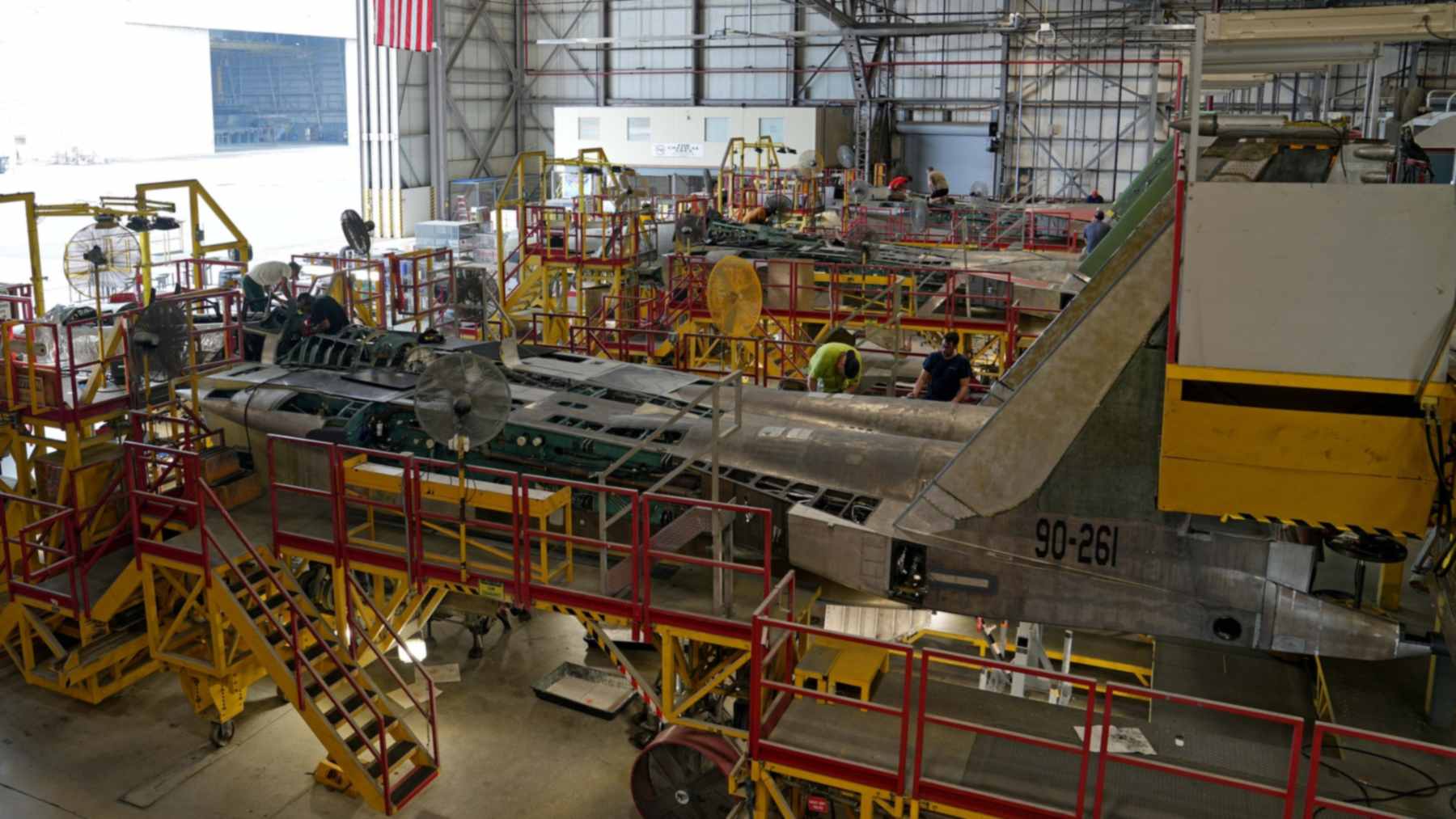
The job is called programmed depot maintenance, or PDM. Basically, it’s a full teardown and rebuild, far deeper than anything a jet’s home squadron does day to day, and an F-15 comes back for one every seven years or so. The Warner Robins Air Logistics Complex has been doing this to F-15s for more than half a century, and it handles C-5M, C-17 and C-130 overhauls on top of that.
Bruce, a Robins maintainer with 21 years on F-15s, walks through it in TWZ’s video from the base. The flight control surfaces, wings, canopies and seats come off. Then the paint gets stripped and inspectors go over pretty much everything, including the longerons. Those are the long structural beams that run the length of the fuselage, and worn ones get replaced right there.
Maj. “Rifle” Wicks, the 339th Flight Test Squadron F-15 pilot TWZ interviewed, says a standard PDM takes about six to eight months, or up to nine if the jet is also getting a major modification like the new EPAWSS electronic warfare suite. Robins is currently putting through about 24 jets a year, roughly two a month.
We covered a museum submarine that spent a summer in a Wisconsin dry dock. Same idea, except that sub had waited 72 years.
And it’s all Strike Eagles now. TWZ notes that only two squadrons of F-15C/Ds are left, and most of those jets no longer need PDM.
The test jets fly with almost nothing bolted on
On a normal day, an F-15E can carry a targeting pod, a navigation pod, weapons on pylons, external fuel tanks and two conformal fuel tanks fitted along the sides of the fuselage (the Air Force says each of those holds 750 gallons). For the test flights, all of that is gone. Some jets don’t even have the gun.
Then there’s the paint. Wicks thinks somewhere between 300 and 600 pounds of it goes on an F-15, and the test jets fly before any of it goes back on.
Weight is only half of it, though. Every pod, pylon and tank sticks out into the airflow and creates drag, which is basically the air pushing back on the airplane. Take all of that off and the engines are pushing a smaller, smoother shape through the sky, so the jet accelerates a lot harder.
The Air Force lists the F-15E at 63.8 feet long and 37,500 pounds, with a maximum takeoff weight of 81,000 pounds. Its F100 engines come in two versions, and the -229 makes 29,000 pounds of thrust each, up from 25,000 on the -220. Wicks says the -229 jets will pin you to your seat when you light the afterburners on takeoff.
“It is a rocket ship for lack of a better word,” Wicks told TWZ.
I couldn’t find a published weight for one of these stripped jets, so I can’t give you a clean before-and-after number. Still, you’re frankly looking at about the cleanest an F-15E will ever be while it’s in service.
How do you test a jet that’s just been rebuilt?
The flying is done by the 339th, an Air Force Reserve Command unit at Robins. It’s an unusual outfit, with C-130, C-5 and F-15 crews under one roof, almost all of them reservists. The F-15 side only has a handful of pilots, so if just one is free that day, the jet goes up with an empty back seat.
Everything follows the Dash 6 checklist, the governing document for these flights. A jet doesn’t go home until everything on it has been signed off.
The walkaround is fairly basic, except for the nose. The first 10 inches of the radome (the cone over the radar) have to be essentially free of dents and scratches, because damage there can mess up airflow over the whole jet at high angles of attack. Then come ground checks on the hydraulic backups and other redundancies.
Takeoff is a full-afterburner climb to 15,000 feet. It might look like showing off, but the logic is sensible. If something on a freshly rebuilt jet isn’t working, the pilot wants plenty of altitude to turn around and land, so they check the flight controls, engines and hydraulics up there first.
After that, the pilot starts switching things off on purpose. The generators get shut down to make sure they come back, and so do the engines, in both primary and secondary mode. Getting through the full profile means shutting down both engines twice, so that’s four restarts.
Then there’s the speed run, which honestly sounds like the best part of the job. There’s a supersonic corridor just south of Robins, running roughly from Columbus to Dublin, Georgia. Air traffic control gives the pilot a block between 43,000 and 55,000 feet, and the jet goes to afterburner and gets up to at least Mach 1.7. On the way, the pilot checks the rudder limiter, a stop that won’t let you kick in full rudder at that speed. That run usually happens on the second or third flight. One of the maintainers apparently told TWZ’s crew that they know a jet is good when they hear the sonic boom, which is a pretty great way to get your quality report.
If everything goes perfectly, two flights get a jet through the whole profile. In practice it’s normally three or four, because something usually needs fixing in between.
Then it gets its paint back
You might expect the paint to go on first. It doesn’t. If a test flight turns something up, maintainers have to drop panels to fix it, and nobody wants to do that on a fresh coat. So the jet stays bare until it’s signed off, then heads to the paint shop.
The conformal tanks go back on as well, and the jet usually flies once more to make sure fuel is moving between the tanks the way it should.
Some of these airframes have been around a while. Wicks says the highest-hour F-15E in the fleet, a Seymour Johnson jet nicknamed Lucky, came through recently with more than 15,000 hours on it. I’d argue that’s about the best ad for PDM you could ask for.
It’s kind of a shame you only get to see a Strike Eagle like this for a few flights between overhauls. Once the paint’s on, it looks like every other gray jet again.
And Robins is already getting ready for the next model. TWZ reported on November 18 that F-15EXs are set to start cycling through PDM there in the next few years, and Wicks says he’s already earned his initial qualification on the EX.