- 5 MONTHS AGO · INDUSTRYA California company built a seabed mining drone that hovers above the ocean floor instead of crawling it, picking up battery metals one nodule at a time with 16 arms, and leaving nearly a third behind on purpose, the ones with living things attached
- 2 MONTHS AGO · INDUSTRYA 4.26-foot drone boat that weighs 123.5 pounds sailed itself almost 3,100 miles across the Atlantic in 117 days on a 52.5-watt solar panel, carrying a thruster it was never allowed to use, and 37 boats have failed the same crossing
- 1 MONTH AGO · INDUSTRYA 66-foot drill rig on a soccer field in Cologne, walled in by stacked containers 33 feet high, cored day and night for almost 10 weeks down 2,631 feet through a 380-million-year-old coral reef and hit water, and now the hole gets plugged and the field goes back to the city
- 1 DAY AGO · INDUSTRYA 21,000-foot robot dive along the Mariana Trench found volcanic rock from eruptions under so much pressure that water can’t turn into steam, the deepest pyroclastic deposits known on Earth, closer to the trench than usual, a clue to why Challenger Deep is the deepest spot in any ocean
- TODAY · THIS ARTICLEThere are no coral atolls in the mid-Atlantic, yet scientists suspected for 30 years that it once had them. They found one almost 3,000 feet down: nearly 1,000 feet tall and about 5 million years old
Some scientific hunches take a long time to pay off. For about 30 years, researchers have suspected that the mid-Atlantic once had coral atolls, which is a slightly odd thing to suspect, since there aren’t any out there today. When you picture an atoll, you’re probably picturing a ring of reef and white sand somewhere in the Pacific, or one of those overwater-bungalow ads for the Maldives.
Now a Brazilian-led team says it’s found one. It’s just sitting almost 3,000 feet underwater.
Schmidt Ocean Institute, which announced the find on November 23, says the sunken coral atoll is about 5 million years old and made of fossilized coral. It stands roughly 984 feet tall, which the institute says is close to as tall as the Eiffel Tower. Its top is about 2,950 feet below the surface.
The whole thing is cemented onto a volcanic ridge that climbs about 13,450 feet from the seafloor. And that ridge sits in the Romanche Fracture Zone, a fault that runs for roughly 590 miles across the Mid-Atlantic Ridge near the equator. Schmidt says no fault in the Atlantic is longer.
If you’ve never heard of a fracture zone, it’s basically a seam where two chunks of seafloor grind past each other sideways instead of pulling apart. The Mid-Atlantic Ridge is full of them, and Romanche is the big one.
So how does an island end up 3,000 feet down?
Charles Darwin worked out the basic answer during his voyage on the Beagle, and it’s held up pretty well. An atoll starts life as a volcanic island. Corals build a reef around its edges, the volcano goes quiet, and the rock underneath cools and slowly sinks. Geologists call that subsidence. The reef keeps growing up toward the light while the island sinks out from under it, until all that’s left at the surface is a ring of coral. NOAA Ocean Exploration describes Pacific atolls that went through millions of years of exactly that.
The catch is that reef-building corals need sunlight. They can only keep up if the island sinks slowly enough, and if it doesn’t, the reef drowns and keeps going down with everything else.
Something along those lines presumably happened in the Romanche, though Schmidt’s release doesn’t actually say how or when this atoll went under. What the team does have is a fossil fragment of shallow-water coral from the site. Shallow-water coral has no business living at 3,000 feet, so finding it there is a pretty good sign the reef was once near the surface.
The release also doesn’t explain how the team arrived at the 5-million-year figure, so I’d treat that as an estimate until the dating work is published. Still, Schmidt says the find confirms that 30-year-old idea about mid-Atlantic atolls. I’d imagine a few geologists are feeling pretty smug this week.
It took a drone and an ROV to find it
You don’t find something like this by dropping a camera over the side and hoping. The team spent 35 days aboard Schmidt’s research ship, Falkor (too), and the expedition wrapped up in October. The atoll first showed up in mapping data from the ship and from an autonomous underwater vehicle called The Childlike Empress.
So what’s the difference between that and the other robot on board? An AUV is an underwater drone. It’s programmed with a route, cut loose, and swims it on its own with no cable attached. An ROV, or remotely operated vehicle, stays tethered to the ship, and pilots in a control room drive it in real time.
Schmidt’s ROV is called SuBastian, and it’s a pretty hefty piece of hardware. It’s roughly 9 feet long, weighs about 7,050 pounds out of the water and is rated to about 14,800 feet. Once the mapping flagged the atoll, the team sent it down with its high-definition cameras to take a proper look. If that scout-first approach sounds familiar, it’s a similar idea to the Woods Hole robot that maps the seafloor ahead of Alvin dives.
Between the ship, the drone and the ROV, somebody at Schmidt is apparently a big fan of The NeverEnding Story. Falkor, Bastian and the Childlike Empress are all characters from it.
There’s a lot living on and around it
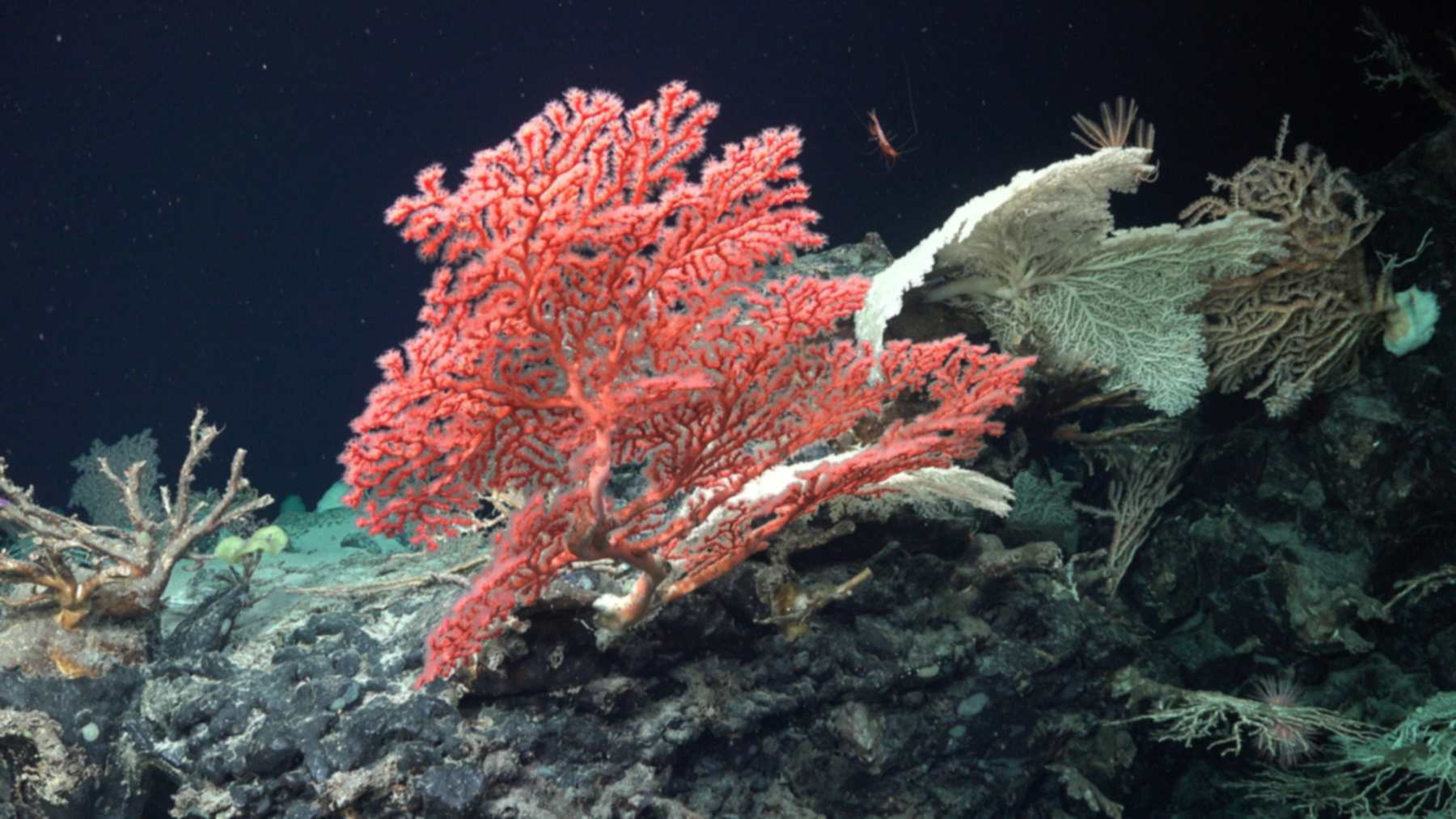
These days, the top of the old atoll is home to a deep-sea coral garden. I like that. The reef died, sank, and then got taken over by a completely different kind of coral, the deep-sea type that doesn’t need sunlight.
The atoll was only part of the haul, though. Across four regions of the fault, the team documented dozens of what scientists call vulnerable marine ecosystems. Those are slow-growing communities that take a very long time to recover if something like a trawl net tears them up.
My favorite find was at about 3,900 feet, where a meadow of tiny, pale pink zoanthids, thousands of them, covered a patch of seafloor roughly as big as a soccer field. Zoanthids are relatives of sea anemones and corals. You’d normally find them in shallow water, and they’re rarely seen this deep.
Farther down, the team recorded cold-water corals and sponges at about 5,520 feet, plus a deep-sea mushroom soft coral called Anthomastus at about 9,275 feet. Then there’s the sponge-and-coral garden sitting at about 14,100 feet, which Schmidt says is deeper than anyone expected to find big groups of these animals. That’s only about 650 feet above the deepest point SuBastian is built to reach. Schmidt’s release puts the four survey regions between roughly 2,000 and 13,100 feet, then mentions that garden separately, so I’m not sure exactly which region it belongs to.
Some of the corals the team documented are estimated to be about 1,000 years old. Sponges and corals down there add only a few millimeters a year, so a coral that old isn’t a fluke. It does mean a few of them were probably already growing when the Vikings were poking around Newfoundland. The release doesn’t say which site those old-timers came from.
The team also spotted squid and octopus. Paulo Sumida, a professor at the University of São Paulo who was on the expedition, put it simply: “Everywhere we looked, we saw stories emerging.”
So what don’t we know yet?
Quite a bit, as you’d expect from a trip that only ended last month. The scientists suspect some of their samples are new species, but that hasn’t been confirmed. Jose Angel Perez, the expedition’s chief scientist from Universidade do Vale do Itajaí in Brazil, says the data the team brought back could keep researchers busy for decades.
Perez also says the data strengthens the case for considering the Romanche Fracture Zone for protection under the High Seas Treaty, the UN agreement covering ocean life beyond national waters that took effect in January. If you’re into this stuff, it pairs nicely with the volcanic rock a robot found along the Mariana Trench.
Schmidt Ocean Institute announced the Romanche discovery from Fortaleza, Brazil, on November 23, and SuBastian’s dives from the 35-day expedition gave scientists their first on-camera look at these ecosystems in the area.
 A 3.5-million-square-foot car plant once rolled a four-engine bomber off its line every 63 minutes, and now the military, which says it will buy millions of drones, is in talks with the car industry to build their motors, actuators, sensors and lidarIndustry · 20 hours ago
 A 1,790-ton tunnel boring machine and its twin digging toward central London are past the halfway mark of a 4.5-mile run as deep as 217 feet, each moving about 52 feet a day as they line the bores with 48,294 concrete segments, and both are due to stop short of the station in 2027Industry · 21 hours ago
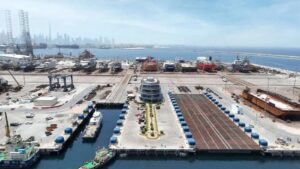 A 984-foot platform designed to raise about 74,000 tons will lower finished ships into the water at a new Texas shipyard, more than twice the capacity of any shiplift on Earth, the companies say, a $100 million-plus machine meant to replace dry docks across 835 acres of flat landIndustry · 2 days ago