My first reaction to Tuesday’s Wall Street Journal report was pretty much the same as my editor’s. A drone from GM or Ford? Has that ever actually happened?
It has, and more than once.
A car-industry inventor designed an unmanned aerial torpedo in 1918, and Ford built the engine for an American flying bomb in 1945. And a Ford plant in Michigan cranked out four-engine bombers like they were sedans. But before you picture a Chevy-badged quadcopter, here’s what’s on the table this time.
So what is the Pentagon asking for?
According to the Journal, whose report Reuters summarized on Tuesday morning, the Pentagon has held preliminary talks with GM, Ford, Canadian parts maker Magna and a few companies outside the car business. They’d supply drone makers with actuators, engines, sensors and lidar.
Nothing’s been signed, and the Journal says auto executives’ reactions have been mixed.
Quick translation if you need it. An actuator is basically a small motor that moves a fin or a flap. Lidar is a laser sensor that maps what’s around it in 3D, and it’s probably the thing you’ve seen spinning on the roof of a robotaxi.
Which means the Pentagon would still be buying drones from drone companies, just with car-industry parts inside.
The Journal says the Pentagon expects to buy millions of drones over the next few years, and it figures military drones could be a $20 billion to $30 billion business every year. GM and Ford didn’t immediately respond to Reuters, and Magna told the agency it had nothing more to share.
So how did a car company end up building bombers?
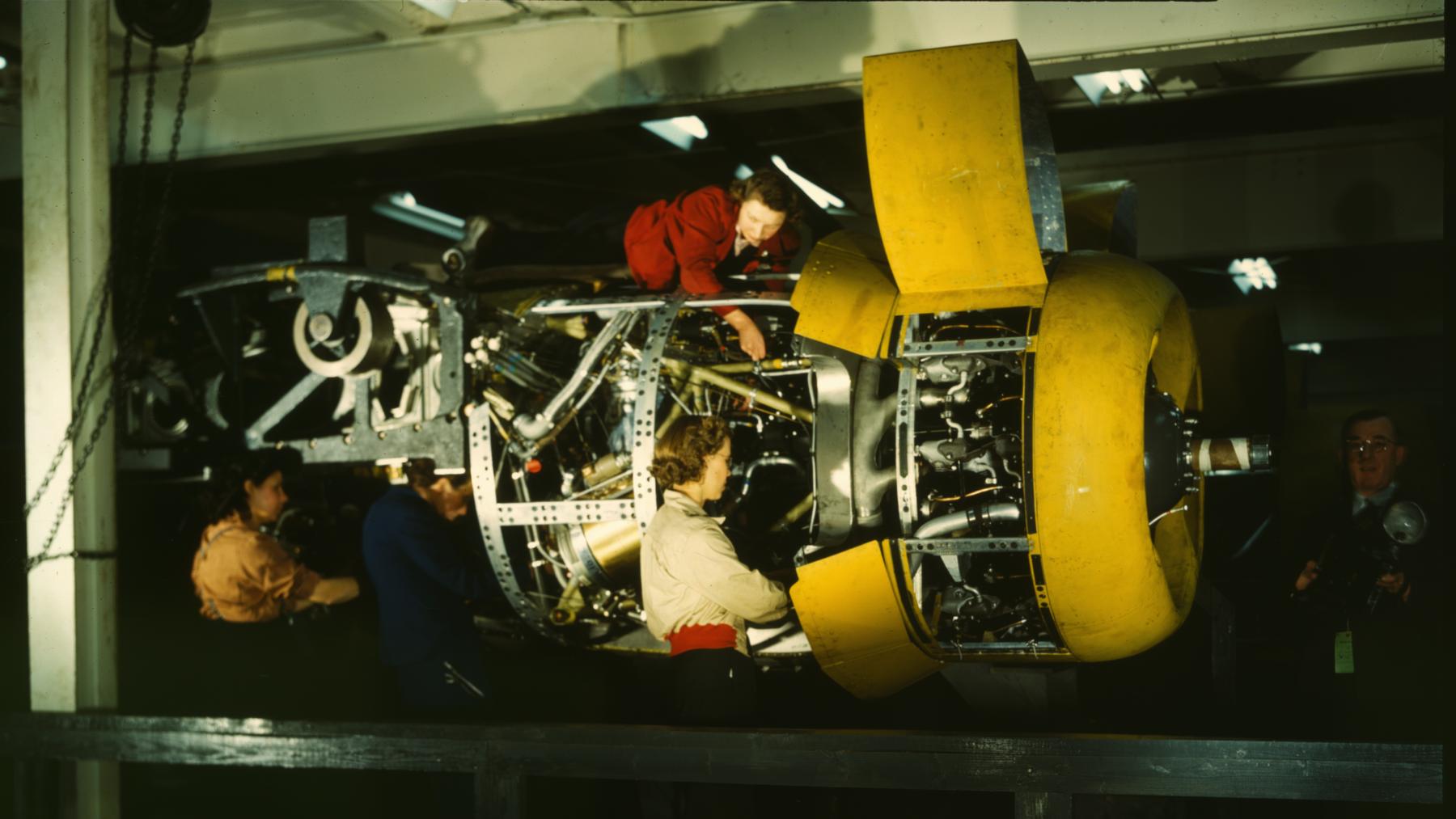
Ford’s Willow Run plant near Ypsilanti, Michigan, is probably the best answer anyone has. The Henry Ford museum says it had 3.5 million square feet under its roof, and its main building stretched over a mile, with two assembly lines side by side.
At its peak, Willow Run finished one B-24 Liberator every 63 minutes, according to The Henry Ford. In case you’re not up on your warbirds, the B-24 was a four-engine heavy bomber.
So how do you build an airplane like a car? Basically, you stop treating it as one airplane. Charles Sorensen’s team at Ford broke the B-24 into 11 major assemblies, then into 69 subassemblies, so big chunks could be built on their own and meet on the final line. A car plant does the same thing with doors, dashboards and engines. The wings are just a lot wider than your garage.
By the time the last one was completed on June 28, 1945, Willow Run had built 8,685 B-24s. That total includes 6,792 complete planes plus 1,893 knock-down kits, which were basically flat-pack bombers shipped out for someone else to put together.
After the war, Kaiser-Frazer built cars there, and GM later made transmissions in the place. So calling it a car plant isn’t much of a stretch. Frankly, it’s still one of the more impressive things an American factory has pulled off.
Charles Kettering’s Bug ran on a 40-hp engine
Charles Kettering, the Delco founder who later became a General Motors executive, designed the Bug for the Army during World War I. It was an unmanned aerial torpedo, and Smithsonian Magazine calls it an early drone, though it says that by today’s standards it’s closer to a guided missile.
The National Museum of the US Air Force lists the Bug at 530 pounds loaded. Power came from a 40-hp DePalma four-cylinder. Dayton-Wright Airplane Co. built it, and it launched off a wheeled dolly running down a portable track.
How did it find the target? Preset pneumatic and electrical controls kept it on course. After a set amount of time, the engine cut out and the wings came loose, so the whole thing dropped. It was basically an egg timer carrying 180 pounds of explosives.
Who actually made that engine is a little murky. Smithsonian Magazine says it was manufactured by Ford. The Smithsonian’s own Air and Space Museum credits DePalma Manufacturing Company of Detroit, led by C. Harold Wills, Henry Ford’s chief engineer. I couldn’t find a document that settles it.
Fewer than 50 Bugs were built before World War I ended, and none of them ever saw combat.
Ford built the JB-2’s pulse-jet
The 1945 example’s a lot less murky. The JB-2 Loon was an American copy of Germany’s V-1, an unmanned flying bomb that’s basically the ancestor of today’s one-way drones. These days we’d call it a cruise missile. Republic Aviation built the airframe, and Ford built the engine.
A pulse-jet’s about as simple as jet engines get. Air comes in through flaps at the front, fuel burns in quick bursts, and each burst slams the flaps shut and shoves hot gas out the back, over and over. It’s loud and crude, which is pretty much fine for something that only flies once.
According to the National Museum of the US Air Force, Ford’s copy of the German pulse-jet was rated at 900 pounds of thrust. The museum says the Army and Navy got 1,000 JB-2s, with production deliveries starting in January 1945. It was never used in combat.
Funnily enough, the Journal says Ford has historically stayed away from making weapons and mostly sells the Pentagon versions of its civilian vehicles and equipment. Those pulse-jets are a bit of an exception.
Why would GM build a lawn mower engine?
According to the Journal, the drone motors GM is weighing would be closer in size to the engine in a riding mower than the one under the hood of a car. Honestly, that tracks. A truck engine hauls a family and a trailer, while a small drone motor only has to keep something light in the air and be cheap enough to lose.
Car companies are probably at their best with the boring stuff they’ve done for decades. Lockheed Martin says it signed a contract with GM Defense on August 6 for housings for the PAC-3 MSE interceptor, and the first batch showed up on August 28, 22 days later.
GM did it with casting and machining, Lockheed says. Casting is pouring molten metal into a mold, and machining is cutting the rough part to exact size, which is basically how engine blocks get made. That’s everyday work for a car company. Reuters adds that GM is also talking with RTX and L3Harris about similar work.
We’ve seen defense parts move to new US lines before, like the Iron Dome interceptor built in Arkansas.
Will carmakers actually want the business?
The executives the Journal spoke to don’t sound totally sold. They’re looking at a low-margin business that automakers could lose money on. They’re nervous about what weapons work does to their reputation. Pentagon demand has been uneven, and the money’s only there if Congress approves it every year.
Max Strasiser, a Navy SEAL senior chief petty officer brought in to help set up the Pentagon’s drone push, seems to get that. The effort now runs through a four-star command set up this fall, and Strasiser told the Journal the Pentagon needs to put up “a dollar amount that justifies them switching over a factory.”
My guess? GM or Ford would rather sell motors and sensors quietly than put a badge on a drone, and from the sound of it, that’s what’s being offered. We don’t know yet how many parts the Pentagon wants or what it’ll pay.
We’ve already covered some pretty odd hardware tied to this push, like the bomber drone that drops mortar rounds.
For a sense of scale, the Pentagon’s existing Drone Dominance program is a roughly $1 billion plan to buy more than 200,000 small drones by 2027, and its first round, held on February 17, ordered 30,000 of them.