If you’ve ever lost a phone call the second you drove into a parking garage, you already get the basic problem with talking to a submarine. Radio waves don’t like going through stuff. And seawater is a lot worse than concrete.
So how do you get a message to a missile submarine that’s built to stay hidden underwater and has no interest in popping up to check its inbox?
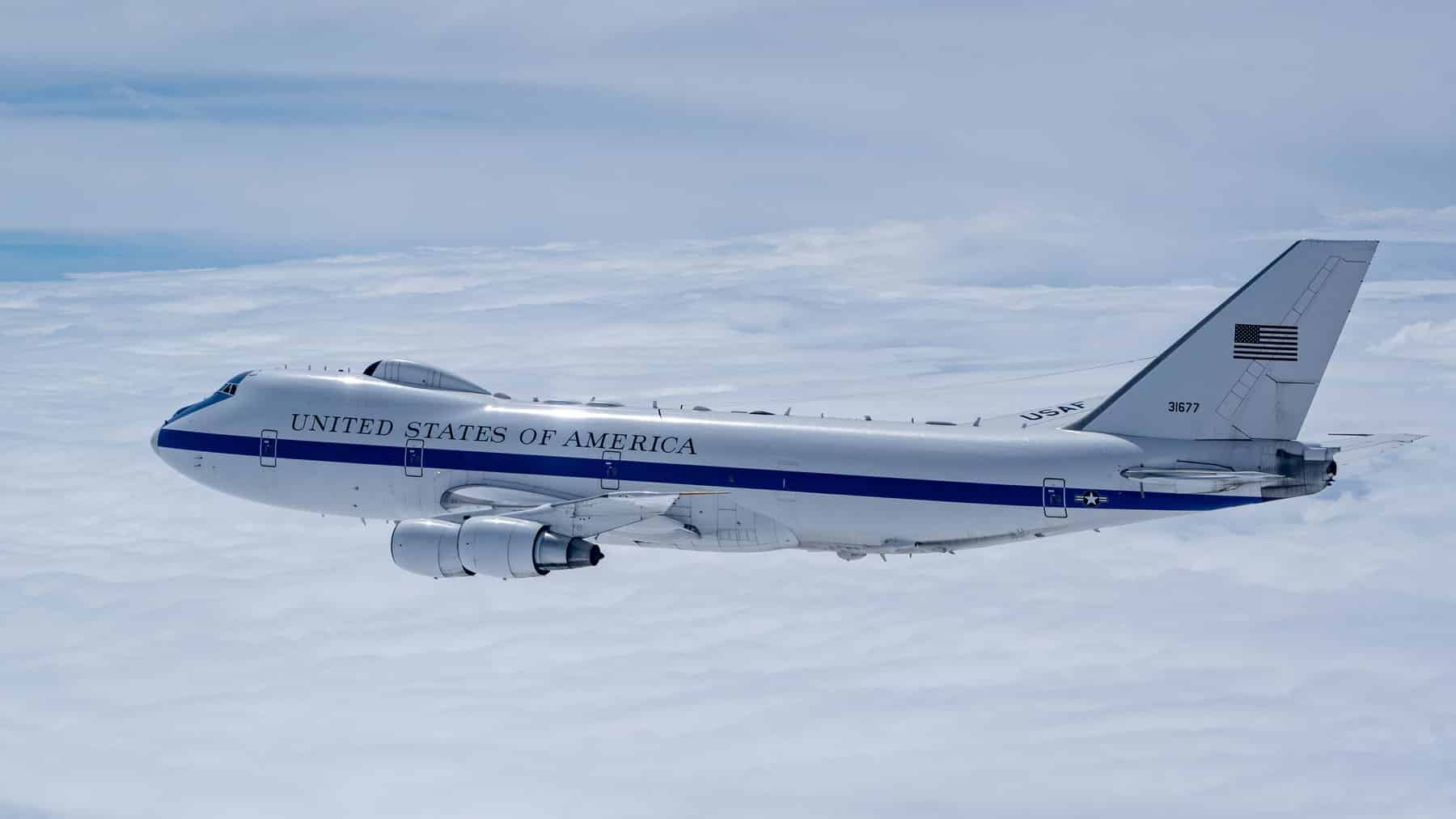
One answer, it turns out, is a 15,000-foot wire that pays out from the back of a jumbo jet. A documentary series called THE WATCH, from NFN Productions, took its cameras into the tail of the Air Force’s E-4B Nightwatch, where that cable lives on a spool, and The Aviationist ran the footage over the weekend. It’s a pretty rare look at hardware that’s been doing the same job for decades.
The E-4B is a modified Boeing 747-200 that works as a flying operations center for the President, the Secretary of Defense and the Joint Chiefs of Staff, and one of its jobs is relaying their orders. The Air Force fact sheet lists it at 231 feet, 4 inches long, with a maximum takeoff weight of 800,000 pounds.
So why does a submarine need a wire this long?
Seawater conducts electricity, so it soaks up radio energy fast, and the higher the frequency, the quicker a signal dies once it hits the water. Very low frequency radio, or VLF, uses waves that are miles long, and those waves can get to a sub that’s sitting below the surface, as long as it’s towing its own receiving antenna (a long trailing wire or a floating buoy) behind it.
Subs themselves get plenty of attention, whether it’s a Virginia-class boat being converted for seabed work or a World War II sub that spent its summer in a Wisconsin dry dock. The radio link that reaches them gets a lot less.
Transmitting is where VLF gets awkward. An antenna has to be big compared with the wave it’s sending if you want it to work well, and a U.S. patent cited by The Aviationist puts the ideal deployed length at roughly half the wavelength. Which means every step down in frequency adds more wire.
But why not just build a giant antenna on the ground? Fixed VLF transmitter sites do exist. Adm. Daryl Caudle, the Chief of Naval Operations, says in the series that sites like that might not last long in a conflict. A jet can keep moving. That’s pretty much the whole case for hanging the antenna off an airplane.
The pilots are basically holding the antenna up
Col. David Leaumont, a former commander of the 595th Command and Control Group, the unit all four E-4Bs are assigned to, shows the cameras where the 15,000 feet of cable sits spooled in the tail, ready to go out behind the jet. That’s a little under three miles of wire.
Once it’s out, the jet flies a banked orbit over the ocean so the cable hangs almost straight down beneath it. That’s the standard method laid out in the same patent. Leaumont says the crew has to hold precise speeds and precise angles to keep the wire taut. Get that profile wrong and the cable goes slack, and a slack cable can’t be wound back onto the spool. Frankly, I’d have assumed getting almost three miles of cable out of a plane would be trickier than getting it back in. Apparently it’s the other way around. Neither the series nor The Aviationist gets into what crews do with a wire that won’t come home, so I won’t guess.
In the series, Caudle talks about eight hours in a banked orbit and sums it up like this: “That is not easy.”
I’m inclined to believe him. Holding a big jet in a steady bank for that long, at a precise speed, with an antenna you can’t let sag hanging off the back, sounds like a pretty grueling shift. And these flights can run long, too. With aerial refueling, an E-4B can stay airborne for up to 72 hours, according to The Aviationist, compared with 12 hours unrefueled on the Air Force fact sheet.
So how much can you actually send?
Not much. Leaumont is pretty blunt that this is nowhere near internet speed, and The Aviationist says only a handful of characters get through. If you’re old enough to remember pagers, you’ve got the right idea. That’s enough for the job, which is getting a short order to a boat that’s hiding.
It’s arguably one of the most analog things the military still leans on, and I mean that as a compliment. A transmitter, a reel of wire and a crew holding a bank angle make for a link that, as far as I can tell, doesn’t depend on a satellite staying up.
The gear behind the wire is getting a refresh, though. Air Force budget documents describe the old VLF/LF transmitter as more than 35 years old and overdue for retirement. Its replacement, the Low Frequency Transmit System (LFTS), comes in three chunks: a control and monitoring group, a power amplifier and coupler, and the trailing wire antenna itself. And the jet’s flight deck hasn’t changed much in about 50 years, according to The Aviationist.
The Navy does it with two wires
The E-4B isn’t the only jet doing this. The Navy’s TACAMO aircraft, the E-6B Mercury, is built from a Boeing 707 and carries a VLF system with dual trailing wire antennas, according to the Navy’s fact file. The Aviationist puts the long wire at about 28,000 feet and the short one at about 5,000 feet, and the two work together as a dipole.
A dipole is basically one antenna split into two halves, with the signal fed in where they meet. So the E-6B’s long wire runs close to twice as far as the E-4B’s 15,000 feet, from a jet that’s 150 feet, 4 inches long, compared with 231 feet, 4 inches for the E-4B.
So will the new jet keep the wire?
We don’t know yet. The E-4B’s replacement is the E-4C, which is based on the Boeing 747-8 and being developed by Sierra Nevada Corp. The Aviationist says it’s not clear whether the new jet will have a wire at all, and it sketches out three possibilities: a transmitter like the current one, letting the Navy’s TACAMO jets handle submarine broadcasts on their own as that fleet moves from the E-6B to the E-130J, or some mix of those with satellite links and other routes.
I’d be a little surprised if the Air Force dropped the wire completely, given what Caudle says about fixed sites. That’s just my guess, though.
Sierra Nevada’s $13 billion E-4C contract runs through 2036. Until the new jets take over, the four E-4Bs based at Offutt Air Force Base in Nebraska keep the 15,000-foot wire in their tails, and at least one of them is on alert at all times.