
Las Vegas got 1.08 inches of rain on October 11, which doesn’t sound like much until you know it tied the city’s all-time record for a single October day. That was what was left of Tropical Storm Rachel.
A second system came through southern Nevada on October 22 with hail up in Lincoln County and 40-mph gusts in the valley. So you’d figure Lake Mead, which sits just east of all of that, would’ve picked up something.
It did. Sort of.
Reclamation’s weekly sheet for the Lower Colorado, dated October 26, puts the lake at 1,038.03 feet as of October 25, up 0.79 feet on the week. The daily gauge tells you where that came from.
The lake sat flat at 1,037.2 feet from October 20 through the 23rd, then jumped to 1,037.7 on the 24th and 1,038.0 on the 25th. Two days, eight-tenths of a foot.
And it kept climbing after the sheet closed. The daily gauge read 1,038.2 feet on the 26th, 1,038.3 on the 27th, 1,038.4 on the 28th and 1,038.44 at 6 a.m. on Thursday, October 29. So the cushion over the 1,035-foot line is back to about 3.4 feet. That’s the same line we’ve been writing about since September, the elevation below which Reclamation says 12 of Hoover Dam’s 17 turbines can’t be run without wrecking themselves.
And the same sheet still has the lake finishing December at 1,034.52 feet. Under the line by a little less than six inches.
So is any of that actually new?
Some of it. I want to be straight with you about which parts, because a lot of what’s floating around about Lake Mead right now is recycled.
The elevation is new. The lake was at 1,037.4 feet on October 16, when we last checked the gauge, so it’s gained about a foot in 13 days, and nearly all of it arrived after the 23rd.
The year-end forecast isn’t. The weekly says so in its own footnote: the projected elevations come from the October 24-Month Study, which Reclamation published on October 15 and which we went through line by line at the time. That study already had the lake dipping under 1,035 at the end of November and sitting at 1,034.52 on December 31. The new sheet just carries the number forward.
What the weekly does add is a comparison. It lists that year-end figure as 0.34 feet higher than the September study had it.
So the forecast got slightly less bad between September and October, and the lake has been running a few tenths above where the model expected. Whether a wet October moves the November study by anything you’d notice is a different question, and I’ll get to it.
Why does three feet matter so much?
Quick refresher if you’re new to this one. A dam makes power by dropping water through a turbine, and how hard the water hits depends on how far it falls. Engineers call that drop “head,” and Lake Mead has lost a lot of it.
Push a turbine far enough below the head it was designed for and the water flowing through it starts misbehaving. Pressure in parts of the runner drops low enough that the water briefly flashes to vapor, those bubbles collapse against the steel, and every collapse knocks a tiny pit out of the blade. That’s cavitation.
Reclamation’s own description, in the environmental study for the river’s new operating rules, has the collapsing bubbles “sending out destructive high pressure shock waves,” which is about as close as a federal document gets to colorful. Run a turbine like that for months and you’ve done the hydraulic equivalent of running an engine with sand in the oil.
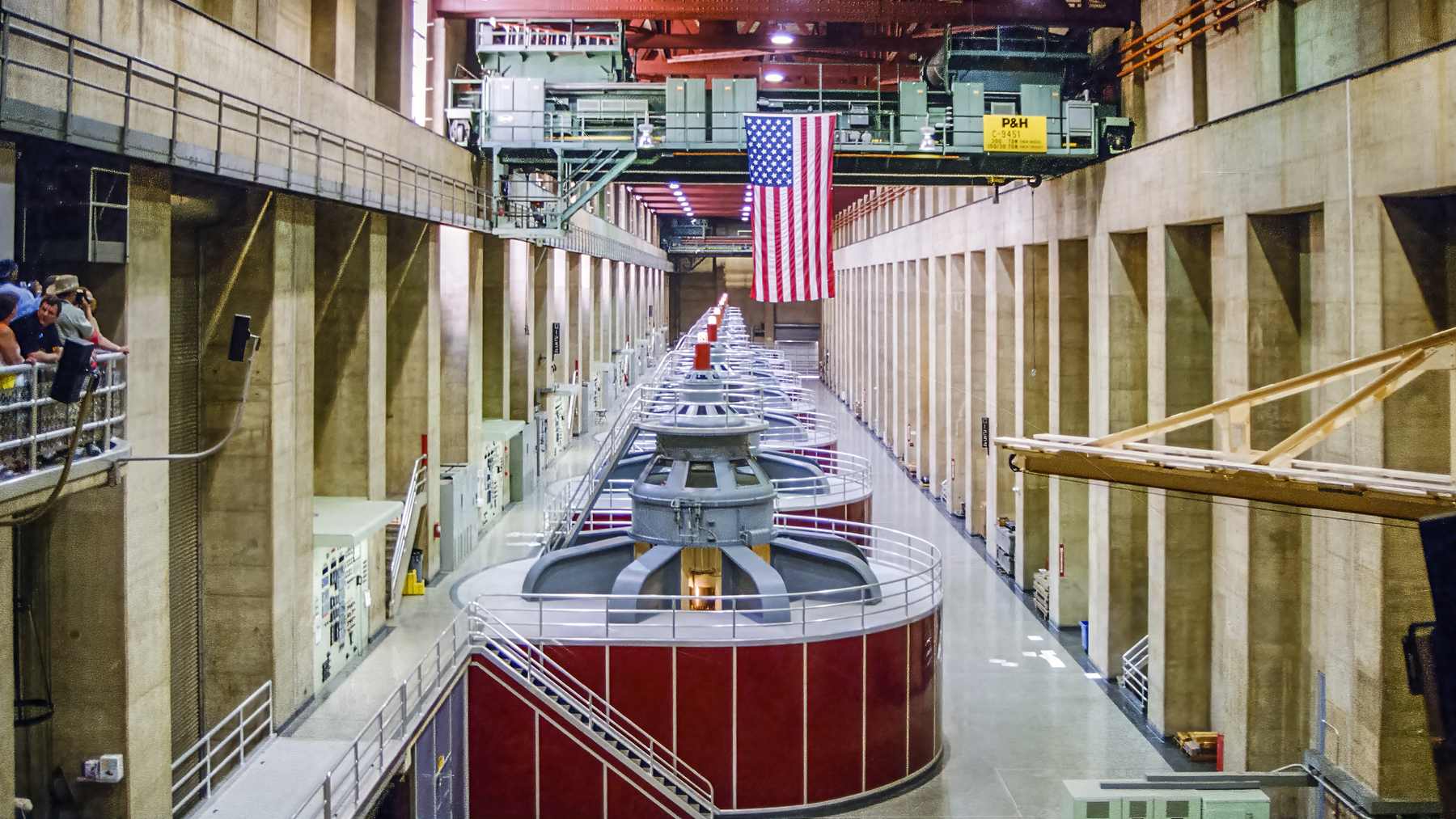
Below 1,035 feet, Reclamation says Hoover’s 12 original turbines would take excessive cavitation damage and wouldn’t be used. The five newer wide-head units, which the agency has been swapping in since 2007, keep going.
The July Final EIS puts the plant’s capacity at that elevation at 382 megawatts, down from 1,274 megawatts. The May press release that announced the turbine money used 1,302 megawatts as the “before” number instead, and I can’t tell you why two Reclamation documents four months apart don’t agree, so I’m going with the one that came out later.
Either way, you’re looking at a plant rated for 2,074 megawatts with a full lake running at under a fifth of that. The EIS also says something I’d frankly consider the more important sentence: with the current turbines, below 1,035 feet the cost of running the plant is expected to be more than the power is worth.
One thing a few readers asked about last time: air. Hoover doesn’t suck air into its turbines when the lake gets low, because the intakes are nowhere near the surface. Each of the four intake towers has two openings, one at 1,045 feet and one at 895 feet, and the lake is already below the upper one.
As far as I can tell from Reclamation’s own description, everything going through the dam right now is coming in through the bottom set, about 143 feet under the surface. The problem is pressure inside the machine, not bubbles from the top.
And while we’re clearing things up, 1,035 isn’t a water-shortage tier. The elevations that decide how much Arizona and Nevada get cut are a different set of numbers under a different set of rules. This one’s a turbine number.
So why did the lake go up?
Rain, mostly, and I’ll hedge that because the sheet doesn’t come out and say it. What it does say is that the Lake Mead basin has had 5.78 inches of precipitation since the water year started on October 1, which is 465 percent of normal.
That’s an enormous percentage built on a tiny base, since October is normally close to dry out there, but it lines up with the gauge jumping right after the October 22 storm. Reclamation’s own footnote warns that these precipitation numbers can swing a lot from week to week this early in the year, which seems fair.
Here’s where it gets interesting for the forecast. The 24-Month Study doesn’t try to predict the rain between Lake Powell and Lake Mead. It plugs in the average inflow from 2020 through 2024 and moves on, which works out to 71,000 acre-feet for October.
The Colorado Basin River Forecast Center, which does try to predict it, has October at 120,000 acre-feet, or 147 percent of average. An acre-foot is a foot of water across an acre, about 326,000 gallons, so that’s 49,000 acre-feet the model isn’t counting.
So the model’s a little pessimistic about October, and the lake is a little higher than the model said it would be. That’s good news in the sense that a guy three feet from a ledge is better off than a guy two and a half feet from it. It isn’t good news in any sense that changes the direction of travel.
Lake Powell, according to the same sheet, rose 6.96 feet on the week to 3,527.51 feet and sits at 24 percent full, and Powell is the reservoir that decides what Mead gets next year. The whole Colorado system is holding 18,775,000 acre-feet, 32 percent of capacity, against 21,924,000 a year ago.
Hoover doesn’t go dark at 1,035
You’ll see “Hoover Dam shuts down” in a lot of headlines when the line gets crossed, and that isn’t what the documents say. Below 1,035 the plant runs on its five wide-head units, and those are designed to keep working down to about 950 feet, which Reclamation calls minimum power pool.
At that elevation the EIS estimates 117 megawatts. Between 950 and 895 feet water can still be released, just without making power, and 895 is dead pool, where nothing gets through the dam at all. So there’s an 85-foot band between “most of the turbines are parked” and “no power,” and the lake is a long way from the bottom of it.
Then there’s the May money. Reclamation said on May 21 it was putting about $52 million from a leftover retirement fund toward Hoover maintenance, with a good chunk of it going to replace up to three of the older turbines with wide-head units, which it expects to restore at least 160 megawatts. Acting Commissioner Scott Cameron said at the time that “unlocking these funds allows us to move forward with critical upgrades,” and I’d call that a fair description of money that was collected for pensions nobody ended up needing it for.
The paperwork has moved since then, which I didn’t expect. Reclamation put out a sole-source solicitation on June 10 for two stainless-steel wide-head runners, for units A2 and N7, with proposals due in August.
Two, not three. The solicitation says the government figures at least 18 months for manufacturing and installation, and the period of performance runs from December 15 of this year to December 14, 2028.
So even on the government’s own paper, the first new runner doesn’t spin before 2028. I couldn’t find an award notice as of October 30, so treat the 160 megawatts as a plan rather than a fix that arrives this winter.
A forecast is a forecast. The October study was run on October 8, before either storm, and the November 24-Month Study, the first one with a chance to account for the rain, should be out around the middle of the month. Until then, the sheet Reclamation dated October 26 has Lake Mead at 1,038.03 feet on October 25 and at 1,034.52 feet on December 31, and the daily gauge had it at 1,038.44 feet at 6 a.m. on October 29, 3.44 feet above the turbine line.