
If you’ve ever shown up at a public pool at eleven on a hot Saturday, you know the lawn fills up long before the water does, and the shade goes first. A town utility just northwest of Frankfurt dealt with that this past summer the normal way, by building more shade. Then it did something less normal and wired that shade into the pool’s pump room. And with the panels barely through their first season, the town’s now getting ready to vote on tearing out the 90-year-old swimming pool they sit next to.
Stadtwerke Oberursel runs the TaunaBad, the public pool in Oberursel, a town of about 47,000 people at the foot of the Taunus hills. Before the outdoor season opened in May it put up three pergolas on the lawn beside the kids’ pool, each one 34 by 38 feet (10.4 by 11.5 meters), with roofs made of 180 solar panels. Stadtwerke Oberursel figures those roofs will make about 69,500 kilowatt-hours a year.
So what is a PV pergola?
A pergola is a freestanding frame with a roof on it, basically the thing you put over a patio when there’s no wall to hang an awning from. The TaunaBad version swaps the wooden slats for photovoltaic modules, so the panels are the roof rather than something sitting on top of one. Three of them cover about 3,862 square feet of grass next to the kids’ area.
That distinction matters more at a pool than you’d think. The buildings on a pool site are small and the open ground is enormous, so the roof space everybody wants to fill with solar barely exists. Anyone who’s priced a patio cover also knows the frame costs more than whatever you lay across the top of it, which is the honest argument against doing this anywhere you’ve got an empty roof. The argument for it here is that shade over the lawn was the thing families actually wanted, and the utility says the pergolas in front of the kids’ pool ended up being some of the most popular spots on the grass.
Why bolt solar panels to a fence?
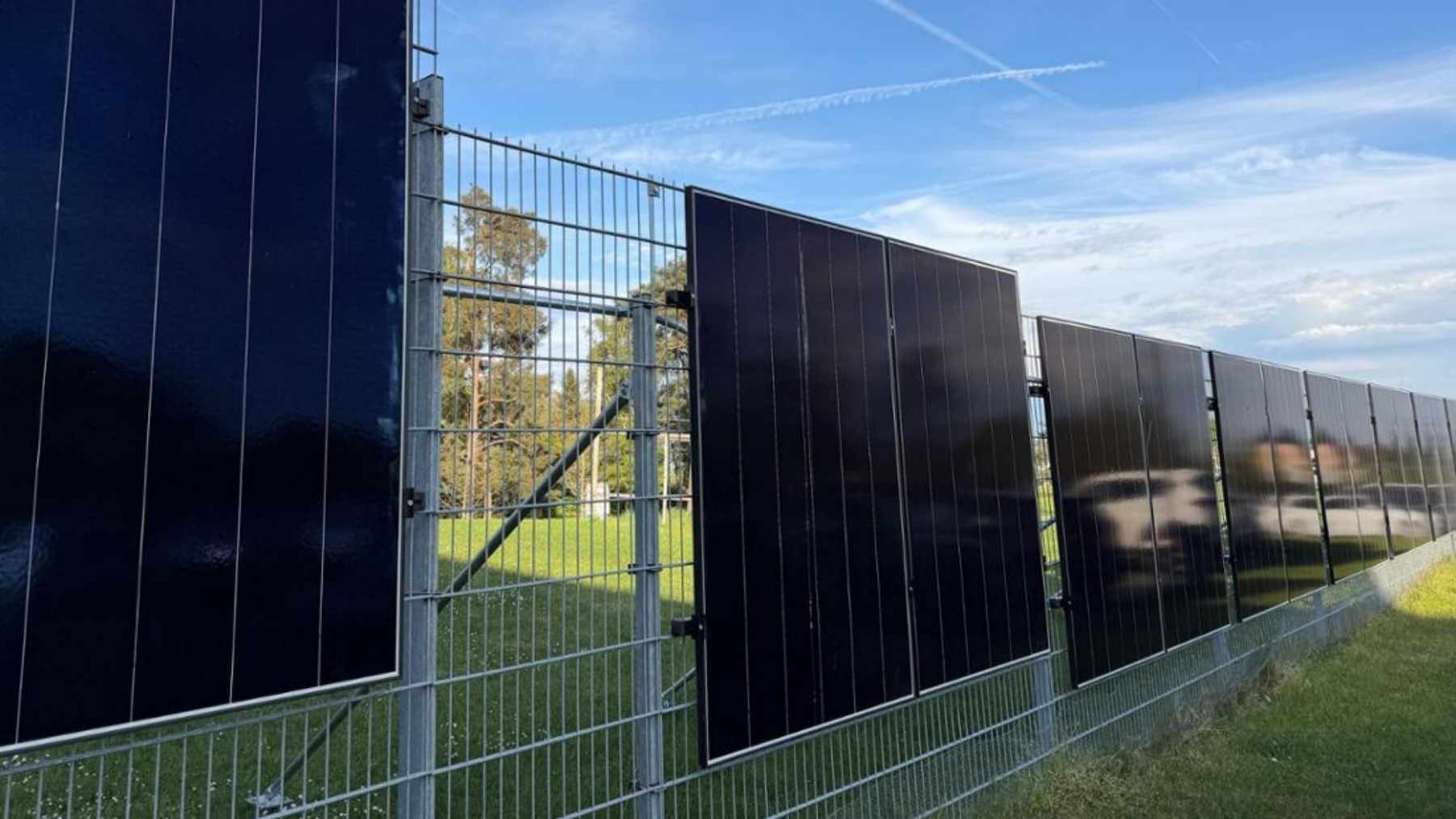
The second half of the job’s stranger, and I think it’s the better idea. A fence already ran between the pool grounds and the parking lot. The utility bolted 64 bifacial modules onto it and expects about 38,000 kilowatt-hours a year off that one line.
So what’s a bifacial module, and why would you stand one upright?
Bifacial panels collect light through the back of the cell as well as the front, which makes standing one on edge a lot less wasteful than it looks like it should be. One face takes the direct sun and the other takes whatever bounces off the parking lot behind it. Stadtwerke Oberursel says the fence modules run on direct and reflected light together. A vertical panel does give up the middle of the day that a tilted array is built around, and it picks up more of the early morning and late afternoon in exchange. We went through the same physics on a Queens rooftop where about a hundred kilowatts of solar panels stand on edge above a garden.
So I did the division myself. I ran the utility’s two forecasts against its own module counts, and each fence module works out at about 594 kilowatt-hours a year, against about 386 for each pergola module. Stadtwerke Oberursel hasn’t published the wattage of either type, so I can’t tell you how much of that gap is bigger panels and how much is the bifacial gain. My guess is it’s mostly the panels, but that’s a guess.
Both installations together come to a little over 107 kilowatts peak and a forecast 107,000 kilowatt-hours a year. That lands at roughly 1,000 kilowatt-hours per kilowatt installed, which is the ordinary rule of thumb for German sunshine rather than an optimistic one. It’s still a forecast. The panels went live in May, so no full year has gone through the meter yet, and the utility hasn’t put out a production number for the summer.
The pumps get the power
Almost all of that power doesn’t leave the site. Stadtwerke Oberursel says the electricity feeds the TaunaBad’s own technical equipment rather than the grid, and it planned the pergolas alongside a replacement of the pool’s pumps. Hessen’s state program for municipal climate protection and adaptation projects paid into the pergola half.
Pool pumps are a pretty good match for solar. Circulation and filtration run through the whole operating day, all season, at a fairly flat load, and the panels make their power in the same window. You don’t need a battery to line those two up.
Compare that with Disneyland Paris, where 82,000 solar panels cover 11,200 parking spaces. The Swiss developer that built it sells the entire output, and the park uses none of it. Both are real projects. Only one of them runs its own equipment on what it makes.
43 German homes, or about ten American ones
Stadtwerke Oberursel puts the pergolas at the annual consumption of about 28 households and the fence at about 15, so 43 between them. Run the same output past an American meter and it shrinks fast. The Energy Information Administration has US residential customers averaging 865 kilowatt-hours a month in its most recent full-year figure, about 10,400 a year, which turns 43 German households into roughly ten American ones.
Why the gap? American houses are bigger and most of them run air conditioning, which the EIA’s own surveys keep finding is the largest single use of electricity in a US home. German homes also tend to heat with gas, and they’ll usually make their hot water with it too, which keeps the electric half of the bill smaller before anyone turns anything on.
None of this is exotic hardware, and that’s frankly the appealing part. The modules are ordinary and the pergola is a patio structure with a stiffer roof, and the whole idea rests on putting panels where the ground was already committed to something else. Frankfurt Airport, on the other side of the same metro area, ran solar panels down the side of a runway on exactly that logic.
The pool itself is up for a vote
The outdoor season closed on September 13 after about 95,000 visits, roughly 3,000 more than the year before, with the busiest day on June 27 at 3,645 swimmers. Then, on October 15, the city of Oberursel put out a release about the water those swimmers were in.
The TaunaBad’s basins have been in service for 90 years. The swimming pool, the wading pool and the diving pool, plus the plant that runs them, are all well past their normal service life, and Stadtwerke Oberursel says it can’t keep repairing them at a cost that makes sense. The city’s position is that a new build is the only way to keep an outdoor pool in town at all.
So the pergolas are brand new, the fence panels are brand new, the pumps are being replaced, and the thing all of that was installed to serve is the oldest part of the site.
What’s in front of the council is a choice between a 25-meter lap pool and a 50-meter one. The city’s proposing 25 meters because of a tight budget, and the swim clubs that were consulted said 50 would be nice but isn’t essential. The planning money, 500,000 euros, is already in the budget, but it’s frozen until the council makes a basic decision, after which the design work can be put out to bid and awarded next year. The federal government has 600,000 euros earmarked for the rebuild under a program that funds municipal pool renovations, on the condition that the city puts the chosen version into its financial plan, and the whole package still needs sign-off from the county.
The city hasn’t said what happens to the lawn or the pergolas while the basins are rebuilt. As far as I can tell from the release, the work’s in the pools and their plant rooms rather than on the grass or the fence line, so I’d expect the panels to stay put, but nobody’s said that in so many words.
The council’s finance committee takes it up on Thursday, October 29, and the full city council’s due to make the decision on Thursday, November 19, with a public consultation on the design to follow next year. “If we put off the decision, we risk Oberursel losing its outdoor pool,” Mayor Antje Runge said in the October 15 release, adding that her goal is to keep the gap between the old pool closing and the new one opening as short as possible.
Image credit: CSC
 @tmc ROOKIE1 month ago