
Anyone who has parked at a theme park in August knows the walk from the car to the gate. The asphalt radiates, the door handle is too hot to touch when you come back, and the lot itself is the least interesting piece of real estate on the property.
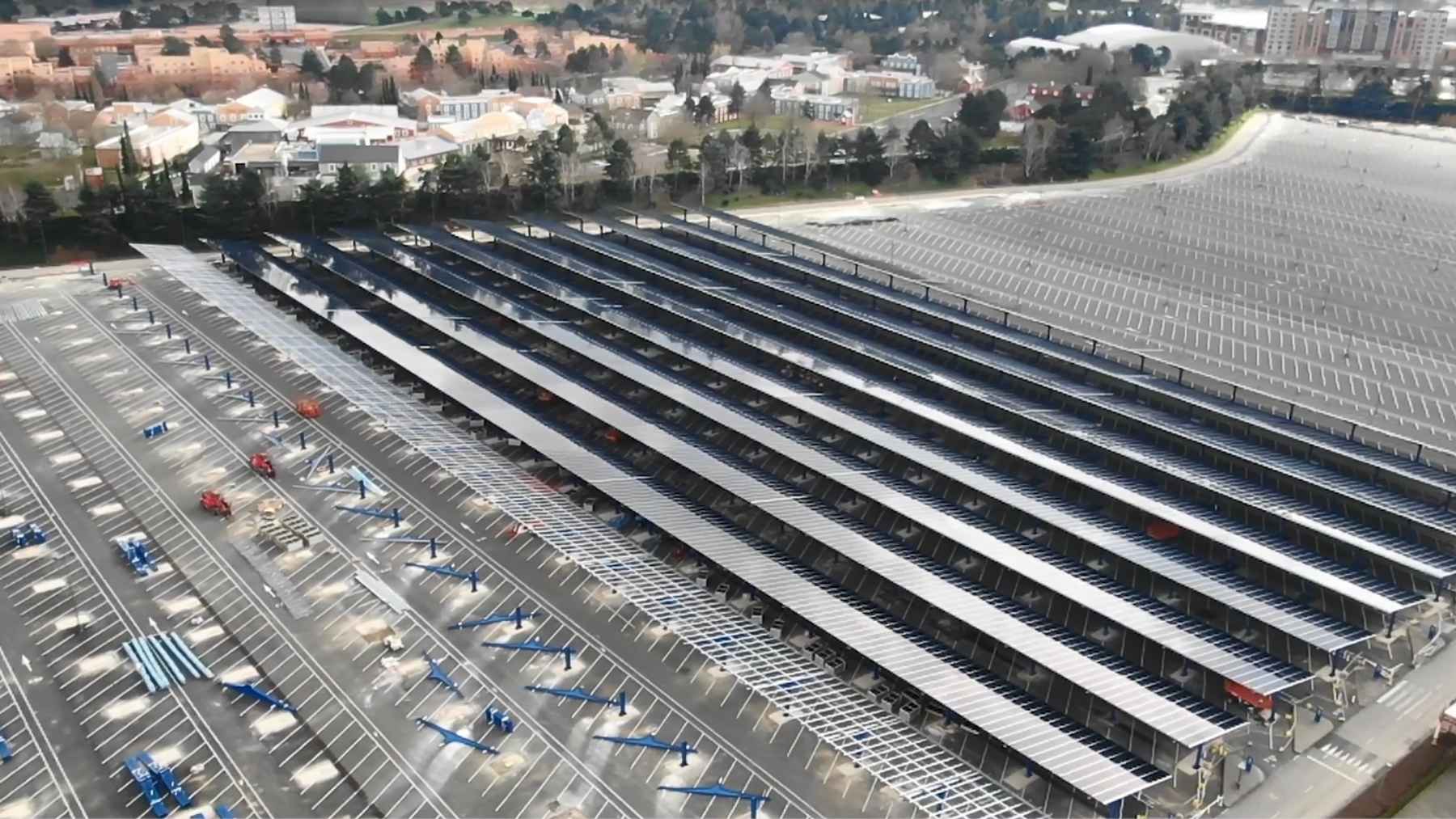
At Disneyland Paris, that lot is now a 36.1-megawatt power plant. It took three years, 82,000 solar panels and 11,200 covered parking spaces to get there, and the guests never stopped driving in underneath it.
The numbers come from Axpo, the Swiss energy group whose subsidiary Urbasolar built it. The canopies span more than 20 hectares, about 49 acres, or roughly 37 football fields of parking.
Axpo puts annual output at 36 gigawatt-hours, the equivalent of what a town of 17,400 people uses in a year.
Both companies have an interest in those figures looking good. So here is the part the press releases skip: none of that electricity powers a single ride.
The hard part was building it without closing the parking lot
Disneyland Paris announced the project on October 22, 2020, and construction started that same year. The original plan was smaller. Early coverage described 67,500 panels over 17 hectares and 9,600 spaces, producing 31 GWh a year. What got built was noticeably bigger on every axis.
The engineering problem was never the panels. It was that the visitor lot at Chessy is the front door to the most-visited theme park in Europe, and it could not shut for three years while a contractor drove piles into it.
Urbasolar told pv magazine France that the central challenge was managing co-activity with the client, which it described as guaranteeing that the park kept operating despite the works. That is a polite way of saying the crew built a power station in slices around cars that were still arriving every morning.
You can track the slices. By April 2021, about 12,000 panels covered 1,770 spaces. In April 2022 the first 17-megawatt section switched on, roughly 46,000 panels over more than 7,000 spaces, good for 10 GWh a year.
By spring 2023 a third section was live, at 63,000 panels and 27 GWh. The last one came online in December 2023, and Axpo and Disney announced completion at the end of April 2024.
Steel erection and module mounting went to Enersteel, a subsidiary of the Ponticelli group. From spring 2022 the site ran around 40 elevated work platforms at once, scattered across the 20 hectares. The work zone moved across the lot in blocks, fenced off section by section, which is why the parking never had to go away.
That “17% of the park’s electricity” line needs an asterisk
Every writeup repeats the same statistic. The array generates enough to cover about 17% of Disneyland Paris’s electricity consumption. Axpo says it, Urbasolar says it, Disney says it.
The word doing the heavy lifting is “enough.” It is a comparison, not a description of where the electrons go.
When pv magazine France asked directly, an Urbasolar spokesperson said the installation will run for 30 years and that the entire output is sold to unnamed buyers, with no self-consumption arrangement at all. The publication also reported that Disney had not responded to questions about the electricity resale business model, or confirmed the total parking area covered.
So the park is not running on its own parking lot. It built a merchant power plant on top of one and sells the output, which is a normal way to finance 20 hectares of steel and glass. It is just a different sentence than the one most readers walk away with.
The distinction shows up constantly in big solar announcements. We ran into the same gap covering JFK’s New Terminal One, where 13,000 rooftop panels sit above a building that actually rides out blackouts on 3.84 megawatts of gas fuel cells. Panels on the roof and power in the building are two separate claims.
The “biggest in Europe” title lasted about three months
Axpo and Urbasolar called it Europe’s largest solar parking canopy when they announced completion on April 30, 2024. That was accurate as stated, and both are the developers, so the claim carries their fingerprints.
Three months later, Belgian firm Perpetum Energy finished a 40 MW carport at the Pairi Daiza zoo in Brugelette, Hainaut. That project used 93,786 panels across 200,000 square meters, cost 40 million euros, and was framed by general manager Grégoire Dewandeleer as the largest wooden photovoltaic carport in the world, built from Douglas fir sourced in the Ardennes.
On raw nameplate capacity, 40 beats 36.1. The Belgian claim is scoped to wooden structures, so the two records are not quite arguing with each other, but anyone writing “Europe’s biggest” in the present tense in 2026 should know a bigger one exists.
France stopped asking nicely on July 1
Here is why a 2023 construction project is suddenly relevant again. France’s APER law, formally law 2023-175 of March 10, 2023, requires outdoor parking lots to cover at least half their surface with shade structures that generate renewable power.
For lots above 10,000 square meters, the compliance date was July 1, 2026. That was six weeks ago. Penalties for non-compliance run up to 40,000 euros per year, recurring annually until the lot complies. Smaller lots between 1,500 and 10,000 square meters have until July 1, 2028, with penalties up to 20,000 euros a year.
French industry estimates put roughly 11,000 lots in the first bracket. A November 2025 amendment known as the Huwart law loosened the technical options, allowing operators to mix photovoltaic canopies with vegetation rather than going all-glass, but it left the deadlines and the fines exactly where they were.
The copying has already started. On June 29, 2026, Parc Spirou Provence and the Wave Island water park in Monteux switched on canopies over 8.2 hectares of their parking, about 27,000 panels for an estimated 17.7 GWh a year, on a 15 million euro build. Urbasolar has done comparable jobs at Walygator Sud-Ouest, Aqualand Agen and Aqualand Fréjus.
France has been the most aggressive country in Europe about finding solar sites that are not farmland. The thread runs from the Wattway solar road in Normandy that got dug up entirely in 2024 to the cognac grower who gave up his appellation to hang panels over his vines.
Parking lots are the version with the fewest downsides, because nothing was growing there to begin with.
American parking lots have the space and not much else
The potential in the US is not in dispute. Research led by Joshua Pearce at Western University in Ontario found that a typical Walmart supercenter’s five-acre lot could carry a three-megawatt array.
Cover all 3,571 US supercenters and you reach 11.1 gigawatts, which Yale E360 compared to about a dozen large coal plants. Lawrence Berkeley National Laboratory work puts pavement at 35% to 50% of a typical city’s surface area, with parking taking 40% of that.
The obstacle is money. Carports are the most expensive way to mount a solar panel, because you are buying a building instead of a rack.
Marketplace data from commercial clean energy platform Station A had carport bids averaging $3.24 per watt DC for systems in the 200 to 800 kW range, against $1.84 for rooftop and $1.94 for ground mount at comparable sizes. EnergySage marketplace figures for 2026 land around $3.62 per watt. The premium buys covered parking and generation on land you already paved.
The federal picture got harder this summer too. Under the One Big Beautiful Bill Act, the residential credit under Section 25D ended on December 31, 2025.
For commercial projects claiming the Section 48E investment credit, construction had to begin on or before July 4, 2026, or the facility has to be in service by December 31, 2027. IRS Notice 2025-42 also scrapped the familiar 5% safe harbor for most solar, leaving a physical work test in its place, with a carve-out for projects at or below 1.5 MW.
France set a fine for not building. The US moved a tax deadline three days later, on the opposite side of the ledger. Whichever way you read that, a developer pricing a canopy in Ohio this month is working with a shorter runway than one pricing the same canopy outside Lyon.
The catch nobody mentioned in 2024
Disneyland Paris sells all 36 GWh into the French market, and the French market has changed a lot since the ribbon-cutting.
Grid operator RTE logged 407 hours of negative wholesale prices in the first half of 2026, close to 10% of the time. That compares with 513 hours across all of 2025 and 147 hours in 2023. On May 1 the spot price hit -498.65 euros per megawatt-hour, nearly touching the -500 regulatory floor. Those episodes average around five hours and cluster between 11am and 4pm.
Which is precisely when a parking canopy is at full output.
France is responding with remote curtailment. From December 1, 2026, photovoltaic installations above 5 MWp can be ordered to stop producing during negative-price windows, and from March 1, 2027 the rule extends down to plants between 1 and 5 MW, a bracket that sweeps in a lot of parking canopies. At 36.1 MWp, the Disney array sits well inside the first tier.
Neither Disney nor Urbasolar has published metered production since the plant went fully live, so 36 GWh remains an estimate rather than a result. Two and a half years on, it is still the number everyone quotes, which tells you how rarely anyone circles back on these projects.
The construction record stands on its own regardless. Three years, 11,200 spaces, not one day of closure. The economics underneath it are being rewritten while the panels sit there working.
 Mike Smith ROOKIE2 months ago