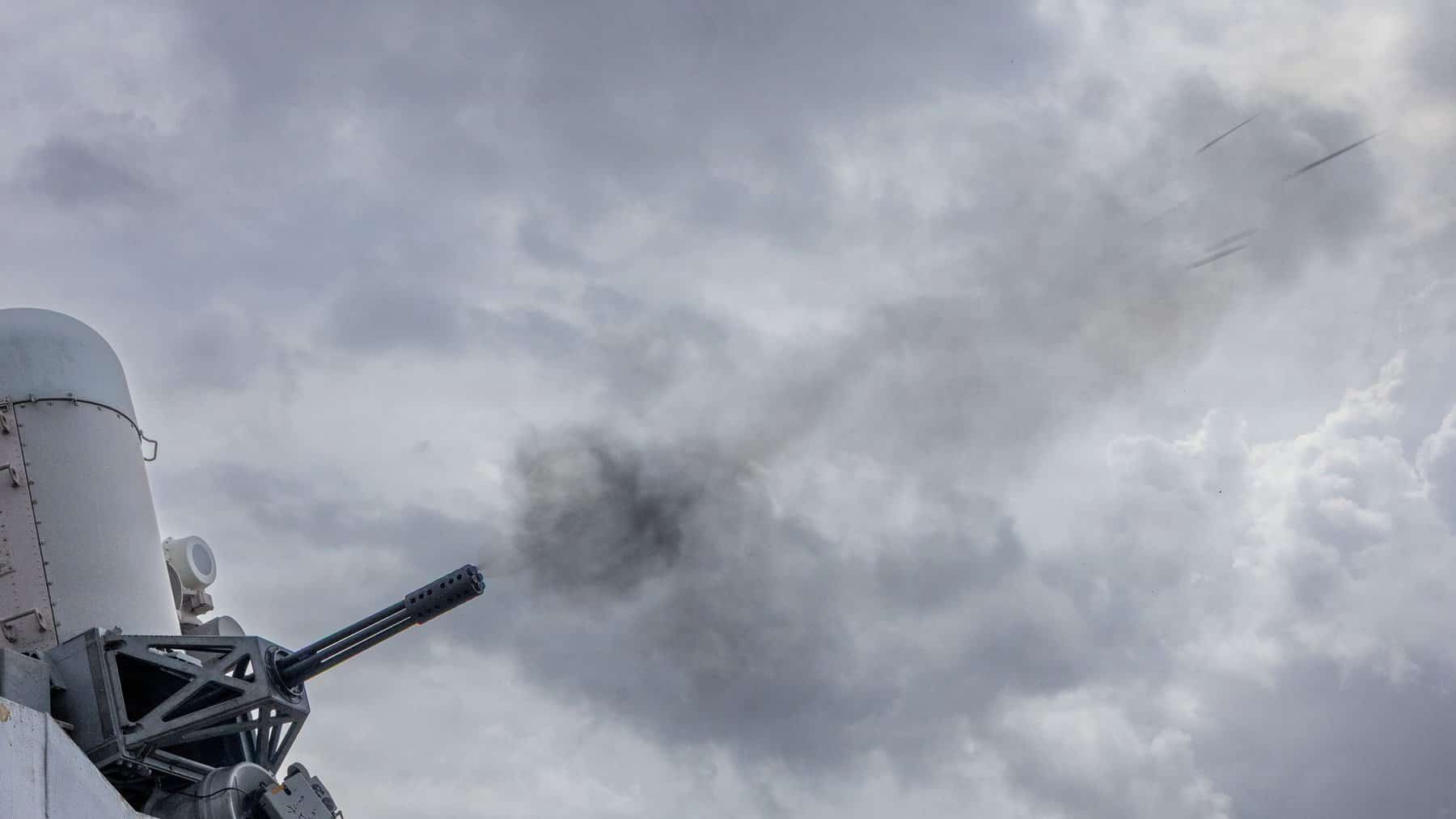

Sailors call it R2-D2, and once you’ve seen one, you can’t really unsee it. It’s the white dome with six gun barrels poking out underneath, bolted to the deck of most American warships, and it looks a lot more like a movie droid than a weapon.
Nobody thinks about it much until something gets close. By the time this gun opens up, whatever’s coming has already gotten past everything else the ship has. But September was a pretty busy month for it.
In the space of 11 days, Navy photo captions show the Phalanx, which is the gun’s proper name, firing from at least three ships in the Middle East. The cruiser USS Princeton fired its mount on September 6, and the carrier USS George Washington did the same on September 15. On September 17, a sailor aboard the destroyer USS Mason was photographed watching that ship’s mount fire.
Then on September 29, the Pentagon announced an order worth $247,089,895 to build more of them and rework ones that are already out there, with the job running through September 2030.
So what’s going on with this old gun?
We looked at it last month, when the destroyer USS Mustin was checking its aim in the Indian Ocean, so I won’t walk you through the whole spec sheet again. The short version is a 13,600-pound self-contained mount with a six-barrel 20mm Gatling gun, a 1,550-round drum and its own radar. According to the Navy’s fact file, it can search, track, shoot and judge its own kills without help from the rest of the ship.
You’ll see it described as firing 3,000 to 4,500 rounds a minute, which makes it sound like a dimmer switch. It’s closer to a two-position switch. The Navy lists 4,500 against missiles and aircraft, and 3,000 against what it calls asymmetric threats, which basically means small fast boats, helicopters and drones. So that drum lasts about 20 seconds at the high setting and about 31 at the low one, and that’s if it never stops to breathe.
So what were they shooting at?
Nothing that was shooting back, as far as anyone has said. The George Washington caption calls it a training event, and the Princeton and Mason captions describe live fire. I can’t find a target or a round count for any of them.
Live fire just means real ammunition instead of a simulated run. You’d want that now and then from a gun that has to work the first time, with pretty much no warning.
There’s a small before-and-after here too. US Central Command posted a 41-second video of sailors doing maintenance on Mason’s mount on August 19, about a month before that live fire. I can’t tell you the two are connected, but that’s the order I’d do them in.
This gun has arguably earned the practice time. USS Gravely used one to knock down a Houthi cruise missile about a mile out in the Red Sea, according to CNN, and that’s about as close as the Navy wants any of this to get.
The timing’s hard to ignore, and I don’t want to oversell it either. On September 5, the day before Princeton’s shoot, Central Command said Iran’s Revolutionary Guard launched ballistic missiles toward a US aircraft carrier and a guided-missile destroyer, and that both ships evaded them. It didn’t name the ships.
Nothing I’ve found ties a Phalanx to that episode, and ballistic missiles aren’t on the fact file’s list of things this gun is for. Still, I’d guess nobody in the 5th Fleet was treating gunnery practice as a box to check that month.
So what does $247 million buy?
The notice won’t tell you. It lists “production, upgrades, conversions, and overhauls” of the gun and its relatives, plus hardware and spares, for the Navy and the Army. It doesn’t say how many mounts that adds up to, so I’m not going to guess.
The closest thing to a yardstick I could find is 19 years old this month. Back then, a pair of orders totaling $241.8 million, against $247 million now, covered overhauling and upgrading 34 Navy guns and one Australian gun, plus 12 new land-based systems for the Army, according to Raytheon’s announcement at the time.
Please don’t divide that and call it a price. A dollar from back then isn’t a dollar today, and nobody’s said the mix is the same.
What the notice does spell out is where the money’s coming from, and I found that pretty telling. The Navy and Army obligated $240,599,326 at award. Obligated basically means the money’s committed, rather than a ceiling the services might spend up to someday. That’s more than 97% of the contract, on day one.
It’s all fiscal 2026 money, and fiscal 2026 ended the day after the announcement. Maintenance money generally has to be committed in the year it’s budgeted, so if you’ve ever rushed to drain a flexible spending account in December, you get the idea. I can’t prove that’s what happened here, and buying money usually gets a few more years to spend.
Now split that pile up. About $169.2 million comes from procurement and shipbuilding accounts, which pay for buying hardware, and about $71.4 million comes from operations and maintenance, which keeps existing hardware running.
So I wouldn’t call this a simple overhaul job, even with overhauls on the list. The line isn’t perfectly clean, since upgrades can come out of those buying accounts too, but roughly 70 cents of every committed dollar is buying money. And $27.4 million of that is shipbuilding money, which I’d read as mounts headed for new ships, although the notice doesn’t say so.
Orders like this are also pretty routine. The Navy’s fact file says Phalanx has been built, upgraded and overhauled without a break since 1978, and last September’s Navy order came in at $205 million, against $247 million this time. That’s not quite like for like, because this one includes the Army.
The notice says the contract wasn’t competitively bid, which won’t shock anyone. Raytheon’s the contractor on the Navy’s fact file, so who else would you call? The notice puts 33% of the work in Louisville, Kentucky, and 5% in Mason, Ohio, which as far as I know has nothing to do with the destroyer. It’s slightly odd that the contract came through Naval Air Systems Command, the outfit that buys the Navy’s airplanes, when the earlier Phalanx orders I checked went through Naval Sea Systems Command. The notice doesn’t explain the switch, and I can’t either.
The Army wants this gun too
The notice covers three versions, and the second one doesn’t go anywhere near a ship. The Land-based Phalanx Weapon System is the Navy design on a trailer, with the same type of 20mm cannon, and the Army uses it against rockets, artillery and mortar rounds.
That mission’s called C-RAM, for counter-rocket, artillery and mortar. It basically means hitting incoming rounds in the air before they land on your base.
The Army says the system has been protecting US and coalition forces since 2005, and an Army story from a couple of years ago credited it with covering troops through more than 100 attacks in Iraq and Syria.
The committed money backs that up, with $104,169,293 from Army accounts against $136,430,033 from the Navy. The notice doesn’t break the money down by version, but it’s safe to assume most of the Army’s share is going to the trailer gun. The Army’s been doing pretty well out of Navy hardware lately, by the way. It’s also flying four retired Fire Scout drone helicopters the Navy no longer wanted.
SeaRAM is in the same order, and it doesn’t have a gun
The third version is SeaRAM. It keeps the Phalanx’s radar and electro-optical sensors on one mount, then swaps the Gatling gun for a launcher holding 11 Rolling Airframe Missiles. The Navy’s fact files put it at about 17,800 pounds above deck, against 13,600 pounds for the gun version.
So you’re trading 1,550 cheap shots for 11 expensive ones, and getting more reach in return. The Navy classifies the range, so I can’t tell you how much.
Keep an eye on the word “conversions” in that notice. HigherGov, a federal contracting data site, reports that the Navy’s fiscal 2027 budget request plans to swap some Phalanx mounts for SeaRAM. I couldn’t get the budget document to open myself, so that’s HigherGov’s reading, and it also points out that the notice doesn’t connect the two.
Does that mean the Gatling gun’s on its way out?
I doubt it, at least not any time soon. This order puts production first on its list and pays for the gun on ships and on trailers, and that’s a funny way to treat something you’re done with. My guess is R2-D2 sticks around for a good while yet, even if a few of them end up carrying missiles.
Naval Air Systems Command lists September 2030 as the expected completion date for this order, which would be 52 years after Phalanx went into production in 1978.