
Making a port deeper is one of those jobs that sounds simple until you learn how it’s actually done. When the bottom is sand or mud, you send in a dredger and vacuum the stuff up. When the bottom is solid rock, the traditional answer has been drilling holes into the seabed, packing them with explosives, and blasting it loose before anything can scoop it.
That works, but ports hate it. Blasting sends shockwaves into quay walls, buried pipelines and every living thing in the water column, which is why plenty of harbors restrict it or rule it out entirely. So the Belgian marine contractor DEME ordered a ship built to skip the explosives and chew the rock straight off the bottom instead.
The ship is called Spartacus, and nothing else afloat bites like it. It stretches 538 feet (164 meters), packs 44,180 kW of installed power, about 59,250 horsepower, and Royal IHC, the Dutch yard that built it, calls it the strongest cutter suction dredger in the world. It entered service in August 2021, which means the ship turns five this month. And this summer, DEME’s own engineers published the report card.
Ports used to get deeper with dynamite
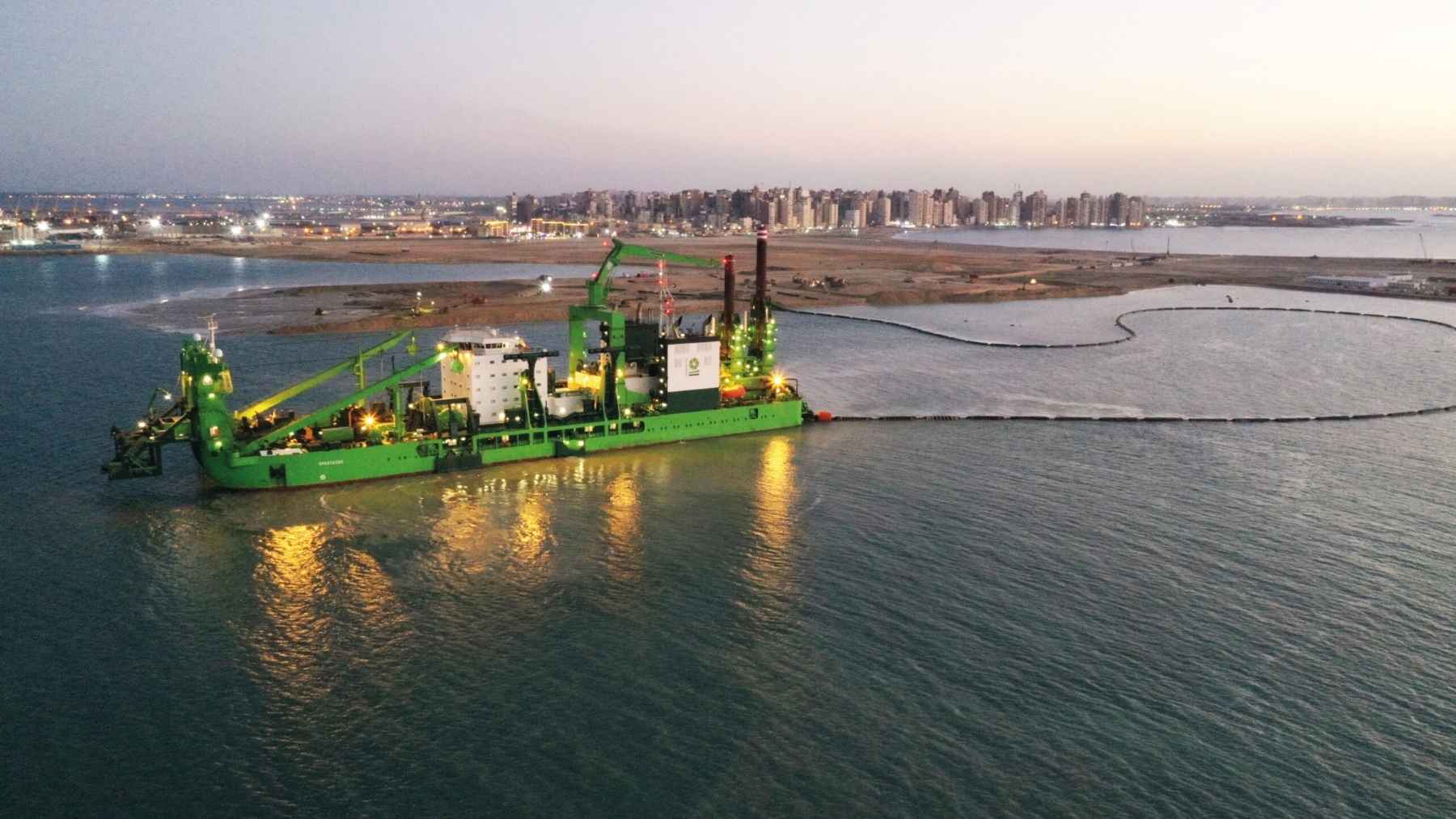
A cutter suction dredger is a strange machine if you’ve never seen one. Picture an apple corer the size of a garage, studded with teeth, spinning at the end of a huge steel arm lowered to the seabed. Behind the spinning head sits a suction pipe, so the rock gets ground into slurry and swallowed in the same motion.
Then pumps push that slurry through a pipeline to wherever it needs to go. On Spartacus, three diesel-electric pumps totaling 25,500 kW can shove the mixture through a 47-inch pipe for more than 6 miles. The ship parks itself on giant steel legs called spuds, swings the cutter in arcs, and eats the bottom one pass at a time.
For most of the machine’s history, there was a hard ceiling on all this. Cutter dredgers handled moderately strong rock fine, but genuinely hard formations wore out teeth faster than they made progress, and drill-and-blast stayed the cheaper option. According to a technical paper by DEME expert engineer Jan van den Broecke, published this summer in the industry journal DFSI, that ceiling is exactly what this ship was designed to break.
The cutting arm alone weighs 2,550 tons
The physics of rock cutting are blunt: the heavier the arm holding the cutter, the harder you can press the teeth into the seabed without the whole head bouncing out of the cut. So DEME made the arm absurd. The cutter ladder on Spartacus weighs 2,550 metric tons, which per the company is significantly more than on any other cutter dredger active in the world.
For scale, the largest hydraulic hammer ever built, the 700-ton monster designed to pound offshore wind foundations into the seabed, would fit inside this ladder’s weight budget three and a half times. That’s 5.6 million pounds of steel hanging off one end of the ship, doing the biting.
Feeding the head are two 6,000 kW electric drives, giving the cutter 12,000 kW to work with. That is double what the previous generation of mega cutter dredgers could deliver, and it flows through a gearbox built to survive the moment a spinning head suddenly jams in rock. A passive damper on the cutter shaft smooths out the torque spikes, so the crew can keep full power applied where an older ship would have to back off.
Even the consumables are oversized. Each interchangeable cutter tooth weighs more than 100 pounds, and the ship carries 14 cutterheads in six different designs, covering everything from fine sand to hard rock. The main spud runs about 240 feet long and holds twice as firmly as the previous generation, and the ladder reaches down 148 feet (45 meters) without extensions. No other cutter dredger design had gone deeper than 35.
Egypt was the shakedown, Portugal was the exam
The first job was enormous. At Abu Qir, near Alexandria in Egypt, DEME signed its largest dredging and land reclamation contract ever, a deal the company valued above $357 million: build 1,000 hectares of brand-new land, nearly three Central Parks’ worth, deepen the approach channel to 23 meters and carve a turning basin to 22.
More than 150 million cubic meters of material got moved in the process. That’s enough to fill roughly 60,000 Olympic swimming pools, and if you’ve ever wondered why the sand for projects like these is such a weirdly precious commodity, the grain-shape economics behind it are their own rabbit hole.
Abu Qir is also where the efficiency numbers come from. DEME ran its older diesel-direct cutter dredgers next to Spartacus on near-identical setups, pumping through about 1.4 miles of pipe. The old generation burned roughly 38 megajoules of energy per cubic meter of rock moved. Spartacus, running on a mix of LNG and marine gas oil, needed 22.4. In greenhouse gas terms that’s a drop from about 2.9 kg of CO2 equivalent per cubic meter to 1.7, a cut of roughly 41 percent.
The ship also kept working in Mediterranean swell that would have parked its predecessors, handling waves over three times taller than the older mega dredgers’ limit, and it set a world record along the way: cutting at 44 meters down, deeper than any cutter suction dredger had ever dredged.
Then came the real test. In Leixões, the port of Porto in Portugal, Spartacus was handed 1.7 million cubic meters of genuinely nasty geology: schist, gneiss, very strong granite and orthogneiss, intact rock with barely any fractures to exploit. That’s textbook drill-and-blast territory. The ship chewed through all of it in six months, on schedule, in what DEME describes as the first time a rock job of that scale and complexity has been completed economically by a cutter dredger.
And at Tanger Med in Morocco, it carved a 15-degree inclined extension into the bedrock of the access channel, through alternating layers of claystone, limestone and sandstone, in seven days. Not seven months. Seven days.
The first dredger of its kind to run on LNG
Spartacus is also the first cutter suction dredger in the world able to run on liquefied natural gas. Four Wärtsilä main engines swallow LNG, marine diesel or heavy fuel oil as needed, and the two auxiliaries carry dual-fuel tech as well. That flexibility matters on a ship built to work for months in remote corners of the map where fuel logistics get creative.
The energy recycling on board borders on obsessive. A waste heat recovery system pulls up to 2,000 kW of electricity back out of the exhaust gases. And because the LNG sits in tanks at minus 256 degrees Fahrenheit, the ship uses that cold to help run the air conditioning, recovering up to another 400 kW. Somebody looked at boiling-cold rocket fuel and saw free AC.
There’s a pattern here, and it’s Belgian. This is the same small country currently sinking 22,000-ton concrete boxes into the North Sea to build an artificial energy island from scratch. Belgium has quietly become very good at manufacturing ground where the map says water.
Where the ship is right now
Five years in, the machine has picked up some mileage. It spent four months in major repairs at Qatar Shipyard Technology Solutions, a project DEME’s own manager described as testing the company’s expertise at every stage before wrapping up in September 2025. Even the world’s most powerful dredger spends time in the shop.
As of mid-August 2026, AIS tracking places Spartacus in Senegalese waters off West Africa, destination field set to Ndayane. That’s the site of DP World’s $1.2 billion deepwater port, the largest private infrastructure project in Senegal’s history, where the 5-kilometer access channel was cut by Jan De Nul’s most powerful cutter dredger, the Willem Van Rubroeck, and the main dredging wrapped 13 months early in late July.
No public announcement ties Spartacus to a contract there. The AIS destination is just what the crew typed in. Make of that what you will.
What’s not in question is what five years of this ship have done to the math of moving rock. Luc Vandenbulcke, DEME Group’s CEO, put it plainly at the handover: “projects that were unfeasible before are now possible” with Spartacus. Ports that once had to choose between staying shallow and shaking themselves apart with explosives now have a third option, and it runs on the fuel of a gas grill. The planet is getting wider one bite at a time, and the teeth weigh 100 pounds each.
 @timturner ROOKIE2 months ago