
Renewable energy runs on a kind of paperwork nobody outside the industry ever talks about. Before a bank lends money against a machine bolted to the seabed, and before an insurer writes a policy on it, some independent body has to sign a document saying the thing was built to a published standard. Offshore wind has had that document for decades. Wave energy never had one at all.
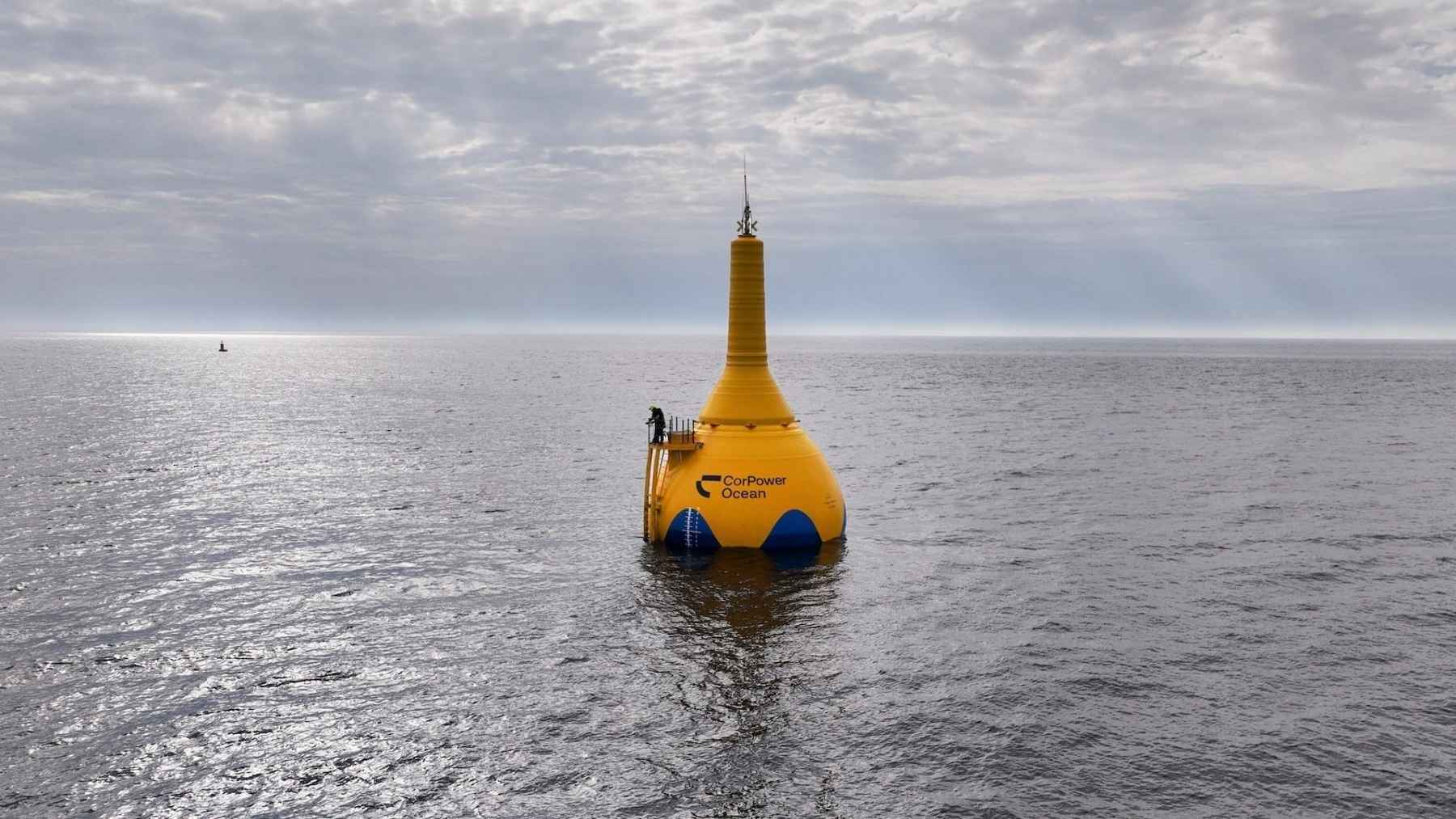
On July 21, DNV issued the first Prototype Certificate it has ever awarded to a wave energy converter. It went to the CorPower C4, a Swedish buoy anchored in the Atlantic about 2.5 miles off Aguçadoura, in northern Portugal, since 2023.
The machine itself is not news. It has been exporting power to the Portuguese grid and it has already survived worse weather than most offshore structures ever see. What is new is that somebody who does not work for CorPower has now put a signature on it.
Seven years of somebody else checking the math
The C4 is a 30-foot spherical composite hull on a machine that stands roughly 59 feet tall overall and weighs about 100 metric tons, call it 110 US tons. It sits in 148 feet of water and has been through three deployment cycles since 2023, including stretches of fully autonomous operation.
The certificate was issued under DNV-SE-0120, a service specification with the extremely dry title Certification of Wave Energy Converters and Arrays. DNV published the current edition in March 2023, and it covers both bottom-fixed and floating machines.
Getting through it took seven years. The program started by establishing the design basis for the C4, which means agreeing on paper what the machine was supposed to be built to survive before anyone argued about whether it had.
From there DNV reviewed and approved concept development, detailed engineering, structural strength and fatigue analysis, manufacturing, assembly, dry testing, installation, operations and maintenance, and device performance in extreme conditions. That is close to every stage a machine has.
Claudio Bittencourt Ferreira, project manager at DNV Renewables Certification, called the result “an important stepping stone in the realisation of commercial wave energy.”
Wave machines have collected certificates before, and it is worth being precise about what is actually new. Finland’s AW-Energy has been working through a certification program with Lloyd’s Register for its WaveRoller since the middle of the last decade, picking up a manufacturing certificate in 2019. What nobody had was a prototype certificate issued by DNV against the standard written specifically for wave energy converters.
The storm did most of the arguing
The number that keeps turning up in the certification scope is 18.5 meters, or about 61 feet. That is the wave height the C4 was sitting in on the night of November 4, 2023.
Storm Domingos had put Portugal’s coastline on red alert. The Instituto Hidrográfico logged the conditions as a historical record for the north of the country. CorPower’s team watched from a control room in Stockholm.
The buoy does not fight weather like that. A phase-control system called WaveSpring tunes the hull into resonance with ordinary swell to pull more power out of it, then detunes when the sea turns dangerous. In that detuned state the machine effectively goes slack and lets the water move past.
The evidence for how well it worked is unglamorous and fairly convincing. While the hull was being fully submerged by wave peaks, the gearbox encoders inside were measuring machinery motion of a few decimeters, well under two feet.
Domingos was not the first one either. The C4 had already ridden out storms Babet, Aline and Ciarán. The design behind that trick came out of a Swedish cardiologist’s research into how the human heart moves blood, which is a longer story on its own.
A prototype certificate is not a type certificate
The document covers one machine at one location, and CorPower is reasonably open about what it does not cover.
DNV’s marine energy certification schemes draw the line the same way throughout. A prototype certificate provides assurance for a demonstration device that is collecting data and validating the design methods behind it. A type certificate is the one that covers series production. Different documents, different scopes.
CorPower’s own project page sets out the sequence without dressing it up. The next phase is three next-generation C5 machines at the same Aguçadoura site, and the stated target for those is full DNV type certification, with industrial-scale commercial readiness in 2027 and a larger C6 after that.
The HiWave-5 program the C4 belongs to was built around that split from the start: prototype certification of one full-scale device, then type certification of a pilot array of three. July closed the first half of it.
So the honest reading is that wave energy now has a bankable prototype rather than a bankable product line. That is still considerably further than the sector has ever managed.
What the paperwork actually buys
CorPower’s argument is that the certificate cuts technology risk enough to unlock project finance, insurance and institutional investment. That is the whole point of the exercise.
Co-founder and CEO Patrik Möller said it moves wave energy “from being a promising technology to being a proven and bankable one.” Santiago Gil, head of VC at Santander Alternative Investments, put it as validation that “significantly reduces technology risk.”
The company is not short of backers already. Its B-round closed at €53 million, and during 2025 its investor list picked up Acario Innovation, the investment arm of Tokyo Gas, plus GTT Strategic Ventures, alongside €17.5 million from the European Innovation Council.
Two projects are waiting on the other side of the certificate. VianaWave is a 10-megawatt farm planned off northern Portugal, built around a CorPack of 30 converters and backed by a €40 million EU Innovation Fund grant. CorPower puts expected output at roughly 30 gigawatt-hours a year, enough for about 7,500 Portuguese homes. Portugal’s national energy and climate plan targets 200 megawatts of installed wave capacity by 2030.
The Scottish one is called Valiant. It would put 14 converters totalling 5 megawatts at EMEC’s Billia Croo site in Orkney, on a berth that is already consented and already has a grid connection. CorPower is targeting a final investment decision in 2027 and operations in 2029 or 2030, with roughly €19 million of Horizon Europe money behind it through the POWER-Farm EU consortium.
Neither of those gets built on enthusiasm. They get built when a credit committee reads a document.
America has the cable. It does not have the certificate.
The United States has spent real money building the place where a machine like this would be proven, and it is still largely waiting on hardware.
PacWave South sits about seven miles off Newport, Oregon, with four berths and enough buried cable to move 20 megawatts ashore. In November 2025 the Bonneville Power Administration signed a power purchase agreement with Oregon State University to buy up to 20 megawatt-hours per hour from the site, running 2026 through 2030. It is the first PPA covering wave power in the continental US.
CalWave is the developer furthest along toward filling one of those berths. The Department of Energy has noted that the company received guidance from DNV on preparing its devices for certification, which is a different thing from holding one.
No American wave machine has a DNV prototype certificate. The Oregon site is wired and mostly empty, and the closest thing on this side of the Atlantic to a long-running operational benchmark is a Spanish breakwater that has been quietly producing around 300 megawatt-hours a year since 2011.
None of this makes the C4 a power plant. It is one buoy, and the farms it is meant to unlock will not produce anything until the end of the decade at the earliest.
Wave energy’s problem was never only physics. Machines got built, some of them worked, and then the money looked at an uninsurable asset in an environment that eats steel and went and bought solar instead.
One prototype certificate does not fix that. It does give a credit committee something to open, which is more than the sector has ever handed them before.