
Thin air is generous with sunlight and rough on machinery. Anyone who has driven a naturally aspirated car over a high mountain pass knows the deal: more sun through the windshield, less oxygen for the engine, and every mechanical part working harder than it does at sea level.
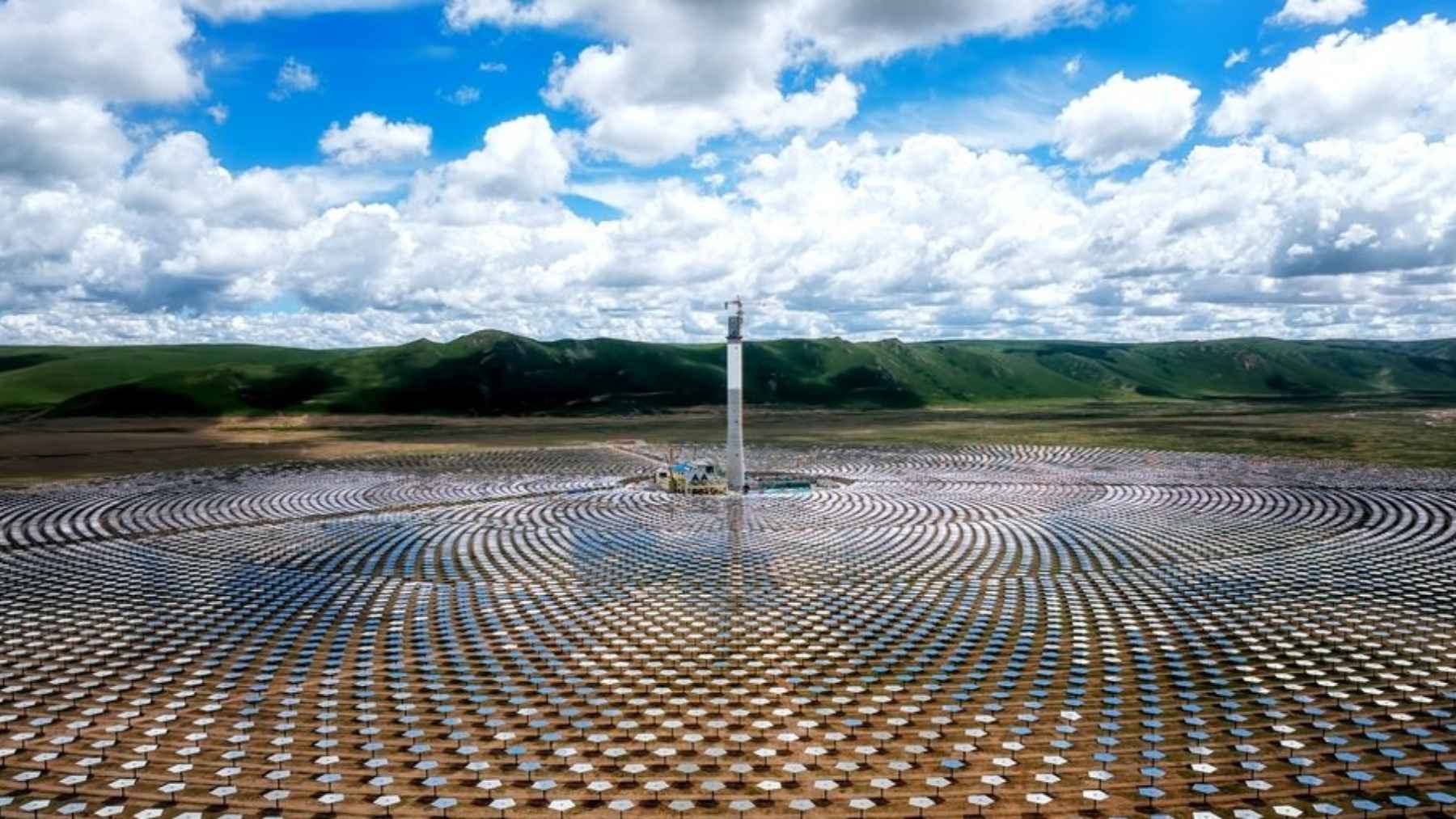
China is about to run that trade-off at industrial scale. On a plain in Amdo County, in the Xizang Autonomous Region, all 15,927 mirrors of the Tushuo solar thermal plant are now standing at 4,650 meters above sea level, and according to People’s Daily the site is heading for grid connection in October.
If the concept rings a bell, it should. This is the same basic technology America tried at Crescent Dunes in Nevada, a plant that has since been through bankruptcy twice. China looked at that track record and built one anyway, in a colder, thinner and more remote place, for less than a third of the money.
The mirror field sits higher than any summit in the lower 48
Amdo County is in Nagqu, in northern Xizang, and the site numbers read like a dare. The area gets more than 2,800 hours of sunshine a year, which is the part the engineers wanted. The rest of the package is thin air, hard winters and plateau winds the hardware has to shrug off every single day.
Start with the altitude. At 4,650 meters, or 15,256 feet, the mirror field sits above the summit of Mount Whitney, the tallest peak in the contiguous United States. Nobody had built a tower-type solar thermal plant in conditions like these before, and SASAC, the agency that oversees China’s state-owned companies, calls it the world’s first at ultra-high altitude, in ultra-low temperatures, on what it describes as an “immature grid.”
Then the scale. Each heliostat covers 50.23 square meters, roughly the floor of a two-car garage, and 15,927 of them track the sun across a field of about 800,000 square meters. Call it 150 football fields of motorized glass, all aimed at a single receiver on a central tower.
High altitude does strange things to solar hardware on this plateau. The thin atmosphere lets more radiation through, which is exactly what a mirror field wants, and it is the same reason developers keep coming back here, including a 50-megawatt photovoltaic array that froze the ground under its own panels for 50 extra days a year. Free extra sunshine has a price, and the price is everything else.
The salt is the point, not the mirrors
A photovoltaic panel makes electricity the instant light hits it and stops the instant it doesn’t. In most places you can paper over that with imports from a bigger grid next door. Northern Xizang does not have a bigger grid next door, which is why sunset there is less an inconvenience and more a supply problem.
The Tushuo design deals with this by never turning sunlight straight into electricity at all. The mirrors concentrate light onto a receiver at the top of the tower, heating molten salt to 560 degrees Celsius, about 1,040 Fahrenheit. The hot salt sits in an insulated tank until the operators need power, then runs through a heat exchanger to raise steam and spin a turbine, day or night.
CGTN reports the storage system holds eight hours of heat, so a chunk of the evening load gets carried on sunlight banked at noon. That matters most in winter, when the regional grid is under its heaviest pressure and photovoltaic output is at its weakest.
The developer, Xizang Development Investment Group, expects around 255 million kilowatt-hours a year, enough for roughly 50,000 households, plus savings of about 60,000 tons of standard coal and 165,000 tons of CO2 annually, figures on-site manager Du Jun gave to China News Service. Total investment comes in a little over 2 billion yuan, roughly 295 million dollars.
Nevada already ran this experiment
Crescent Dunes, outside Tonopah, Nevada, is the American version of this idea: a 110-megawatt molten-salt tower ringed by 10,347 heliostats. When it synchronized with the grid in late 2015 it was the flagship of US concentrated solar, built for close to a billion dollars with a 737 million dollar federal loan guarantee behind it.
The salt betrayed it early. A leak in the hot storage tank in October 2016 knocked the plant offline for eight months, NV Energy dropped its power contract in 2019 after years of missed output, and the owner filed for Chapter 11 in 2020. Production restarted in 2021 under new operational control, and this past January the operating company filed for bankruptcy a second time, citing recurring equipment failures that had cut production roughly in half.
The economics hurt as much as the hardware. Crescent Dunes was selling power at around 135 dollars per megawatt-hour while new Nevada photovoltaic projects were signing for under 30. When flat panels get that cheap, a premium storage tower only earns its keep where storage is desperately needed, and Nevada, wired into the wider Western grid, could always buy its way out of the dark.
Northern Xizang cannot. There is no giant neighbor to import from at night, winters are long, and the region’s energy plan leans on solar thermal precisely because it keeps producing after sunset. The Tushuo build also costs less than a third of what Crescent Dunes did, for nearly the same capacity, a decade of construction learning later.
China keeps swinging big on solar in general, with projects like the planned 250-mile “solar great wall” filling in a desert in Inner Mongolia. Tower plants with exotic working fluids have had a rougher ride elsewhere: the Australian liquid sodium design never made it past its receiver.
Building mirrors at 4,650 meters needed its own factory
You do not haul 800,000 square meters of precision glass onto a plateau without rethinking how you make it. Dongfang Electric, the state manufacturer behind the heliostats, set up what SASAC calls the world’s first fully automated production line for ultra-high-altitude heliostats, capable of turning out 6,000 square meters of mirror surface a day.
The engineering brief reads like mountaineering gear. CGTN reports the mounts pair lightweight, high-stiffness supports with a near-zero backlash tracking system, so the mirrors hold their aim in plateau winds, plus ultraviolet-resistant coatings, because UV at this altitude chews through ordinary finishes.
Every one of those 15,927 mirrors has to keep a moving reflection parked on one receiver, all day, in the wind, in cold that would send most construction schedules home. SASAC figures the finished plant will run about 2,551 hours a year. Getting the field up may prove to have been the easy half of the job.
October is the date that matters
The last mirrors went up in spring, and state media spent early August showing off the finished field as the countdown runs. The target is grid connection in October, and the regional Xizang Daily reported the project is “striving” to hit it, which is the sort of verb that tells you nobody on site is fully relaxed.
More is coming behind it. The Amdo tower anchors a 750-megawatt solar thermal push in the region, construction started in April on a 50-megawatt trough plant in Damxung County paired with a 400-megawatt photovoltaic array for 2027, and ultra-high-voltage lines are going up to ship plateau power south.
Whether molten salt finally earns its keep at 4,650 meters comes down to the same thing that decided Nevada: uptime. Crescent Dunes ran fine on its good days. The problem was all the other days. If Tushuo strings enough good days together, the technology America wrote off gets a second act on the roof of the world. If it doesn’t, there will at least be nothing cheaper waiting to take the night shift.