
The pitch for rooftop solar has been more or less the same for twenty years. Panels go on the roof, they make power in the middle of the day, you use what you can, and the rest goes back to the grid for whatever your utility feels like paying. It works fine if your electricity habits happen between 10am and 4pm.
A dairy farm’s do not.
Peter Mulheron is a fourth-generation dairy farmer at Swan Marsh, in south-west Victoria, Australia, milking around 240 cows with his wife Trish and son James. Salespeople have been finding their way up his driveway for years, and he was never against any of it in principle. He got as far as signing for a system once, until a friend who works as an electrician went through the paperwork with him at the kitchen table and showed him the thing did not fit what the farm actually burned.
Speaking to Renew Economy’s Anne Delaney at the National Renewables in Agriculture conference in Orange, New South Wales, on August 12, he put it plainly: “We use a lot of power in the dark, so early morning and late evening, so solar panels just never added up for us.”
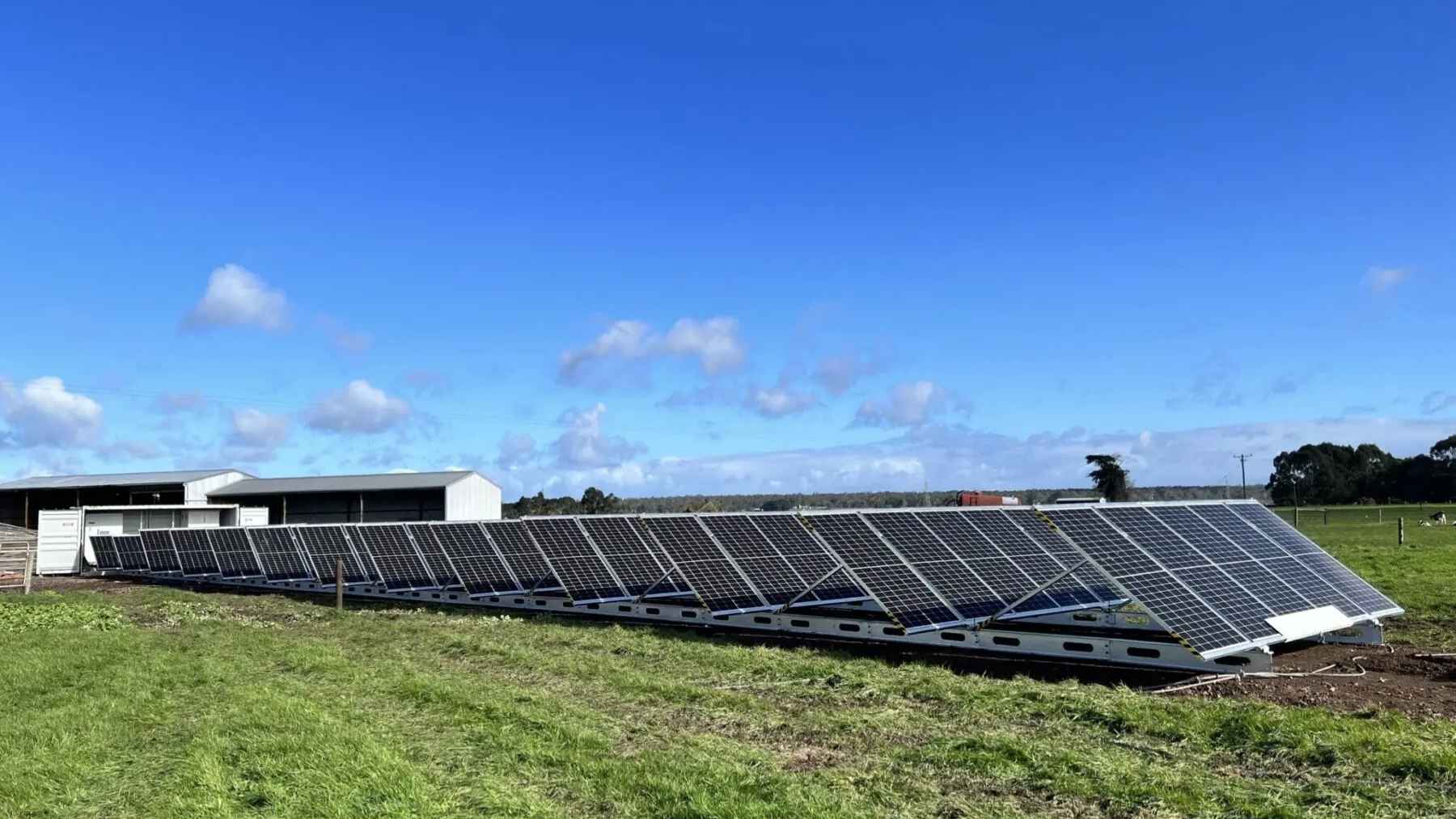
What eventually went in, back in March, was 105 kilowatts of solar and 241 kilowatt-hours of battery storage. It arrived inside shipping containers. The panels ride out on rails and open like an accordion, and the whole assembly can be folded up again and driven somewhere else.
Cows do not care what time the sun comes up
The reason rooftop solar keeps failing this particular math has nothing to do with the panels themselves. It is that the load is big and the milking roster sets it. The sun gets no vote.
“The cows have a very demanding electricity schedule. They don’t take any days off, so it’s every day of the year, twice a day, and we need to have power there so we can do our job,” Mulheron said.
Then there is the hot water. Cleaning and food safety rules mean a dairy has to get water up to roughly 90°C, and once the Mulherons put proper metering on the place, that single job accounted for over half the electricity going through it.
Both of those loads land at the dark ends of the day. An array that peaks at noon is handing you power at the exact hour you need the least of it.
This is a different problem from the one most farm solar stories are about. It is not panels sharing ground with a crop, the way a German orchard has been ripening apples under 1,148 of them. Nothing here is competing with the grass. The fight is purely about what time of day the electricity shows up.
The pilot ran for months before anyone bought anything
The way in was pure accident. Mulheron’s son Matthew, an electrical engineering student at the University of Melbourne, picked up an internship at Phnxx, a Melbourne outfit then building portable solar and battery kit mostly for mine sites. The company wanted somewhere real to prove a prototype.
“Matt came home and said, ‘Dad, I’ve got a good idea. We’ll set up the pilot program here on the farm.’ So, as you do, you always do what your kids want you to do,” Mulheron said.
Version one was two solar panels, a small wind turbine and a battery running a single spotlight. Wind was later dropped as unsuitable, according to Dairy News Australia, and the rig that replaced it was 32.5 kW of solar with 128 kWh of storage, pointed squarely at the hot water.
That one stayed on the farm for months, logging what got used and when. Renew Economy puts the savings from it at around A$13,400, about $9,400, though the money was the smaller half of what it produced.
“We had confidence because we had the numbers to back us up, so it wasn’t a door-to-door salesman that was coming and selling us his story and not the real story that we needed,” Mulheron said.
An outage on a dairy has a price tag attached to it
The other thing pushing Mulheron toward storage is a grid that is not especially dependable. Bushfires in summer, storms in winter, and blackouts the August account puts at six to eight hours or longer. His March description was gentler: three to five hours most of the time, with about ten minor disruptions across the previous year.
Either version is long enough to hurt, because the milk does not wait for anybody.
With up to 9,000 litres sitting in the vat, a single outage carries a spoilage risk of up to A$10,000, roughly $7,000. In March he framed that exposure as 10,000 litres and about A$8,000, on top of what it costs to dispose of the milk and sterilise everything afterwards.
Resilience is the argument that sells farm storage, and it is worth poking at every time. It is the same claim that surrounded a Florida town that kept its lights on through a Category 4 hurricane, where the local utility went on record saying the 687,000 solar panels next door had nothing to do with it.
The numbers do not all line up, and that is worth saying out loud
Read two write-ups of this project six months apart and the figures wander. They are worth putting side by side, because the drift is instructive rather than sinister.
Coverage first. In Renew Economy’s March report, Mulheron forecast 80% of his power across twelve months, working from four months of pilot data. By August the reported number was around 90% of the farm’s grid consumption. Those are two different denominators, which is not the same thing as two different outcomes.
Savings next. A$20,000 in March, about A$25,000 when Mulheron spoke to Stock & Land later that month, and more than A$22,000 in Phnxx’s August estimate. All three are forecasts. The system was commissioned in March 2026, so twelve months of audited bills does not exist yet and will not until next spring.
On how fast it unfolds, take your pick. Phnxx chief operating officer Wei-Chi Lee said a day. Dairy News Australia reported about seven hours to erect and four to strike. Mulheron told the Orange conference roughly four hours.
The battery has appeared as 215, 240 and 241 kWh across various outlets, with the two most recent agreeing on 241. None of this makes the machine less real. It makes it a machine that got written about before a full year of bills existed, which is the normal condition of nearly every energy story you will read this month.
It folds up because nobody knows what the farm will be
What sealed the deal for the Mulherons was not the savings column. Peter and Trish have a fair idea how many milking seasons they have left in them, and nobody in the family can say with any confidence what happens to the place afterwards.
Writing a large cheque for something you cannot unbolt is a hard sell in a district where the neighbours have been walking away from the milking shed for years.
The district data backs that up. Agriculture Victoria’s Dairy Farm Monitor Project counted roughly 2,768 dairy businesses statewide in 2023-24 and about 2,476 the year after. South West Victoria, where Swan Marsh sits, was down to around 831 of them, running an average herd of 438 cows.
Mulheron’s 240 is a little over half that average, on a farm that in 2024-25 watched the statewide milk price drop 8% to A$8.86 per kilogram of milk solids while feed costs went up 8%. Margins like that are how a power bill gets interesting.
An array bolted to a dairy that closes is scrap on somebody else’s roof. A container full of panels and batteries is an asset with a resale value, which is a distinction that does not come up much in solar brochures. Renew Economy noted in March that the system will most likely sit exactly where it is for the next 30 to 35 years anyway. Having the option is the product.
The same box is now being sold in America
Phnxx is not staying in Victoria. In October 2025 it teamed up with Paired Power, a California microgrid and software manufacturer, on a joint product called PairPHNXX, shipped on a flatbed inside a 20-foot ISO container and designed to be unfolded and generating within a single day.
The American configurations come in at 46.4, 69.6 or 92.8 kW of solar, with 42.4 to 636 kWh of storage and 30 to 60 kW of output per container, at 208 or 480 volts three-phase or 120/240 single-phase. Anyone doing the arithmetic will notice the largest US option is smaller than the 105 kW standing at Swan Marsh.
The division of labor is clean enough. Paired Power chief executive Tom McCalmont told pv magazine USA that the Australian side built the hardware, panels and folding gear included, while the American side brought the computer, the software and the work of wiring the inverter and batteries into it.
The stated targets are ranches, construction sites, mining operations, military outposts, emergency response and remote communities. Which is to say American loads that look considerably less like a suburban roof and considerably more like a milking shed at 5am, or like the largest working cattle station on Earth running its headquarters on 49 kilowatts because that is what a truck could get out there.
Measure the farm before you buy the panels
The advice Mulheron gave the room in Orange had nothing to do with hardware, which is probably why it is the most useful thing in the whole story.
“You need to understand your own farm usage,” he said. “You need to measure the resources so you’re familiar with what your climate will actually produce.”
The folding container is the photogenic part and it will get all the attention. The step that changed the outcome was four months of a small rig sitting in a paddock recording when the hot water switched on, which is unglamorous, took a whole season, and is the exact thing nearly every rooftop quote skips.
He turned salespeople away for years, then bought from the company that measured his farm before quoting him anything. Worth remembering next time somebody turns up at the door with the number already filled in.
 @andrewburgess ROOKIE2 months ago