
Both of the machine types the world now uses to dig tunnels under its cities, the slurry shield and the earth pressure balance shield, started out as Japanese prototypes in the 1960s. Japan does not import this equipment. Japan is where this equipment comes from.
Which is why the highway tunnel under Mount Futaba in Hiroshima is such an odd bird. The hardest 0.9 miles of it were dug by an American-designed machine, because no foreign-built slurry borer of that size had ever been allowed to cut hard rock in Japan before.
The road it belongs to finally has a finish line, too. In June, the Hiroshima Expressway Public Corporation put out a CG drive-through video of the completed route, and the city’s current schedule has Hiroshima Expressway Line 5 opening in the first half of Japan’s fiscal 2027, which lands somewhere between April and September of next year.
Getting to that date took a 2,650-ton machine, six and a half years of digging, a court case that is still running, and one six-month stop triggered by ground movement roughly the thickness of a sheet of paper. Start with the machine.
Japan usually builds these itself
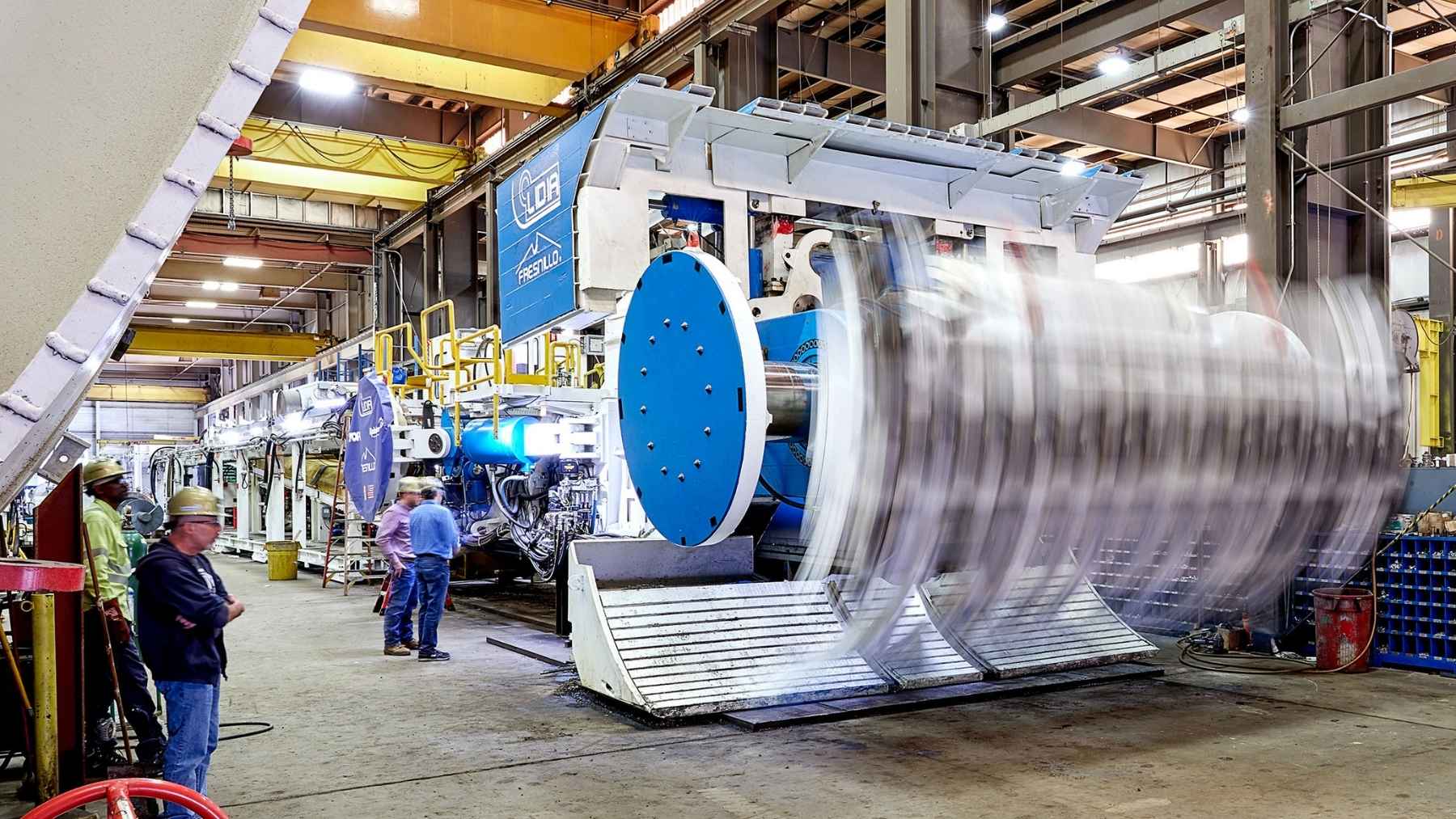
The borer came from Robbins, the American tunneling outfit whose hard rock résumé includes the cross tunnel through Yucca Mountain in Nevada. For Hiroshima it supplied a slurry machine with a 13.67-meter cutterhead, 44.8 feet across, about the height of a four-story building stood on its face.
The whole rig weighs 2,400 metric tons, or 2,650 US tons. That is 5.3 million pounds of machine, around 1,500 midsize sedans on one scale.
It was not a purely American product, either. The design is Robbins, but Japan’s JIM Technology Corporation built the cutterhead drive and articulation seals, and the face carries 20-inch pressure-compensating disc cutters designed to keep working with the groundwater pushing back.
It needed all of it. The route runs through granite with compressive strengths up to 130 MPa, or 19,000 psi, roughly five times the concrete your driveway is poured from, with water pressure specced to 13 bars. That is about 188 psi, close to six times what is in your tires.
Then there was the parking problem. Hiroshima’s transport limits meant the machine arrived chopped into small loads and was assembled for the first time on site, on a lot 100 feet by 200 feet, about the footprint of a small supermarket. Crews had eight months to bolt together a 2,650-ton machine in that space, and on September 18, 2018, it made its first cut.
Nine-tenths of a mile took six and a half years
The Futabayama Tunnel is 1.8 kilometers end to end, starting a few blocks from the north side of Hiroshima Station. A separate contractor drilled and blasted the far 400 meters the conventional way and wrapped that section in March 2021. The Robbins machine had the remaining 1.4 kilometers, the part running under a residential neighborhood, for the Obayashi-Taisei-Kosei joint venture.
Three months in, the machine was already stopped with reported cutter damage, and it stayed parked until May 2019. In October 2021 it moved under the houses, and things got slower still. By the end of 2022 the work had been halted seven separate times since passing beneath the neighborhood.
The dig had been penciled in to finish by July 2022. By the middle of 2023 the machine had covered 886 meters of its 1,400, roughly 60 percent, five years after launch.
The strange part is how it ended. Once boring resumed for the last stretch, crews probed 160 feet ahead of the face every 50 meters and, according to Robbins, the fracture zones everyone expected never showed up. The granite stayed massive and hard, the machine ran clean, and excavation finished on April 30, 2025, about a year ahead of the revised outlook.
Average the whole drive over the calendar anyway and it comes to less than two feet a day. Toronto drivers will recognize the genre, because the machine grinding under their city, Diggy Scardust, spent eight months of its own drive not moving at all. On May 21, 2025 the bore met the conventionally dug section and became a through hole, and local residents were walked through it two weeks later.
Parked half a year over the thickness of a sheet of paper
To understand the stoppages, you need the backstory. When Hiroshima bored the Fukugi Tunnel for Expressway Line 1, the city’s own account records surface settlement of up to 18 centimeters, about 7 inches, with damage to houses above. So when Line 5 came along, residents fought it for years, and the shield method was picked in 2012 specifically because it disturbs the surface least.
The corporation then wrote itself movement limits in the low millimeters. On December 22, 2022, one monitoring point in the Ushita-higashi neighborhood read 2.5 millimeters of uplift against a 2.4-millimeter threshold.
One-tenth of a millimeter over. A sheet of printer paper is about that thick. The 2,650-ton machine sat still for roughly half a year over it, while residents pressed claims of damage to their homes and the corporation dropped explanation packets at every house above the route. Work restarted on June 29, 2023, with the corporation saying it had met its duty to explain and would keep responding in good faith.
You can read that stop as caution bordering on the absurd, or as a public body that remembered the 7 inches on Line 1 and refused to gamble. Machines in this business have hit stranger obstacles, like the German borer under the Chesapeake that started sending pieces of an English ship’s anchor up its conveyor. This one got stopped by a number on a dial.
For its part, the contractor maintains the sensitive stretch went fine. “There was a section of low cover directly beneath a residential area, but we were able to pass through it safely by taking the appropriate measures to mitigate environmental impacts such as vibration, noise and ground surface displacement,” Tetsuya Taniguchi, Deputy Director of Obayashi, said in Robbins’ account of the project.
The hole is finished and the bill is not
Somebody has to pay for six and a half years of a machine that was supposed to run for four, and that argument outlived the digging.
The joint venture first took the extra costs to Japan’s Central Construction Work Disputes Committee in December 2022. That mediation was cut off in March 2024 with no deal. In May 2025, one month after the breakthrough, the JV sued the Hiroshima Expressway Public Corporation in the Tokyo District Court, initially seeking around 4 billion yen more.
Then the number grew. On February 13, 2026, Nikkei xTech reports, the JV amended its claim to roughly 14.2 billion yen, about 90 million dollars at current exchange rates. Per the filing as reported, the contractor pins the delays mainly on rock conditions beyond what the contract assumed and on spalling at the face, and argues that some of the suspensions were unnecessary and drove up its costs.
The corporation is contesting the claim, the court has ruled on none of it, and no finding of fault exists against either side. What the size of the number tells you is the scale of the disagreement: the entire 2.5-mile Line 5 project carries a stated budget of 125.9 billion yen, close to 800 million dollars, so the disputed add-on alone is more than a tenth of the whole road.
Opening day gets a date after 15 years of misses
Line 5 was supposed to partially open in fiscal 2012. Then 2017. Then 2020, 2022, 2024, and at one point fiscal 2028. The current answer, first half of fiscal 2027, actually pulls the date forward, because the digging that was the bottleneck ended early once the machine finally got a clear run.
When it opens, with one lane each way to start, the 2.5-mile road ties the north side of Hiroshima Station straight into the national expressway network, and the corporation’s math has it shaving five to seven minutes off the run to Hiroshima Airport out in Mihara. Obayashi, in Robbins’ account, says the team came away with results and technical knowledge for future large-diameter slurry drives in hard rock, which is corporate for: it works, we would do it again.
And that is the machine’s real legacy. It proved a big foreign slurry face can chew Japanese granite under a neighborhood without moving the ground more than a couple of millimeters. Whether anyone in Japan orders another American one, though, probably gets decided in a Tokyo courtroom before it gets decided at the rock face.