
Putting solar panels on land you already own is usually a matter of paperwork and a phone call. You get a permit, you hire someone to bolt the racking down, and you sign whatever the utility puts in front of you so the meter runs both ways. Most of the fight is with a zoning board.
The Vatican has been working on this since June 2024, and last Tuesday it got as far as a first committee meeting.
On August 4, officials from the Italian government and the Holy See sat down in the Sala Verde at Palazzo Chigi for the opening session of a joint committee whose entire job is to oversee the building of one solar farm. Not a fleet of them. One. The Italian side alone brought chiefs of staff and technical representatives from the foreign ministry, the interior ministry, the culture ministry and the environment and energy security ministry, plus the Lazio Region, the city of Rome, the national energy regulator ARERA, grid operator Terna and the utility Acea.
That is the machinery it takes when the country buying the panels is 44 hectares of walled city and the field they are going on sits in somebody else’s territory.
Why a field of panels needed a treaty
The land is at Santa Maria di Galeria, north of Rome, and it is Vatican property under a 1951 agreement with the Italian state. It runs to 424 hectares, about 1,048 acres, which makes it close to ten times the size of Vatican City itself.
It has been the transmission site for Vatican Radio since 1957, when Pius XII inaugurated a broadcast center with a transmitter hall designed by Pier Luigi Nervi. The shortwave service still runs from there today, on a published schedule of directional antennas beaming at Africa, Asia and the Americas.
The site is extraterritorial, which sounds like a technicality until you try to sell electricity across the fence. Power generated on Holy See land and pushed onto the Italian grid is an international transaction, and Italy does not hand out grid connections to foreign sovereigns on a standard form.
So the two states negotiated one. Archbishop Paul Richard Gallagher, the Holy See’s Secretary for Relations with States, signed an agreement with Italy’s ambassador to the Vatican, Francesco Di Nitto, at Palazzo Borromeo on July 31, 2025. The Italian parliament then ratified it through Law 52 of April 1, 2026, published in the official gazette three weeks later, and the whole thing entered into force on May 27, 2026, once both sides finished the procedures in Article 5.
Italy’s foreign ministry confirmed the entry into force the following day. Roughly two years and two popes to reach the point where an installer could theoretically show up.
The Vatican pays no import tax and gets no subsidy
The financial terms were never published in full, but the Associated Press reported the shape of them at signing. The Vatican is exempt from Italian taxes on importing the panels. It also does not get the incentives an Italian homeowner or business collects for going solar, which leaves the Holy See in the odd position of being the only landowner in the country who can bring the hardware in duty-free and then has nobody to send the rebate paperwork to.
Italy gets something concrete out of it too. Under the arrangement, the country can count the field toward its European Union clean energy targets, which is a neat trick given the electricity is destined for a state that is not in the EU.
Officials speaking anonymously to AP put the build cost at under 100 million euros, about $114 million, and said any power generated beyond the Vatican’s own needs would go to the surrounding community. Contracts were expected to go out for bids once the Italian parliament signed off, which it now has.
Leo XIV built a company to own it
Francis started this with an apostolic letter called Fratello Sole, dated June 21, 2024, the summer solstice. It ordered an agrivoltaic plant at Santa Maria di Galeria that would cover the radio station’s power draw and the “complete energy sustenance” of Vatican City State, and it made the heads of the Governorate and of APSA, the office that manages Holy See property, extraordinary commissioners with the authority to get it done.
Leo XIV took the next step on June 1 this year, signing a chirograph that created the Fratello Sole Foundation and approved its statutes on the spot. Sister Raffaella Petrini, president of the Governorate, was named foundation president for the first three years, with APSA president Archbishop Giordano Piccinotti as vice president.
The statutes are worth reading, because they describe something closer to a small utility than a charity. The foundation is a Vatican public legal person with its own balance sheet. APSA will grant it use of the land. It will handle production, distribution, sale, supply and monitoring of electricity, and its annual plan has to include a proposed tariff for the power it sells to Vatican entities.
Those entities go beyond the walls. The text names the buildings covered by Articles 14, 15 and 16 of the 1929 Lateran Treaty, which is how the major basilicas and the Holy See’s other extraterritorial properties around Rome end up on the same bill.
Two more details stand out. The foundation is explicitly allowed to build further agrivoltaic or other renewable plants at other sites, so this is written as a template rather than a one-off. And the board is three people, unpaid, with expenses reimbursed and nothing else.
Then on June 10, the Governorate, APSA, the foundation and Acea signed a memorandum of understanding to define and progressively implement the plant, with the Roman utility bringing the energy, water, environmental and agricultural expertise. Acea already had a foot inside the walls, having helped build out the charging network the Vatican put in as it started swapping its state car fleet over to electric.
Agrivoltaic means the farming stays
The design brief is not a scraped field of racking. Agrivoltaics puts the panels high enough that crops or grazing continue underneath, and the Italy–Holy See agreement specifically commits to preserving agricultural use and holding down the environmental impact. The site is currently farmed.
That is a live engineering trade rather than a slogan, and the results depend heavily on the crop. Spanish researchers grew tomatoes 40 percent heavier under a semi-transparent solar roof because in a hot enough summer the shade is worth more than the light it steals. Arizona has been running raised arrays over vegetable beds and finding the same thing, along with a drop in skin temperature for the people working underneath.
Other crops disagree. A Bavarian grower who mounted panels on the poles already holding up his hop bines got excellent electricity out of his first prototype and fewer cones, because the plants climbed into the glass and went bushy instead of flowering. Rome sits at a latitude where the shade argument generally works. What actually gets planted at Santa Maria di Galeria has not been announced.
Nothing has been built yet
This is the part worth being clear about. There is no plant. There is a treaty in force, a ratifying law, a foundation with statutes, a memorandum with a utility and a joint committee that met for the first time last week. No official capacity figure has been released, either. L’Espresso reported in June that information emerging during the approval process pointed to something near 100 megawatts, which would be enormous next to the Vatican’s own demand, but that number has not come from the Holy See or from Rome.
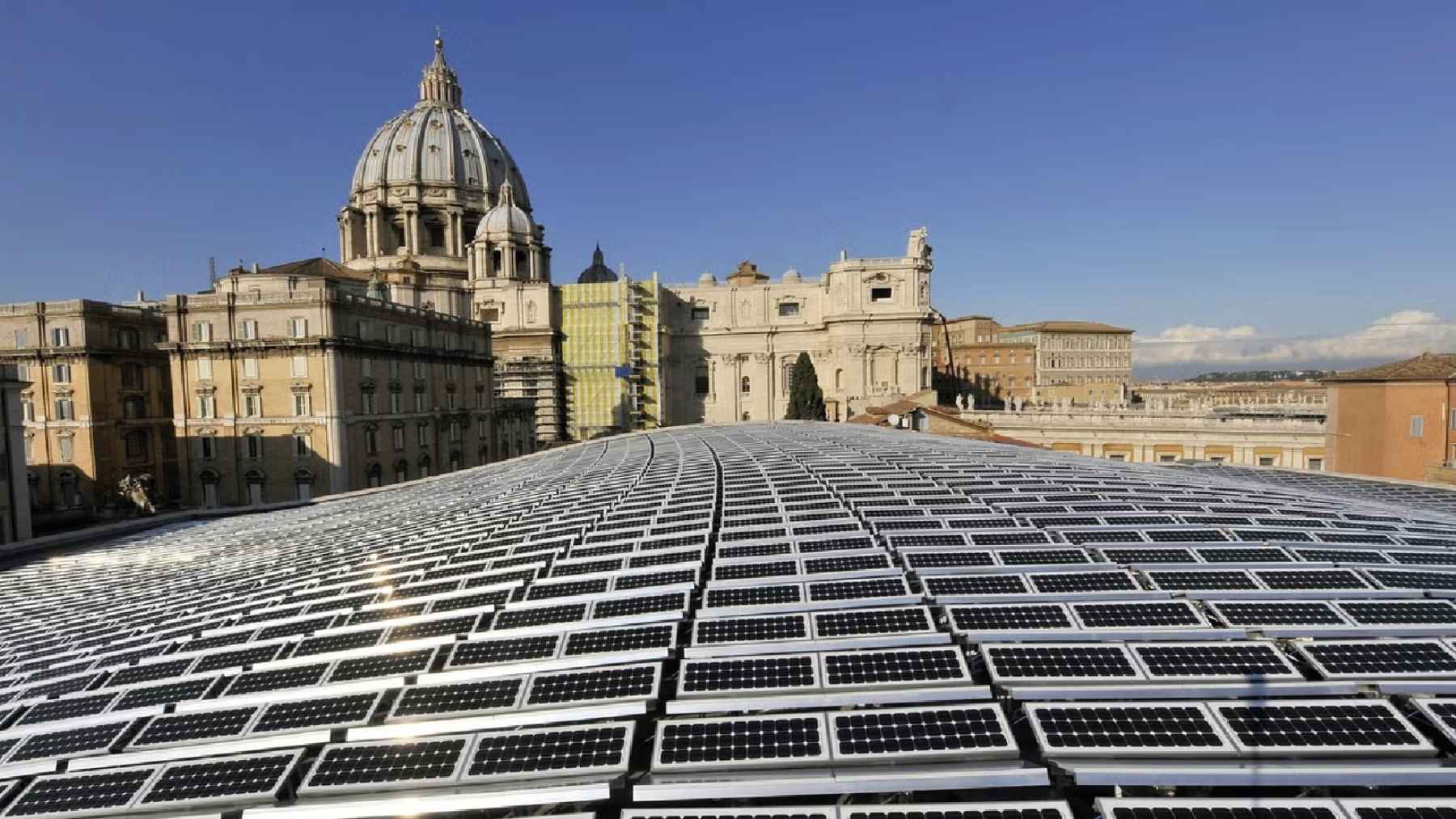
What does exist is 2,400 panels on the roof of the Paul VI Audience Hall, put up in 2008 and making around 300 megawatt-hours a year. That hall was designed by Nervi as well, the same architect who drew the transmitter building out at the radio site half a century earlier, which is a tidier piece of continuity than most energy projects manage.
The Holy See’s stated goal is to cover its electricity entirely, and Vatican officials have said they expect the result to make this the world’s first carbon-neutral state. Seven countries already run their grids on close to 100 percent renewable power, mostly hydro and geothermal, so the distinction being claimed is narrower than the headlines around it.
The next hard date is buried in the statutes. The foundation’s board has three months from its June 1 constitution to promulgate its operating regulation, which puts the deadline around the start of September. After that comes the tendering, and only then does anyone find out how many panels actually fit between the antennas.