
If you’ve heard anything about California’s high-speed rail over the past decade, it was probably a joke. The bullet train to nowhere. The Central Valley money pit. Eighteen years and billions of dollars after voters approved it, and still not one mile of high-speed track actually in the ground. That last part stopped being true on June 1.
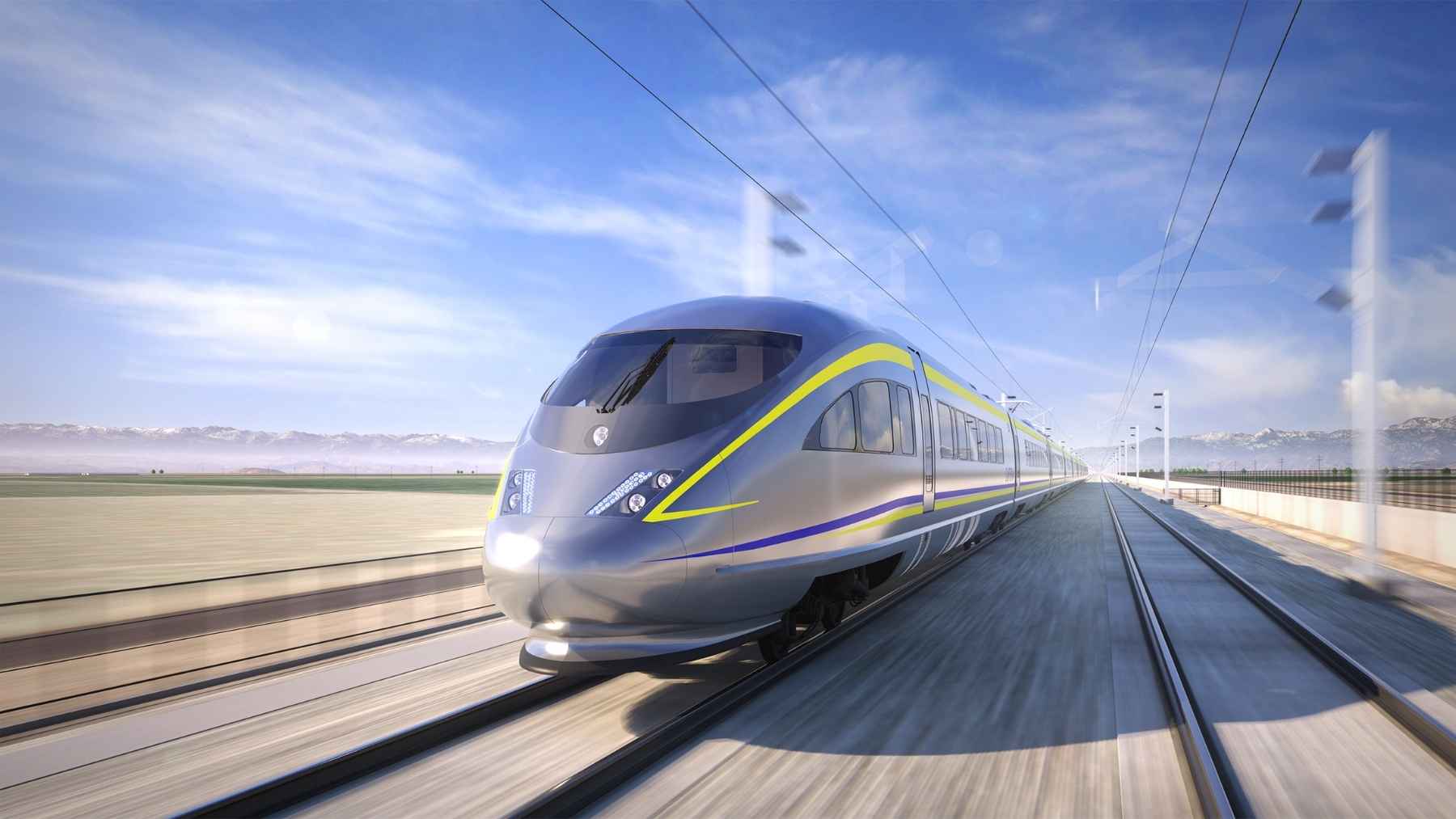
The California High-Speed Rail Authority‘s board approved a contract worth up to $3.5 billion to lay track and string electrification along the starter section in the Central Valley: the physical rail, the overhead wire, the signaling, the certification, all of it. According to the Authority, it’s the first true high-speed rail track ever built in the Western Hemisphere, designed for speeds up to 220 mph (354 km/h). The work went to an American-led consortium of Kiewit, Stacy and Witbeck, and Herzog, and tracklaying is expected to start before the end of the year, according to Railway Gazette.
Why this is the real starting line
For most of the last decade, the visible progress on California high-speed rail has been civil construction. Viaducts, grade separations, trenches, bridges. Impressive concrete, but concrete nobody can ride. The Track and Systems Construction Contract approved June 1 is the part that changes that. It covers the 119 miles of guideway already finished in the Central Valley and extends north and south toward Merced and Bakersfield in phases, each of which still needs its own board sign-off.
The scope is everything that turns a viaduct into a working railroad: ballasted track, the overhead contact system that powers the trainsets, train control, communications, and the testing and safety certification you need before anything carries a passenger. The Authority has been buying long-lead materials directly (rail, concrete ties, ballast) and has already finished laying track at a 150-acre railhead in Kern County that will serve as the staging yard, so freight trains can haul materials straight to the work front.
CEO Ian Choudri said the award marks the point where the program “transforms from major civil construction into delivering an operating railway.” The board’s new chair, Steve Kawa, was blunter about it at the meeting: track and system construction is when the project “truly begins to become a railroad,” according to the Fresno Bee. Ezra Silk of the US High Speed Rail Association told Railway Gazette there’s “no turning back now.”
Eighteen years and $9.95 billion in bonds
The project goes back to 2008, when California voters passed Proposition 1A and approved $9.95 billion in bonds toward a Los Angeles-to-San Francisco line then pegged at around $45 billion. What came after is the part everyone remembers: years of fighting over funding, environmental review, and buying up right-of-way through the Central Valley. Costs climbed, schedules slipped, and the line meant to link the state’s two biggest metros narrowed, for now, to a 171-mile segment between Merced and Bakersfield, targeted for 2033 at a low-end estimate of $34.76 billion, according to the Fresno Bee.
The money already spent did buy real things, even if none of them move yet. More than 80 miles of guideway are finished, with 60 major structures complete and 30 more underway across Madera, Fresno, Kings, and Tulare counties, and 463 of the 494 miles between San Francisco and Los Angeles/Anaheim are fully cleared environmentally. The Authority puts the economic footprint at nearly 19,200 jobs and roughly $25 billion in impact, with up to 1,700 workers on site on a typical day.
None of that erases the overruns, and the project has no shortage of critics who’ll happily walk you through them. But the distance between “approved in 2008” and “laying track in 2026” is the figure that’s hardest to argue with, and it’s exactly the one this contract is meant to start closing.
It’s track and wire, not a maglev
Here’s the distinction that trips people up. California isn’t building a maglev. Nothing is levitating on magnets. What’s going in is conventional steel rail on ties, fed by overhead catenary wire and run by electric trainsets, the same basic architecture as the bullet trains in Japan, France, Spain, and China, just new to the United States at this speed. This isn’t an exotic science project like the hydrogen and fuel-cell pilots that keep making rail headlines, from a short California hydrogen line to the UK strapping a Toyota fuel cell onto a 1959 diesel locomotive. It’s the most conventional fast-train technology on earth. The US just hasn’t laid any of it.
That word, “true,” is carrying real weight in the Authority’s claim. The fastest train running in the US today is Amtrak’s Acela, which tops out at 150 mph on short stretches of the Northeast Corridor and spends most of its trip going a good deal slower. A line built for 220 mph of electrified running is a different category of machine, and the country has never put one in the ground.
Japan built its first bullet train in 1964
To feel how late the US is here, look across the Pacific. Japan opened the first Shinkansen line between Tokyo and Osaka in 1964, sixty-two years ago, and its bullet trains have carried more than 10 billion passengers since without a single passenger death in a train accident, at service speeds up to 199 mph (320 km/h). That’s not a prototype or a pilot. It’s the daily commute.
Japan also holds the outright rail speed record. In April 2015, a JR Central L0 Series maglev hit 603 km/h (375 mph) on a test track near Mount Fuji, the fastest any train has ever gone. Except that came on a test track, not a service you can board. Japan’s commercial maglev line, the Chuo Shinkansen, was once aimed at 2027 and has since slipped indefinitely amid a fight over groundwater from tunnel construction, with realistic estimates now in the early 2030s.
China, for its part, runs the largest high-speed network on the planet and the world’s only commercial maglev, the Shanghai airport line, at 431 km/h (268 mph). Strip out the hype and the global picture is simple. Asia has been moving people at genuine high speed for decades. The United States is laying its first true high-speed track in 2026, sixty-two years after Japan’s first bullet train pulled out of Tokyo.
Brightline West got there first, sort of
There’s an asterisk on the word “first.” Brightline West, the privately funded line meant to connect Las Vegas with Rancho Cucamonga outside Los Angeles at up to 200 mph, broke ground back in April 2024, and Fortune called it “America’s first true high-speed passenger train” at the time. It even hired the same track-and-systems contractor California just did: Stacy and Witbeck.
The catch is that Brightline West hasn’t laid any track either. As of early 2026 it was still in the civil construction phase, with surveying done and station work underway near the Strip, no set date for tracklaying, and a $6 billion federal loan it was still waiting on. So California’s claim is narrower and more precise than the headlines make it sound: not the first high-speed project in the hemisphere, but the first to actually start installing high-speed track and the systems to run it. Which of the two ends up carrying the first paying passenger at speed is a separate race, and neither has won it.
California has quietly been collecting rail firsts lately. It’s also home to the first hydrogen-powered passenger train cleared to run in the US, a two-car unit on a nine-mile commuter line in San Bernardino. But that’s a different scale of ambition. This is 220 mph across the spine of the Central Valley.
A contract and a railhead, not a train yet
Still, this is a specific kind of milestone, and it’s easy to oversell. What got approved June 1 is a contract and a railhead, not a train you can ride. The first passengers on the Merced-to-Bakersfield segment aren’t expected until 2033, and the full San Francisco-to-Los Angeles vision is further out and pricier still. But after eighteen years of mostly pouring concrete and taking flak, California is finally about to do the one thing that makes a railroad a railroad: put down the rail. The trains can’t run until somebody does.