
Anything that runs on a battery eventually has to stop and charge, and the robots we send to the bottom of the ocean are no exception. The catch underwater is that you can’t exactly run an extension cord down there. The usual fix is to send a crewed ship out to babysit the thing, winch it up every few days, swap or recharge its batteries, and drop it back over the side.
According to Infinity Fuel Cell and Hydrogen, the Connecticut company that built the power system at the center of this story, that support vessel can run as much as $100,000 a day. So when a Canadian outfit announced its submarine drone had stayed underwater for 385 hours straight and covered 1,257 miles on a single hydrogen fuel cell, the distance wasn’t really the headline. The headline was that nobody had to go out and get it.
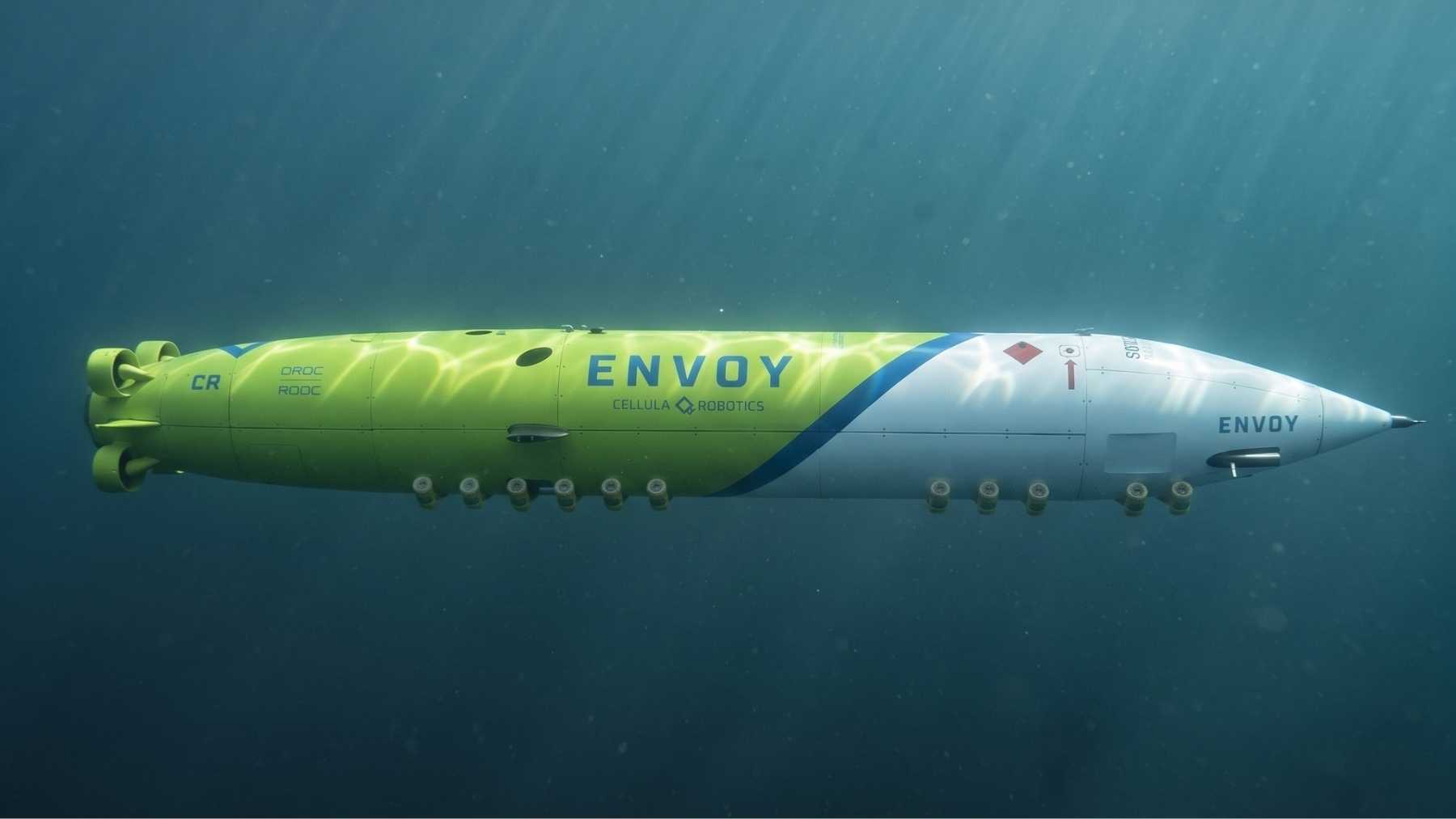
The company is Cellula Robotics, based in Burnaby, British Columbia, and the drone is the Envoy, an autonomous underwater vehicle it used to call the Solus-LR. On April 21 the company said the Envoy had completed a fully submerged mission of 2,023 kilometers, which is where the 1,257-mile figure comes from, over 385 hours without surfacing once. Interesting Engineering called it a world first. Cellula itself was more reserved. The company’s own framing was simply that the run exceeded the Envoy’s published performance specification, which is a more interesting claim than it sounds.
The Envoy beat its own spec sheet in the worst possible conditions
Exceeding a spec sheet matters here because of how the spec sheet is written. The Envoy’s published numbers for the hydrogen version put it at 2,000 kilometers of range and 370 hours of endurance, roughly 15 days. The mission ran 2,023 kilometers and 385 hours. It didn’t just hit the brochure figure, it walked past it.
The harder part is how it got there. A straight-line cruise is the easy way to rack up range, because a fuel cell is at its most efficient when it’s just holding a steady speed. This was not that. Over the course of the mission the Envoy executed more than 4,000 turns and maneuvers, and every one of those burns energy you don’t spend going in a straight line. Cellula ran the drone through a profile meant to look like actual subsea work rather than a record attempt on a flat course, and it still came out the other side past its rated numbers. Neil Manning, the company’s CEO, said the significance was “not just the distance travelled, but that it was achieved fully submerged.” That makes the 1,257 miles a number you could plan a job around, not a best-case figure off a sales deck.
Batteries tap out long before this, and the physics is the whole reason
Cellula sells the same Envoy hull with a lithium-ion battery pack instead of a fuel cell, which makes the comparison clean. The battery version is rated for up to 168 hours and about 930 kilometers. The hydrogen version is rated for more than double that on both counts. The mission only pushed the gap wider.
The reason comes down to energy density. Hydrogen carries far more usable energy per kilogram than a lithium-ion cell, and that advantage barely registers in a commuter car, where you’re rarely more than a few hours from a plug. It matters enormously when the mission is measured in weeks and the nearest plug is a ship floating 2,000 meters above you. That gap is exactly what the broader push to put hydrogen drones into service keeps aiming at, and it’s why fuel cells keep turning up in the one place hydrogen has quietly made sense: long-duration machines that can’t stop to charge.
Then there’s the money. A battery drone that needs hauling up every few days needs that support ship standing by the whole time, at six figures a day. A drone that stays down for 16 days needs the ship for a launch and a recovery and not much in between. Infinity’s case for fuel cells leans on precisely that math: launch one from a dock, let it run with no chase vehicle, and the savings can climb into the millions per mission. At those numbers, the fuel cell doesn’t have to be elegant to pay for itself.
The fuel cell came out of a NASA and Navy contractor in Connecticut
The power system is the part that makes all of this work, and it didn’t come from a garage startup. Infinity Fuel Cell and Hydrogen has been in Windsor, Connecticut since 2002, building proton-exchange-membrane fuel cells for jobs where you can’t troubleshoot the hardware once it’s deployed: spacecraft, aircraft, and underwater vehicles. Its architecture traces back to a NASA program, and the company has done work for NASA and the U.S. Navy, including a regenerative fuel-cell system tested for potential lunar use.
What its cells are built to do is run without air. A normal fuel cell pulls oxygen from the atmosphere; an air-independent one carries its own, which is the only way the chemistry works a couple thousand meters down. The cell combines hydrogen and oxygen, generates electricity onboard, and the only thing that comes out the back is water. William Smith, Infinity’s president and CEO, called the result a milestone for “what hydrogen fuel cells can enable in real subsea operations.” For once that’s more than a press-release line, because a water-only exhaust is a real advantage when your operating environment is the ocean.
Canada’s defense research agency actually owns the drone
One detail is easy to skate past: Cellula didn’t run this on its own dime with its own hardware. Marine Technology News reported on June 3 that the specific Envoy used in the endurance testing is owned by Defence Research and Development Canada, the Canadian government’s defense science agency, and that Cellula has been maturing the platform under a DRDC contract over several years.
That puts the Envoy squarely in dual-use territory, which is where most long-endurance underwater robots live anyway. Cellula lists three markets for the vehicle: energy, science, and defense. The same drone that can inspect an offshore wind farm can run persistent surveillance, and the company notes that some of its defense capabilities are available to naval customers only and subject to export restrictions. None of that changes the engineering on display. It does mean the budget behind the longest verified runs in this class tends to come with a flag on it, the same way Germany’s hydrogen submarine-drone program is being driven by a defense consortium rather than an offshore-survey company.
What you’d actually send a drone like this to do
Strip away the record-keeping and the Envoy is a survey tool, and a patient one. With a 2,000-meter depth rating and a 500-liter payload bay, it can carry synthetic-aperture sonar, multibeam echosounders, sub-bottom profilers, cameras, lasers, and magnetometers down to depths most crewed operations would rather avoid. The jobs are the unglamorous backbone of the offshore world: mapping the seabed, surveying pipeline and cable routes, checking subsea infrastructure for damage, and supporting offshore wind.
It has one more trick that makes the endurance even more useful. The Envoy carries a suction anchor that lets it grab onto the seabed and sit there, so it doesn’t have to burn energy holding position to keep watching a single spot. Park it on a pipeline junction or a cable landing and it can monitor for days with no ship overhead and no trips to the surface. Deep-sea robotics is having a moment in general; Japan is building a drone to go 6,000 meters down after rare earths on the ocean floor. The Envoy is chasing the less cinematic prize, which is simply staying down long enough to make the trip worth the diesel it didn’t burn.
The driveway was the wrong place to look
Cellula was careful about what it claimed. The company never put out a number for the longest hydrogen drone mission ever, and it didn’t have to. It said the Envoy beat its own published spec on a realistic mission, fully submerged, and let 385 hours do the rest. Hydrogen spent the better part of a decade getting written off everywhere it had to go up against a cheap charging cable. Down where there is no cable to compete with, and where surfacing every few days costs more than the drone itself, it turns out to be the right tool for the job. The driveway was always the wrong place to be looking for it.
 @anitalivemore ROOKIE5 months ago