
Cruise ships and cargo vessels burning diesel at the dock just to keep their own lights on is one of those quietly absurd realities of modern shipping. Shore power, where a vessel plugs into the grid and shuts off its onboard generators, has been the obvious fix for years, except most ports either do not have the electrical capacity to handle a docked cruise ship or are staring down a decade of substation upgrades to get there. A UK-backed consortium thinks it has found a way around the wait entirely, and it floats.
ELIRE Maritime and a group of engineering partners just wrapped a six-month feasibility program validating what they call one of the world’s first fully grid-independent floating hydrogen power hubs. The pitch is simple: drop a modular hydrogen-powered platform into the water next to a berth, run a cable to the ship, and skip the years of civil works that traditional shore power would have required. The numbers behind the pitch are less simple, and that is where it gets interesting.
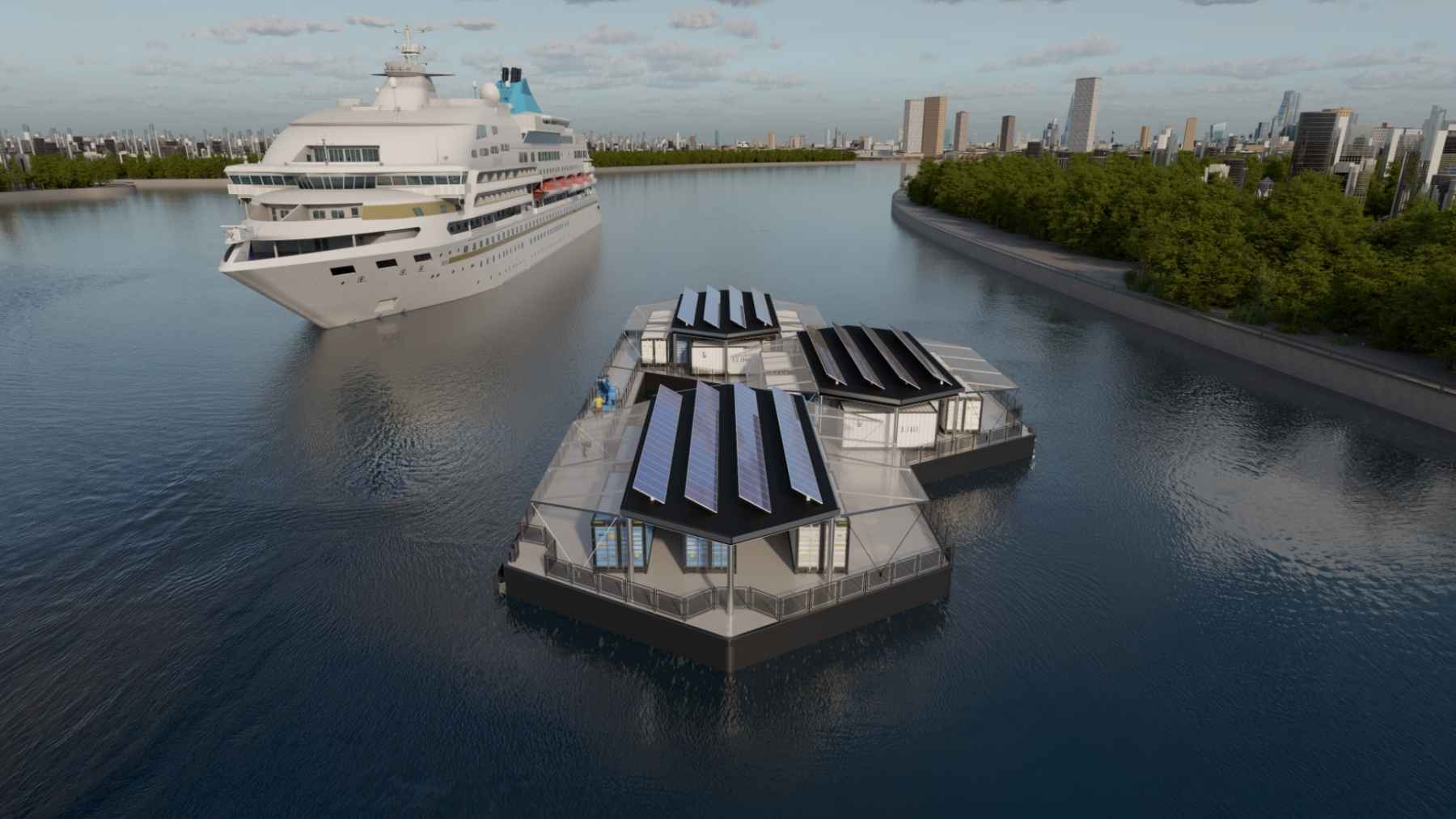
A 5MW floating power station, with three hexagons and a lot of hydrogen
The hub is built around three modular hexagonal platforms covering a combined footprint of about 1,200 square meters, or roughly 12,900 square feet. Packed into that footprint is about 45MWh of battery storage, a stack of modular fuel cells, onboard solar, and a grid-forming AC/DC electrical architecture designed to feed power straight into a docked ship. The whole thing is rated to deliver 5MW of continuous clean power to vessels at berth, enough to support medium-size cruise ships and other large assets that need 6.6kV and 11kV shore power connections.
Rather than running one giant generator, the platform leans on modular 1.3MW fuel cells running continuously to charge onboard batteries through the week, then dumping that stored energy fast when a vessel ties up. Luke Jenkinson, founder and CEO of ELIRE Maritime, frames it less as a power plant than a giant floating battery you top up between port calls, an approach he says reshapes the economics of maritime electrification.
The energy budget is hefty. The platform is designed to deliver roughly 91MWh per week while burning through 7,500 to 8,000kg of hydrogen, stored in modular ISO-compatible low-pressure containers. The current layout runs seven onboard hydrogen tanks with refueling expected about twice a week, plus up to 146kW of onboard solar to trim hydrogen use when the sun cooperates.
Why floating beats waiting for the grid
The reason any of this exists comes down to a brutal infrastructure timeline. Traditional shore power is not just a plug on the dock. It usually means substation upgrades, grid reinforcement, long permitting fights, and a chunk of civil engineering that can stretch the calendar past most port managers’ patience. ELIRE’s whole pitch is that “ports do not need to wait years for grid upgrades to begin reducing emissions,” in Jenkinson’s words.
Conventional shore power projects can take anywhere from three to seven years to deliver, sometimes longer. That is a long runway when the International Maritime Organization is pushing decarbonization targets and cruise lines are getting hammered in port-city air-quality fights from Venice to Vancouver. By putting the energy infrastructure on the water instead of buried in the quay, ELIRE’s argument is that ports can start cutting emissions in months rather than years, without committing to permanent hydrogen storage on land.
That is also why the system uses ISO-compatible low-pressure containers rather than a fixed tank farm. Swap the cylinders, refuel the platform twice a week, and a port gets to dip a toe into hydrogen logistics without first paying for a stationary hydrogen plant it may not need long-term. It is the same closed-loop logic that has made hydrogen genuinely work in controlled fleets with a single refueling point, even as it flops at the passenger-car pump.
The £1 million feasibility program behind the validation
The whole project was bankrolled by a £1 million grant under the UK government’s Clean Maritime Demonstration Competition Round 6, a £30 million pot the Department for Transport launched in January 2025 to fund pre-deployment trials and feasibility studies for clean maritime tech. The funding came through CMDC6, part of the DfT’s UK Shipping Office for Reducing Emissions (UK SHORE) programme and delivered by Innovate UK. The feasibility work ran from September 2025 to March 2026.
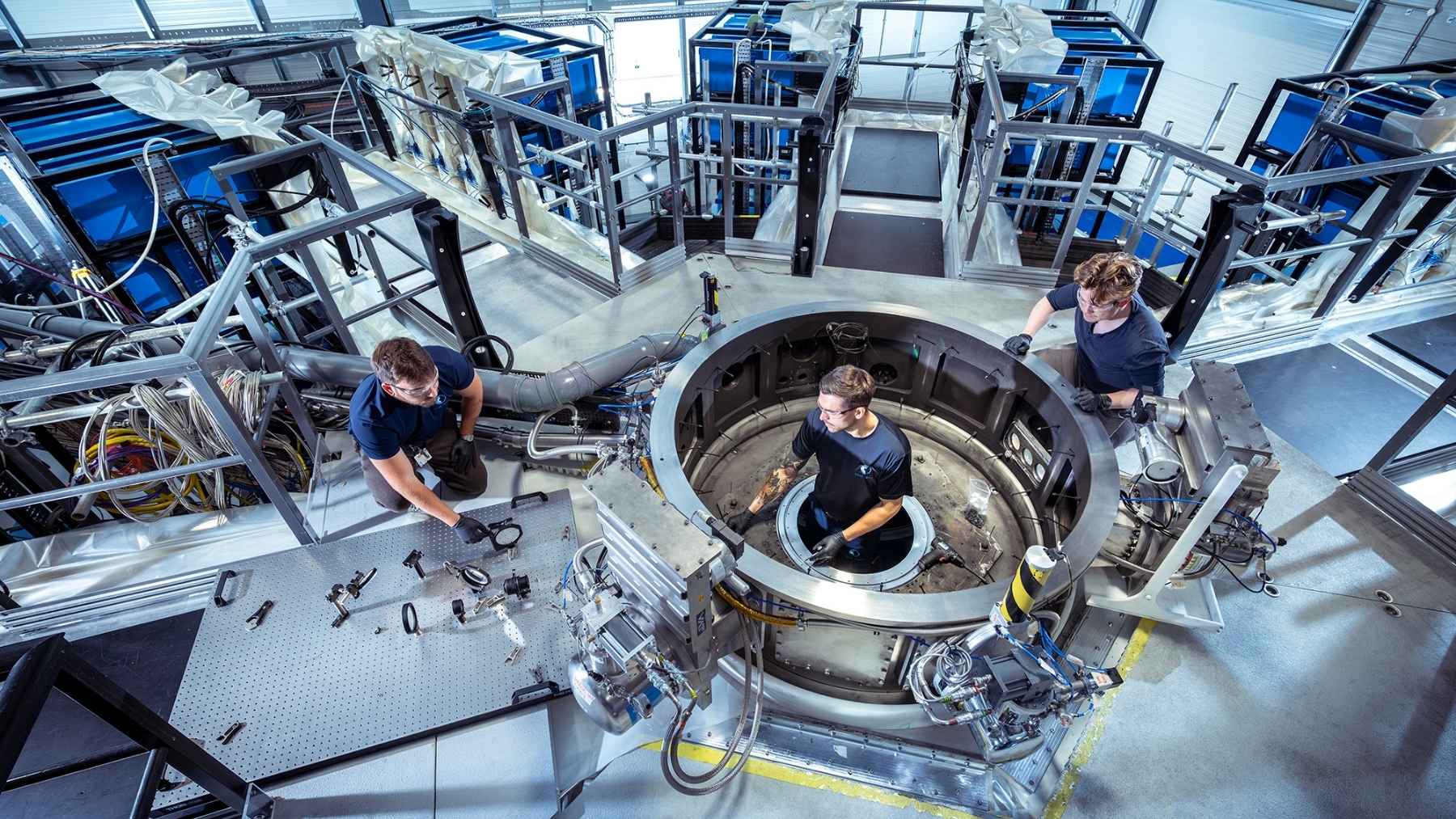
The consortium is not small. ELIRE lists the partners as Ricardo UK, Schneider Electric, Rux Energy UK, Triton Anchor Europe, the Offshore Renewable Energy Catapult, the University of Strathclyde, and Sealand Projects, each bringing a specific piece of the puzzle. Rux Energy supplied nanoporous hydrogen storage modules, Ricardo handled the hydrogen balance-of-plant and power conversion, Schneider built the electrical architecture, and the University of Strathclyde ran the naval architecture and wave-tank testing.
That last bit matters. A floating platform feeding 11kV into a docked cruise ship is not something you want to discover has bad motion characteristics in a storm. Strathclyde’s wave-tank work covered platform stability, structural integrity, motion response, and how multiple hexagonal modules connect under different sea states, while Triton Anchor signed off on mooring and anchoring with no major barriers flagged, and Schneider verified the grid-forming electrical architecture and battery systems.
Emissions math, and the cost catch
The emissions case is where the project has to earn its keep, and it is not bad. Emissions analysis led by Ricardo UK estimated the system could cut vessel emissions at berth by about 77% versus conventional onboard diesel, even after accounting for hydrogen production, storage and transport losses. That works out to roughly 47 metric tons of CO₂ saved per vessel per week, or about 2,444 tons a year per ship.
Scaled up, ELIRE pegs the total opportunity at cutting 500,000 tonnes of CO₂ globally over the next decade, with a global addressable market it estimates at roughly 62TWh a year for grid-independent maritime energy. Those are vendor numbers, so apply the usual skepticism, but the underlying physics of swapping a diesel auxiliary engine for a fuel-cell-fed battery bank are well established.
The catch is price. Current demonstrator-scale energy from the system runs an estimated £0.25-£0.50/kWh (about US$0.34-$0.67), against £0.15-£0.25/kWh (US$0.20-$0.34) for conventional shore power. So ports and operators are paying a premium for the floating hydrogen route, with the consortium betting that cheaper hydrogen and manufacturing scale will close the gap. Until they do, this is a tool for ports willing to pay extra to skip a decade of substation work, not a wholesale replacement for grid-fed shore power, the same economics-versus-chemistry gap showing up across the green-hydrogen mandates now landing on shipping.
What comes next, and where it might dock first
A feasibility phase ending is not the same as a hub actually floating next to a cruise ship. The next milestone, according to ELIRE, would be the UK’s first fully operational Hydrogen Floating Power Hub by 2028, subject to a positive investment decision, with the River Thames flagged as a likely early UK site given its mix of cruise traffic and industrial port infrastructure.
ELIRE Maritime says it is now in discussions for deployments across the UK, Europe, Australia and Asia, with early-stage talks in London, Singapore, Hamburg, Brisbane and Riga, and the modular design pitched as something that can be towed wherever a port needs supplemental capacity. It is the same pattern playing out elsewhere in maritime hydrogen, where the chemistry is technically real but commercially embryonic. Whether the economics get there before regulators force the issue is the open question. For now, the consortium has a validated design, a 77% emissions cut on paper, and a price tag that still runs roughly double conventional shore power. Ports willing to pay that premium to skip the seven-year grid wait now have an option that did not exist before the program closed in March.