
Wind turbine blades have one job, and they do it in some of the worst weather America can throw at them. Twenty-odd years of gusts, hail, ice and UV, flexing thousands of times a day without cracking. Then they retire, and that’s where things get awkward.
Fiberglass composite doesn’t melt down the way steel does. You can’t feed a blade into a furnace and get a new one out the other side. So the standard end-of-life plan for most American blades has been refreshingly medieval: saw them into sections and bury them in a landfill.
Which is why a small park in northwest Atlanta deserves your attention. Since June 2025, people in the Wildwood neighborhood have been crossing their local creek on a 7,000-pound retired blade trucked in from a Colorado wind farm. It’s the first pedestrian bridge in the United States built this way, and more than a year after it went in, national outlets have been rediscovering it this summer.
The park needed a bridge nobody wanted to pay for
Beaverbrook Park is a neighborhood story before it’s an engineering story. Jud Ready, a principal research engineer at the Georgia Tech Research Institute, first visited the place for an adopt-a-stream cleanup back when he was a grad student. He later moved into the neighborhood and spent years helping fix the park up.
Over time the community added an exercise trail, playgrounds, a gazebo and ball fields. What it couldn’t add was a way to actually walk through its own woods, because a creek cut the property in two and there was no bridge over it.
The neighborhood landed a grant from Park Pride, a nonprofit that helps Atlanta residents improve their parks. It wasn’t close to enough for a conventional pedestrian bridge. Bridges, even little ones, are expensive.
Then Ready learned that a Georgia Tech colleague was putting decommissioned wind turbine blades into footbridges. That colleague’s world revolved around Russell Gentry, a professor at Georgia Tech’s School of Architecture and a member of the Re-Wind Network, a group of universities in the U.S., Ireland and the U.K. that has spent years studying second careers for retired blades. The two teamed up, Georgia Tech students did the engineering, and the Wildwood Civic Association signed on as the network’s first American client.
One blade, laid on its side, doing all the work
The blade itself came from a Colorado wind farm and was donated by Siemens Gamesa. The piece doing the structural work runs about 15 meters, which is right at 50 feet, and weighs roughly 7,000 pounds. Moving three and a half tons of fiberglass from the Rockies to a Georgia public park was, per the people involved, not a casual errand.
The design is the genuinely clever part. The two bridges Re-Wind built in Ireland each used a pair of blades set side by side. Atlanta uses one. Engineers call it a monogirder: a single blade laid on its side, bolted into concrete abutments, acting as the spine of the whole crossing. A wooden deck runs along either side of it, and according to CompositesWorld, those flanking decks are there specifically to minimize torsional loads on the blade.
And here’s the thing people miss about turbine blades: this is not scrap that happens to be strong. A blade is born a cantilever beam. It’s engineered to hold its own weight sticking out sideways in the air while taking bending loads through every storm for two or three decades. A footbridge, by comparison, is a light-duty gig.
Gentry is careful about the vocabulary, and he’s right to be. This isn’t recycling, because nothing gets ground down or melted. “Think of it as the difference between wood and paper,” he explained to Georgia Tech’s Institute for Matter and Systems. Shred a tree and you get pulp. Leave it whole and you get lumber, which can hold a roof up. Same logic here: keep the blade intact and you keep the structural performance somebody already paid for.
The Irish loaded one until something should have broken
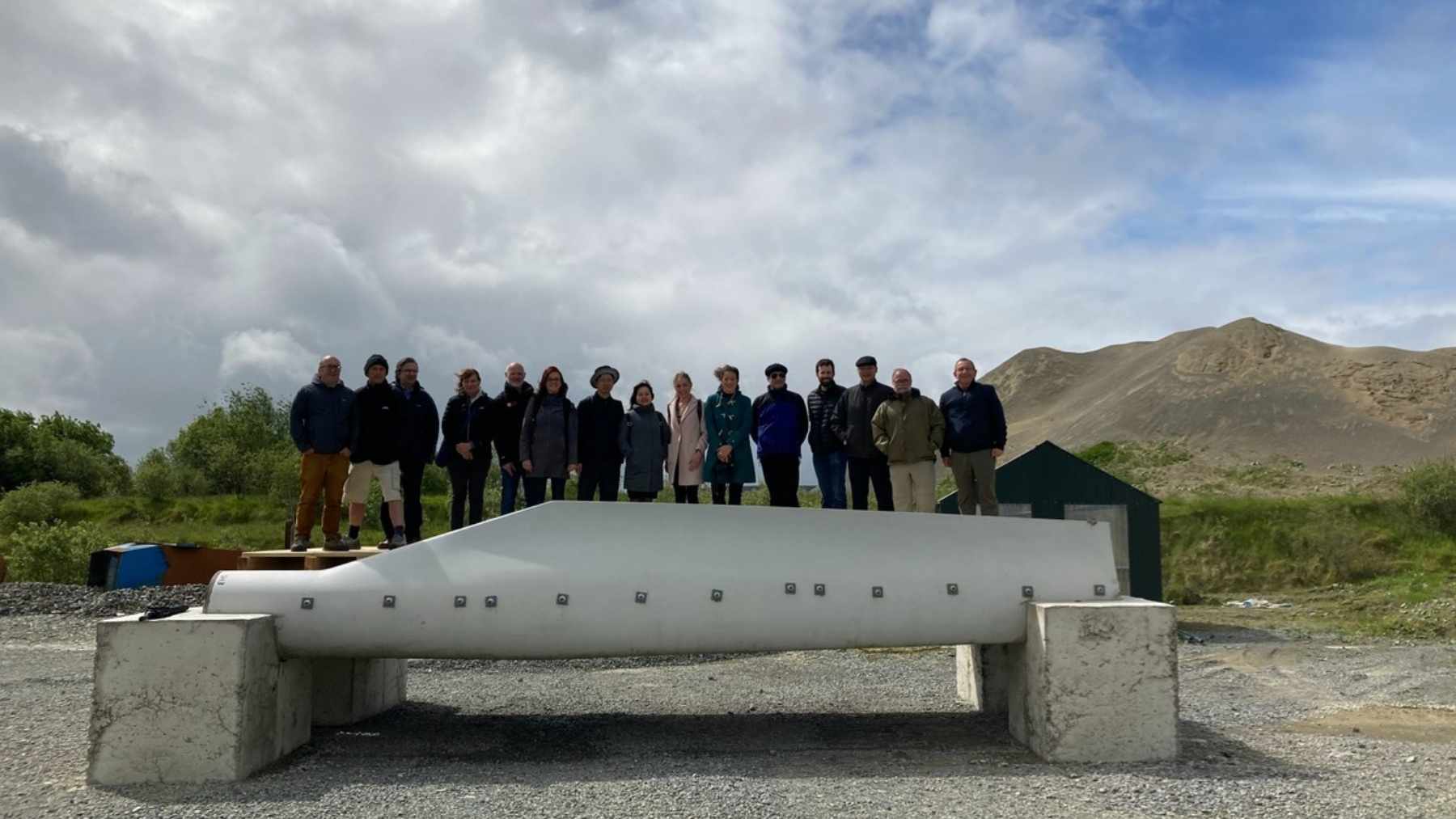
None of this was a leap of faith, because the Re-Wind crew had already stress-tested the concept in Ireland. The first BladeBridge anywhere went in on a greenway in County Cork in January 2022, spanning a stream between Midleton and Youghal on two blades from small turbines.
The second one was built a few months later in a quarry near Draperstown, Northern Ireland, and that one existed to be abused. In May 2023, engineers from Queen’s University Belfast and their Re-Wind partners piled concrete blocks onto it while strain gauges, drones and digital image correlation watched every fiber.
The bridge took 33 metric tons, which is about 72,000 pounds, or roughly a loaded 18-wheeler’s worth of concrete stacked on a footbridge. The deflection at mid-span under full load was 9 millimeters. That’s about a third of an inch of sag, on a structure made from something the industry had written off as trash.
So by the time the Colorado blade got bolted down in Atlanta, this was the third BladeBridge ever built and the first outside Europe. The homework was done.
Two acres the neighborhood couldn’t touch
The payoff in Atlanta is easy to measure. That creek wasn’t a landscaping feature, it was a wall. Ready puts the ground unlocked by the crossing at about two acres of park that residents simply couldn’t reach on foot before.
The Re-Wind Network lists the installation date as June 12, 2025. The neighborhood held its ribbon-cutting that September, and Gentry didn’t oversell it to WSB Radio: “it’s the first one here in America.”
Since then the bridge has just quietly done bridge things. Dog walkers, joggers, kids. The recent wave of coverage hasn’t changed anything on the ground; the blade was interesting in 2025 and it’s interesting now, because it still isn’t buried in a hole somewhere.
There’s a second blade waiting for a job
Gentry has said his team is already working on bringing a second BladeBridge to the area, and Re-Wind’s ambitions run past bridges. The network keeps a design catalog of second lives for blades, including BladePoles for power lines, with bus shelters and e-mobility hubs in development on both sides of the Atlantic.
There’s also a quiet pattern forming in Georgia specifically. The state now hosts a plant that strips old solar panels back down to silver, copper and glass by the million, and now it has America’s first bridge made from a turbine’s cast-off. Clean-energy hardware is starting to get a second act here instead of a burial.
Turbine blades in general are having a strangely productive stretch. Some are getting painted to stop killing eagles. One is holding up joggers in Atlanta. Not bad for a product category whose retirement plan used to be a hole in the ground.
As for the Beaverbrook blade: its first job was holding itself up in Colorado wind for years on end. The new job is supporting the occasional stroller and a golden retriever or two. It is, frankly, overqualified.
 @davidkessler ROOKIE2 months ago