Follow us on Google Get our news on Discover Follow

A Florida reactor was running at full power when three control rods dropped into the core with nobody asking for them, and nothing holds those rods up but a magnet, so the crew tripped the unit by hand at 9:47 in the morning and the same drop hit the same unit in 2024

A Florida reactor was running at full power when three control rods dropped into the core with nobody asking for them, and nothing holds those rods up but a magnet, so the crew tripped the unit by hand at 9:47 in the morning and the same drop hit the same unit in 2024

{{author_name}}

Luis Reyes

Sep 1, at 10:00am ET

The failsafe in a pressurized water reactor is gravity. Control rods hang above the fuel on electromagnets, and cutting the current to those magnets is the whole mechanism: the rods fall, the boron in them soaks up the neutrons, and the chain reaction stops. Engineers built it that way on purpose, so that losing power at a plant could never mean losing the ability to shut one down.

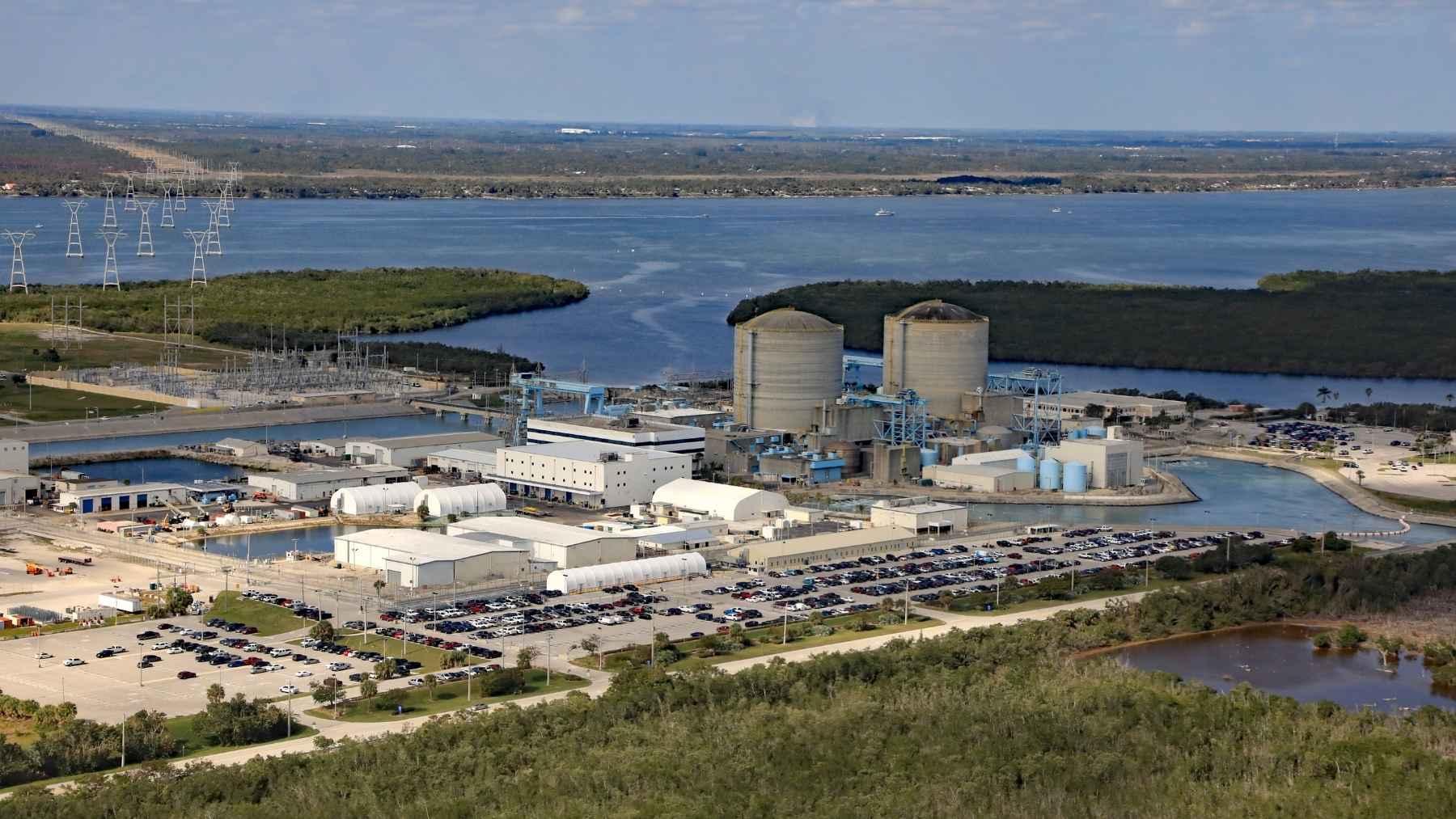
Then three of those rods dropped into the core of Unit 1 at Florida’s St. Lucie plant at 9:47 on the morning of August 13, with the reactor sitting at 100 percent and nobody having called for a shutdown.

The operators tripped the reactor by hand.

A manual trip with the unit at full power

The Nuclear Regulatory Commission filed the event as number 58408 in its event notification report covering August 13 and 14. Unit 1 was in Mode 1 at full power when three control rods went into the core, and the control room staff answered by tripping the reactor manually, which sent every remaining rod down after them. Power fell from 100 percent to zero. The unit settled into Mode 3, hot standby, and stayed there.

Nothing in that notification describes a safety system failing to do its job. The licensee told the agency the trip was “uncomplicated with all systems responding normally post-trip.”

Decay heat came out through the main condenser, dumped as steam through the turbine bypass valves with the main feedwater system moving it along. That is the everyday path for heat a reactor keeps making after the fission stops, and it runs through the same bundle of condenser tubes a station spends its whole life keeping clean.

Unit 2, running a few hundred feet away on the same site, was not affected.

The agency classified the whole thing as a non-emergency under 10 CFR 50.72(b)(2)(iv)(B), the paragraph that covers an actuation of the reactor protection system while the reactor is critical. The resident inspector got a phone call.

Trip time
9:47 a.m.
Manual reactor trip, August 13, 2026, Unit 1 in Mode 1.
Rods in the core
3
Control element assemblies dropped without an order. The core holds 217 fuel assemblies.
Time to notify
3h 23m
Trip at 9:47 a.m. EDT, notification logged at 1:10 p.m. ET. The rule allows four hours.
AUG 17
Back at full power
100%
NRC power reactor status report for August 17, 2026.

The magnet is the whole trick

St. Lucie runs two Combustion Engineering pressurized water reactors, and CE plants call their control rods control element assemblies. Each assembly is a cluster of inconel-clad boron carbide absorber rods riding in zircaloy guide tubes inside a fuel assembly, and each core holds 217 of those fuel assemblies.

Sitting on top of the vessel head is the control element drive mechanism, and inside it, according to NRC training material written for CE plants, are two magnetically operated grippers that walk the rod up and down a fraction of an inch at a time. A licensee letter on the NRC docket covering the same drive design at another CE station is blunter about what that means: nothing mechanically couples the coil to the gripper. Magnetism is the connection. Kill the current and the gripper opens.

Designers wanted precisely that behavior. The same letter spells out the logic: a loss of power on its own, with no trip signal generated anywhere in the plant, still puts the rods into the core. Opening the reactor trip breakers de-energizes every coil at once, and every rod follows gravity down its guide tube. The upward flow of coolant slows the fall a little. The rods get there anyway.

The training material lists one more gripper in the same housing, spring-loaded, doing nothing during normal operation. That one is there to stop a rod being blown upward and out of the core if the pressure housing above it ever failed. Every piece of the mechanism argues for the same direction of travel, and the direction is down.

So a rod that drops with nobody asking is doing the only thing it can do once whatever was holding it stops holding it. Where that holding current went on August 13 is the part Florida Power & Light has not made public.

One dropped rod is a nuisance. Three is a trip.

A control rod that enters the core where nobody asked for it reshapes the power around it. Fission falls off near the rod and picks up elsewhere, and the operating limits written into a plant’s technical specifications are built around how much local peaking the fuel is allowed to see. A crew can often ride out a single dropped rod by backing off turbine load and working the problem. Three at once takes that option away.

Donald Wall, a nuclear engineering professor at the University of Florida, told WFLX that people living around the plant had nothing to be alarmed about. “There’s no cause for worry at all,” Wall said. He put the shutdown decision alongside a check engine light on a car: the light tells you something changed, it will not tell you what, and pulling over costs you almost nothing compared with the alternative.

St. Lucie’s safety analysis is written around the opposite failure. FPL has to demonstrate that the reactor still reaches a safe shutdown with margin left over after a trip even if the single most reactive rod in the core sticks fully withdrawn and never comes down at all. Rods arriving early cut power. The case the paperwork worries about is a rod that refuses to move.

Wall also raised a question the utility has not answered in public. He pointed the station to an NRC report on a November 2024 event at this same Unit 1, when three rods dropped during rod control maintenance and operators again shut the reactor down by hand. He asked what the two events have in common.

The investigation is open.

The license runs to 2056

The NRC signed subsequent renewed operating licenses for both St. Lucie units on April 28, 2026, three and a half months before the trip. Unit 1 can now run until midnight on March 1, 2056, and Unit 2 until April 6, 2063. The Federal Register notice caps licensed core power at 3,020 megawatts thermal.

March 1, 1976 is the day the commission issued Unit 1’s original license. The new expiration date lands exactly 80 years after it.

FPL’s own site fact sheet lays out the hardware those licenses cover. A reactor vessel 42 feet tall carries a 172-inch inside diameter and 8.7 inches of steel around it, and the containment building over it stands 243 feet high and 154 feet across with 3-foot walls.

The two units together are rated at 1,821 megawatts net, drawing their cooling water straight out of the Atlantic.

Florida’s only other operating nuclear station, Turkey Point south of Miami, cleared its own second renewal in 2024 and is better known lately for the crocodile nursery that grew up in its cooling canals. FPL’s corporate parent, NextEra Energy, is separately spending its way toward restarting a reactor in Iowa that a 2020 windstorm helped close.

FPL calls it an equipment issue

The utility told WPTV that operators had “safely resolved an equipment issue” and put Unit 1 back online at full power. FPL says nobody on the site or off it was in danger and no customer lost power.

The regulator’s own paperwork backs the restart. The NRC’s power reactor status report for August 17 lists Saint Lucie 1 at 100 percent, with Saint Lucie 2 alongside it at 100. Those numbers get collected between 4 and 8 in the morning, eastern time, which puts Unit 1 back at full output within four days of the trip.

Sarah Logsdon called the NRC operations center at 1:10 p.m. on August 13, three hours and 23 minutes after the rods went in and comfortably inside the four hours the rule allows. FPL has published no cause in the two and a half weeks since. The plant is licensed to run that core until March 1, 2056.

THE LOTvia The Lot
26 comments

Don't bite your tongue. Speak up.

Sign in with Google when you post
ROOKIEDRIVERENTHUSIASTEXPERTLEGEND ★
@arthurbreaux DRIVER6 days ago

These kinda of plants are shut down by increasing boron concentration. Urgent shutdowns are caused by either manual or automatic SCRAM. Three rods dropping into a civilian core is NOT an acceptable shutdown methodology: it causes flux tilting which causes power peaking and that can cause exceeding thermal profiles, which can cause allotropic transformation of the fuel cladding. Allotropic transformation of the fuel cladding can lead to fuel element failure, or a loss of one of the radioactive boundaries. Why would anyone believe that dropping rods unexpectedly is "normal" ? Dropping them in two separate events over a few years time at a plant with a long history of reliable operation is seemingly symptomatic.
1
williamsabey DRIVER5 days ago

Who said that it's "normal"? It was said that it is *safe*, which it is.
1
@mileshawthorne ROOKIE4 days ago
It wasn't a "shut down methodology". It was an equipment failure. The shutdown was done manually as a response to the failure precisely to avoid neutron flux. All the rods were inserted.
0
arthurbreaux DRIVER3 days ago
Nor is it "safe". Nuclear plants get downgraded precisely because of unexpected screams. The reason is not just due to a purturberance to the grid, but, also due to all major nuclear plant disasters were initiated during the effect or consequences of a scram. That is a known fact which is the root behind minimizing unplanned screams.
0
garyhalmbacher DRIVER6 days ago
My understanding is 'full shutdown' with all control rods down still produces about 70MW or 7% or so, of decay heat for about a week, heat which must be dissipated passively or actively.
0
@arthurbreaux DRIVER6 days ago
A SCRAM is not normal; it is a symptom.
0
@williamliddell ROOKIE5 days ago
This event was NOT a scram.
-1
arthurbreaux DRIVER3 days ago
You are correct. The EVENT was three rods dropped due to unplanned cause. The SCRAM was unplanned.
0
@mike ROOKIE5 days ago
And now we have given the hackers that dropped those rods, confirmation of their exploit, and the resultant chain of events. 3 at once better be found out to be a hardware failure, or something bad is afoot!
0
@ralphewing ROOKIE5 days ago
What about a possible "test" cyber attack from a hostile foreign government like Iran, China, or Russia?
0
@garryupton ROOKIE4 days ago
There are zero American power plants where the plant control system is connected to the Internet. It's even more strict at nuclear plants. There's an air gap between the control system and anything external. There is no one with any level of access who could affect the operation of a nuclear plant from a terminal off-site.
0
arthurbreaux DRIVER3 days ago
Not posible with the system installed..
0
@grichwatson ROOKIE5 days ago
they can call it a mechanical issue all they want .... The plant used non union workers. Now I'm not sayin that union workers are trained better have a higher skill level, and work with more pride and self worth.... but I really dont have to do I ? Let the actions speak for themselves !! Hey but look at the bright side ... the Utility company made more profit from the low wages they paid the workers and it only impacted the enviorment and public safety ... and who really cares about that .. as long as the profits line the pockets of the shareholders .... at everyone elses expence..
0
a ROOKIE4 days ago
union only make cost of worker higher but does not increase safety or productivity. it's not like non-union working in a nuclear plant salary is dirt cheap exploitation. look at all the industry union destroy, airline, rail, mining, firemen...just keep asking for more money or we leave... it is already way pass the original intend of helping under paid workers into exploiting employers and customers.
0
arthurbreaux DRIVER3 days ago
The phenomenon is called "power peaking". The rod drops and nuclear fissions immediately around the rod go down. The steam demand for power remains the same, however, causing the -alpha-T to cause power in the rest of the core to rise AND the colder water around the dropped rod now slows neutrons a bit more. When those neutrons slow down more, they are absorbed more readily in the surrounding fuel. That increase in absorption of thermal neutrons causes an increase in fassions, which results in power at that location to rise above the rest of the elevated core power profile. That increase in power, if the core was operating at 100% power would then be greater than 100% power, which is a violation of the license. That mandates an immediate shutdown via scram.
0
arthurbreaux DRIVER3 days ago
Your premise that non union workers is rediculous.
0
@marktoth ROOKIE4 days ago
Good article explaining some of the concerns mandating full manual scram and about rod control design.. Rattled some old cobwebs.

Underway on my old boat in '70s our correction then recovery would have been completed sooner. Didn't know after S1C prototype and Tullibee's S2C that CE went civilian.
0
@outcastspartan ROOKIE4 days ago
Sounds like anti-nuclear power hot air, blowing things out of proportion to drive up clicks and narrative due to the layman not knowing much about nuclear beyond Chernobyl.
0
@scottyates ROOKIE4 days ago
Definitely not a DEI environment. Competency is a must.
0
@williamliddell ROOKIE5 days ago
Fear mongering.
-1
@davidhoskins ROOKIE5 days ago
"A control rod that enters the core where nobody asked for it reshapes the power around it. Fission falls off near the rod and picks up elsewhere, and the operating limits written into a plant’s technical specifications are built around how much local peaking the fuel is allowed to see."

What is that word salad trying to say? A dropped control rod most certainly does not cause fission to pick up anywhere! A control rod is a neutron absorber, if neutrons are being absorbed they are not contributing to fission, period. Saying otherwise is like claiming that when I turn the light off in my room it causes the rest of the house to get brighter. Is anyone proofreading this slop?

"A crew can often ride out a single dropped rod by backing off turbine load and working the problem. Three at once takes that option away."

Yes the option is taken away because the plant is no longer able to produce power. Just like what happens constantly across the country every time a drunk slams into a power pole, or transformer at a substation pops, or there's any number of other daily occurrences only no one is fear mongering about those!

This article should have read, power plant had to be taken off line today, there was no disruption to service because other sources picked up the increased demand exactly like the system is designed to do.

Are we going to see the same nonsense a gas plant can't get fuel? How about a solar plant going offline due to a cloud?
-2
@mike ROOKIE5 days ago
If it was a negative thermal coefficient reactor running at its self regulating temperature, then yes, it could create more reactivity in other parts of the pile due to cooling. This could lead to uneven fuel burn after a time (long time) and require repositioning of the fuel elements to bring the pile back into balance.
0
@belindaroscoe ROOKIE5 days ago
Oh dear, you're definitely a nuclear engineering rookie aren't you? Please don't feel that you are qualified to comment on nuclear reactor ops when you clearly aren't. The description is not slop, it's exactly what would likely actually happen due to thermal feedback. Power decrease due to dropped rod causes lower core outlet temperature. Constant power offtake by the turbines leads to a cooler inlet temperature, which increases power across the core.
0
@davidbarnosky ROOKIE4 days ago
This tells others more than it tells you. Lowering power where a rod drops increases the fuel reactivity in that area the next time they go full power in that cell in proportion to how long they leave it at full power. With 217 cells they could easily still produce power with 3 rods down but this article implies procedures demand a manual scram if 3 drop. Unbalanced reactors make it difficult to calculate the estimated critical position putting uncertainty into your startup, which would make you have to go much slower and is part of the safety criteria of your automated safety systems being properly ensured to react in time during startup from a below detectable levels startup. But I’ve only driven little Navy reactors, I shouldn’t say any more than that.
0
@aurorasideras ROOKIE4 days ago
I get what you’re saying… HOWEVER… umm… turning the lights off in a room can in fact make other lights in your house brighter. I totally understand what you meant, but it was just a really bad example that you used.
0
@michaelwoolhise ROOKIE4 days ago
A dropped rod does cause fission to pick up elsewhere since heat demand is the same so the moderator cools which increases the reactivity around operating regions. Local power generation exceeds 100% design but not by much for a reactor with so many assemblies. Single drop scenarios are all modelled. Multi drop scenarios are not so the safe option is a scram.
0
THE LOTOwner community
Visit →
Luis Reyes

Luis Reyes

With more than 14 years covering the automotive industry, Luis Reyes is a seasoned voice in the field. A law graduate, he channels his curiosity and expertise into the detailed analysis of national and international regulations that shape the automotive world. At Autonocion.com, Luis combines his strong legal background with a deep passion for vehicles — especially those that have left a mark on automotive history. His experience writing for multiple brands across the industry has established him as a trusted authority. Luis is committed to sharing his expertise and enthusiasm with enthusiasts and industry professionals alike, with a firm belief in the continuous evolution and innovation driving the auto industry forward.
Contact: info@autonocion.com
autoNotion · The Box